E-commerce SEO : What Is It? A Complete Guide


Every online store eventually faces the same equation. Paid acquisition works, but the moment you stop spending, traffic stops with it. Costs per click rise year after year, margins get squeezed and your growth stays permanently rented rather than owned. E-commerce SEO is what breaks that dependency. So what exactly is it, and how do you do it properly?
E-commerce SEO is the practice of optimizing an online store so its product pages, category pages and content rank in organic search results, bringing in qualified buyers without paying for each click. It shares its foundations with general SEO but differs in ways that matter enormously. A blog optimizes a few dozen articles. A store may manage thousands of product URLs, faceted navigation generating near-infinite page combinations, seasonal inventory that appears and disappears, and duplicate descriptions supplied by manufacturers to every retailer selling the same item.
That scale changes the priorities. On a store the category page is usually the most valuable asset since it targets commercial queries with real volume, while individual product pages capture long-tail, high-intent searches. Technical SEO carries far more weight than on a content site because crawl budget, indexation control, canonical tags and site architecture determine whether Google even discovers your products. Structured data earns rich results showing price, availability and ratings directly in search. And search intent must be matched precisely, since someone typing "best running shoes" wants comparison content while "nike pegasus 41 size 10" wants a product page ready to buy.
The payoff justifies the effort. Organic traffic compounds rather than resets, converts at rates that frequently outperform paid channels because it captures active intent, and keeps working months after the initial investment. A well-ranked category page can generate sales for years.
This guide covers everything you need: what e-commerce SEO actually involves, how keyword research differs for stores, how to structure your site architecture, how to optimize category and product pages, the technical foundations that matter most, how content marketing supports commercial pages, how link building works for stores, and how to measure what is working.
In this complete guide we explain what e-commerce SEO is and how to implement it.
What Is E-commerce SEO and Why Does It Matter?
E-commerce SEO applies search optimization principles to the specific structure and economics of an online store. Understanding both its definition and its business impact explains why it deserves a place in any serious growth strategy.
A definition built around commercial pages
E-commerce SEO is the process of optimizing a store's category pages, product pages, technical infrastructure and supporting content so they rank in organic search results for queries with purchase intent. Where traditional SEO often focuses on informational articles, e-commerce SEO centers on pages designed to sell.
That distinction reshapes the work. The pages that matter most are not blog posts but collection pages targeting commercial queries like "linen bed sheets" and product pages capturing precise searches like "washed linen duvet cover king size sage". Content still plays a role, but primarily to support and link toward those commercial pages rather than as an end in itself.
Organic traffic compounds instead of resetting
The first reason it matters is economics. Paid acquisition stops the moment your budget does, and costs per click have risen steadily across Meta, Google and TikTok. Every sale bought through advertising carries a variable cost that never disappears.
Organic traffic works differently. A category page ranking on the first page generates visits every day without any cost per click, and it keeps doing so for months or years after the initial work. This compounding effect is why SEO frequently becomes the most profitable acquisition channel for mature stores.
Search traffic converts on intent
The second reason is conversion quality. Someone searching for a specific product is actively looking to buy, not scrolling past an interruption. Organic visitors arriving on a relevant category or product page often convert at rates comparable to or higher than paid traffic, precisely because the intent was there before they clicked.
It reduces platform dependency
The third reason is resilience. A store relying entirely on paid social is exposed to algorithm changes, account suspensions and rising auction costs outside its control. Organic rankings diversify acquisition and protect revenue when a paid channel underperforms.
It builds a durable asset
Finally SEO increases the value of the business itself. A store with stable organic traffic is worth considerably more at acquisition than one entirely dependent on ad spend, since its revenue does not collapse the day marketing stops.
How Does E-commerce SEO Differ From Regular SEO?
The fundamentals are shared: relevant content, solid technical foundations, quality backlinks and alignment with search intent. But the way those fundamentals apply to an online store differs so significantly that treating a shop like a blog is one of the most common and costly mistakes. Here is how e-commerce SEO differs from regular SEO.
Table: e-commerce SEO vs regular SEO
| Criterion | Regular SEO | E-commerce SEO |
|---|---|---|
| Priority pages | Blog articles and guides | Category and product pages |
| Dominant search intent | Informational | Commercial and transactional |
| Site scale | Dozens to hundreds of pages | Hundreds to hundreds of thousands |
| Content volume per page | Long-form, 1,500 words or more | Short, conversion-focused |
| Duplicate content risk | Low | High, from manufacturer descriptions and variants |
| Faceted navigation | Rarely an issue | Major crawl and indexation challenge |
| Crawl budget | Rarely constraining | Often critical |
| Structured data | Article or FAQ schema | Product, offer, review and breadcrumb schema |
| Inventory changes | Stable content | Products appear, sell out and disappear |
| Conversion link | Indirect | Direct, ranking drives revenue |
| Keyword research | Topic clusters | Product modifiers and buyer language |
As the table shows the first and most fundamental difference concerns which pages matter. On a content site the article is the star. On a store the category page usually carries the most SEO value because it targets commercial queries with meaningful volume, such as "women's running shoes", while product pages capture long-tail searches that are individually smaller but convert extremely well. Blog content still has a place, but its main role becomes feeding authority and internal links toward those commercial pages.
The second difference is search intent. Regular SEO often aims at informational queries where the visitor wants to learn. E-commerce SEO targets people ready to compare or buy, which changes how pages must be built. A category page answering "best running shoes for flat feet" needs filters, clear pricing, visible reviews and fast access to products rather than a 3,000-word essay above the fold.
The third difference is scale, and it drives most of the technical complexity. A blog might manage a few hundred URLs. A store can easily reach tens of thousands once you count products, variants, categories, subcategories and filter combinations. At that scale problems that are marginal elsewhere become decisive.
Faceted navigation illustrates this perfectly. Filters for size, color, price and brand can generate millions of URL combinations, most of them near-duplicates with no search demand. If Google crawls them freely it wastes its crawl budget on worthless pages and may never reach your important products. Controlling this through canonical tags, robots directives and careful parameter handling is a core e-commerce skill with little equivalent on a standard site.
The fourth difference is duplicate content. Manufacturers supply the same product descriptions to every retailer, which means hundreds of sites publish identical text. Product variants add another layer when a shirt in eight colors produces eight nearly identical pages. Writing unique descriptions and consolidating variants correctly separates stores that rank from those buried beneath larger competitors.
The fifth difference is inventory volatility. Articles stay published indefinitely while products sell out, get discontinued or return seasonally. Each situation requires a deliberate decision: keep the page with an out-of-stock notice, redirect to a close alternative, or remove it. Handled carelessly this generates broken links, lost authority and frustrated visitors.
The sixth difference is structured data. Product, offer and review schema allow Google to display price, availability and star ratings directly in results, which measurably increases click-through rate on commercial queries.
The final difference is the direct link to revenue. On a store every ranking gain can be traced to sales, which makes prioritization far more concrete than on a content site.
How to Do Keyword Research for an E-commerce Site?

Keyword research for a store follows a different logic than for a blog. The goal is not to find topics to write about but to map the exact language buyers use onto your categories and products. Here is how to do keyword research for an e-commerce site.
Start from your product catalogue
Identify head terms for each category
Expand with product modifiers
Analyze search intent on each query
Mine competitor rankings
Use marketplace and autocomplete data
Evaluate volume, difficulty and commercial value
Map each keyword to a single page
Identify supporting informational queries
Prioritize by revenue potential
The first step is to start from your catalogue rather than from a keyword tool. List your product categories and subcategories as they actually exist in your store. This keeps research anchored to pages you can build and prevents chasing keywords with no matching offer.
The second step is to identify head terms for each category, the broad commercial queries like "linen bedding" or "trail running shoes". These carry the highest volume and usually map to your main category pages. They are also the most competitive, so treat them as long-term targets.
The third step is to expand with product modifiers. This is where e-commerce research diverges most from content SEO. Buyers qualify their searches with attributes such as material, color, size, gender, use case, price range and brand. Combining your head terms with these modifiers produces queries like "washed linen duvet cover king" or "waterproof trail shoes women" which carry lower volume but far higher purchase intent.
The fourth step is to analyze search intent by looking at what currently ranks. Type the query and observe the results page. If Google shows category pages, a category can rank. If it shows comparison articles, a product page will struggle regardless of optimization. Matching the format Google already rewards is essential.
The fifth step is to mine competitor rankings. Enter competing stores into a tool like Semrush or Ahrefs and review the keywords driving their organic traffic. This reveals categories you have overlooked, modifiers you had not considered and gaps where competitors rank weakly.
The sixth step is to use marketplace and autocomplete data. Amazon, Etsy and Google autocomplete suggestions reflect real buyer language. Typing a product term and noting the suggested completions surfaces phrasing that keyword tools sometimes underreport, particularly for newer product types.
The seventh step is to evaluate volume, difficulty and commercial value together. A keyword with modest volume but strong purchase intent and weak competition often outperforms a high-volume head term you cannot realistically rank for. Cost per click in keyword tools is a useful proxy for commercial value since advertisers pay more for queries that convert.
The eighth step is to map each keyword to one page. Assign every target query to a single URL to avoid keyword cannibalization, where several of your own pages compete for the same term and weaken each other. A simple spreadsheet linking keywords to category or product URLs keeps this under control.
The ninth step is to identify supporting informational queries such as "how to wash linen sheets" or "linen vs cotton bedding". These rarely convert directly but they attract earlier-stage visitors, build topical authority and create internal linking opportunities toward your commercial pages.
The tenth step is to prioritize by revenue potential. Rank your list by estimated traffic multiplied by conversion rate and average order value. A mid-volume keyword on a high-margin category often deserves attention before a high-volume term on a low-margin product.
Keyword research is not a one-time exercise. Revisit it seasonally, when you add categories and whenever competitors shift their positioning.
How to Structure Your E-commerce Site Architecture for SEO?
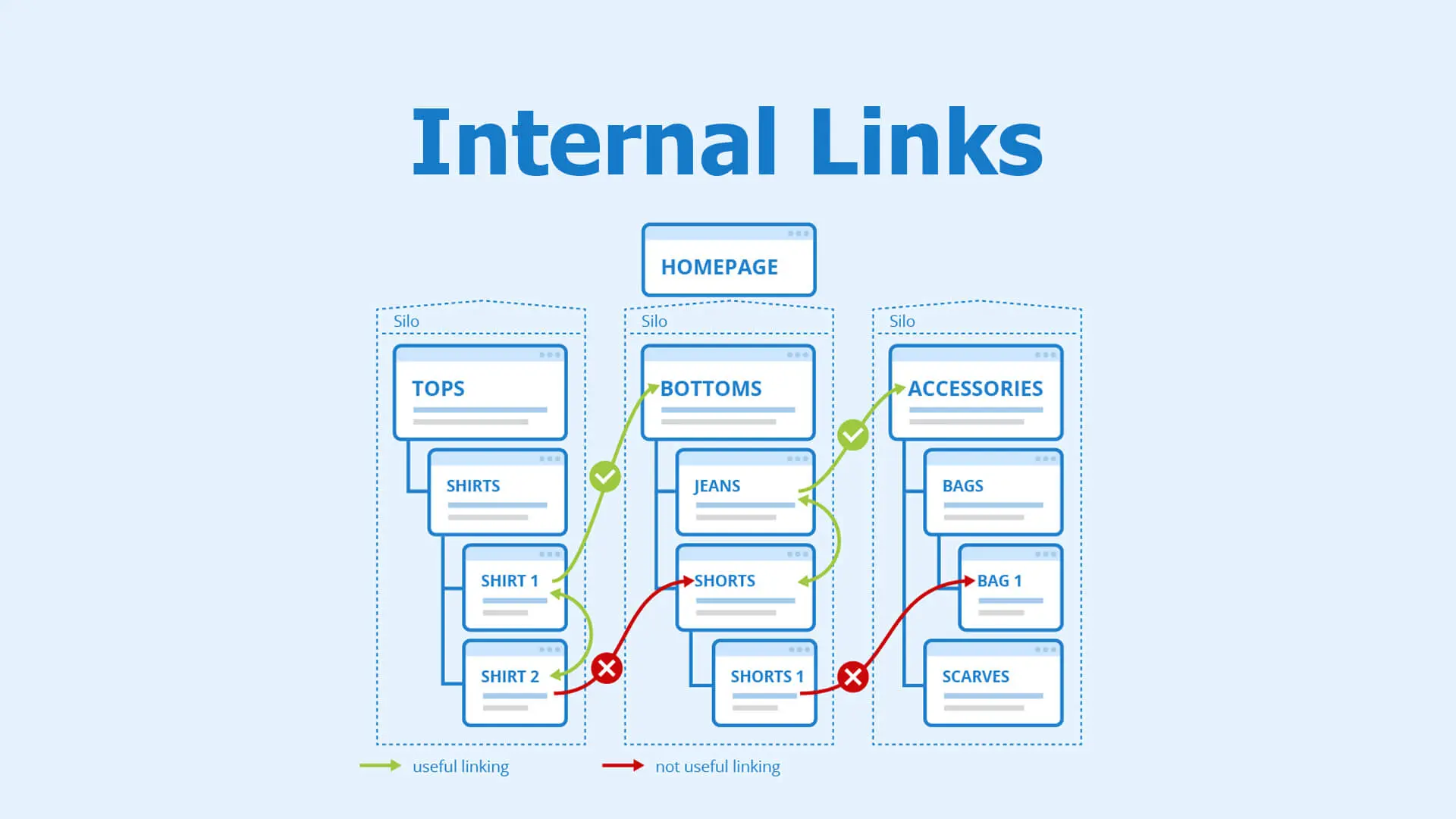
Site architecture determines how easily Google discovers your products, how authority flows between pages and how quickly visitors reach what they want. On a store with thousands of URLs it is arguably the most important structural decision you make. Here is how to structure your e-commerce site architecture for SEO.
Keep the hierarchy flat
The guiding principle is depth. Every important page should be reachable within three clicks from the homepage. A logical structure follows Homepage then Category then Subcategory then Product. The deeper a page sits, the less frequently Google crawls it and the less authority it receives from internal links.
Deep architectures are a common consequence of adding categories organically over time without revisiting the overall structure. A product buried six clicks down may never be indexed properly regardless of how well it is optimized on-page.
Build categories around search demand
Your category structure should reflect how buyers search, not how your warehouse is organized. If people search "women's trail running shoes" that deserves its own category page rather than being hidden behind a filter. Keyword research directly informs which categories and subcategories to create.
Each category should target a distinct keyword cluster. Two categories competing for the same search term create cannibalization and dilute both pages.
Use clean, descriptive URLs
URLs should be short, readable and reflect the hierarchy. A structure like store.com/running/trail-shoes/women communicates the page topic to both users and search engines. Avoid session IDs, unnecessary parameters and auto-generated strings.
Decide early whether product URLs include the category path. Including it adds context but creates duplication when a product belongs to several categories. Many stores keep product URLs flat and rely on canonical tags to consolidate signals.
Control faceted navigation
Filters for size, color, price and brand improve user experience but can generate millions of near-duplicate URLs. Left uncontrolled they waste crawl budget and dilute authority across worthless pages.
The solution is selective. Allow indexation only for filter combinations with genuine search demand, such as "black leather boots", and block or canonicalize the rest through robots directives, noindex tags or canonical tags pointing to the parent category.
Strengthen internal linking
Internal links distribute authority and help Google understand relationships between pages. Link from categories to subcategories and products, between related products, and from blog content toward the commercial pages it supports. Breadcrumbs reinforce the hierarchy on every page and should be marked up with breadcrumb schema.
Prioritize internal links toward your highest-margin and highest-potential categories rather than distributing them evenly.
Plan for scale and change
Architecture must accommodate growth and inventory changes. Define in advance how you will handle new categories, discontinued products and seasonal collections so the structure remains coherent as the catalogue evolves rather than degrading into a patchwork.
How to Optimize Category Pages for SEO?
Category pages usually carry the most SEO value on a store because they target commercial queries with real volume. Yet many are left as a bare product grid with no optimization at all. Here is how to optimize category pages for SEO.
Target one primary keyword per category drawn from your research, such as "women's trail running shoes", and avoid assigning the same term to several pages
Write a unique title tag placing the main keyword near the start and adding a compelling qualifier, kept under around 60 characters
Craft a meta description that includes the keyword and a reason to click, such as free shipping, range size or price positioning
Use a single H1 matching the category name and the primary keyword
Add introductory text of 100 to 200 words above the products explaining the range and naming key attributes buyers search for
Place a longer section below the grid answering common buyer questions and covering related terms without pushing products down the page
Link to relevant subcategories so both users and search engines understand the hierarchy
Optimize product thumbnails with descriptive file names and alt text
Implement breadcrumb schema to reinforce structure and earn enhanced display in search results
Handle pagination correctly so deeper product pages remain crawlable without creating thin duplicate pages
Among these the text content makes the biggest difference and is the most frequently neglected. A category page containing only product names gives Google almost nothing to understand its topic. A short introduction above the grid and a more developed section below it provide context without harming conversion, since shoppers still see products immediately.
Keyword uniqueness comes next. When two categories target the same query they compete against each other and neither ranks as well as a single consolidated page would.
Finally keep the user experience first. Filters, clear pricing, visible ratings and fast loading matter as much for rankings as on-page text, because Google rewards pages that satisfy commercial intent.
How to Optimize Product Pages for SEO?
Product pages capture long-tail searches with the highest purchase intent. Individually they bring modest traffic, but across a full catalogue they represent a substantial share of organic revenue. Here is how to optimize product pages for SEO.
Write unique product descriptions rather than copying the manufacturer's text, which is published identically on hundreds of competing sites
Include specific attributes in the title tag such as brand, model, material, color or size to match the precise queries buyers type
Use a descriptive H1 containing the full product name as customers search for it
Structure the description with benefits first, then technical specifications, dimensions and care instructions
Optimize every image with descriptive file names, alt text and compressed formats like WebP to protect loading speed
Implement Product schema including price, availability, brand and review data to earn rich results in search
Display customer reviews since they add fresh, unique content and supply the ratings used in structured data
Add a FAQ section answering real buyer questions about sizing, compatibility or delivery
Link to related products and the parent category to distribute authority and help Google understand context
Handle variants carefully by consolidating color or size versions under one canonical URL where appropriate
Among these the unique description is the most decisive. Duplicate manufacturer copy gives Google no reason to rank your page over a larger retailer selling the identical item. Rewriting descriptions for your priority products, even briefly, is often the single highest-return action on a store.
Structured data comes next. Displaying price, stock status and star ratings directly in results measurably increases click-through rate on commercial queries without changing your ranking position.
Finally plan out-of-stock handling in advance. A temporarily unavailable product should generally remain live with a clear notice, while a permanently discontinued one should redirect to the closest alternative rather than returning an error.
What Technical SEO Issues Matter Most for E-commerce?
Technical SEO carries far more weight on a store than on a content site because the sheer number of URLs magnifies every structural flaw. A mistake affecting one page on a blog can affect ten thousand on a shop.
The most consequential issue is crawl budget. Google allocates a finite amount of crawling to each site, and stores routinely waste it on low-value URLs generated by filters, sorting options, session parameters and internal search results. When crawlers spend their time on thousands of near-identical pages they may never reach your important products, which remain unindexed regardless of how well they are optimized. Controlling which URLs can be crawled is therefore the foundation of everything else.
Closely related is duplicate content. Product variants, filtered views, pagination and products listed under several categories all produce pages with nearly identical content. Canonical tags tell Google which version to treat as authoritative and consolidate ranking signals onto it. Without them authority fragments across dozens of versions and none rank as well as a single consolidated page would.
Site speed follows directly behind. Product and category pages load heavy images, scripts from apps and third-party tracking tools. Google measures this through Core Web Vitals, and slow loading also damages conversion directly, which makes performance optimization both a ranking and a revenue issue.
Indexation management requires ongoing attention as inventory changes. Discontinued products left returning errors create broken internal links and waste accumulated authority. Deciding systematically whether to keep, redirect or remove each unavailable product prevents this decay.
Structured data is the technical element most directly tied to visibility, since product schema enables price, availability and ratings to appear in results.
Finally mobile performance matters because Google indexes the mobile version of your site first and a large share of shopping now happens on phones.
Addressing these issues rarely produces dramatic overnight gains, but neglecting them caps everything else you do.
How to Build Links to an E-commerce Site?
Link building is harder for stores than for content sites because few people naturally link to a product page. Commercial pages rarely earn links on their own, which means you need deliberate strategies. Here is how to build links to an e-commerce site.
Table: link building strategies for e-commerce
| Strategy | How it works | Difficulty | Link quality |
|---|---|---|---|
| Linkable content | Guides, studies and tools that attract citations | Medium | High |
| Digital PR | Newsworthy data or stories pitched to journalists | High | Very high |
| Supplier and brand links | Stockist pages on the websites of brands you sell | Low | Good |
| Product reviews | Sending products to bloggers and reviewers | Medium | Good |
| Unlinked mentions | Converting existing brand mentions into links | Low | Good |
| Broken link building | Replacing dead links on relevant sites | Medium | Good |
| Partnerships and sponsorships | Collaborations with associations or events | Low | Variable |
| Guest content | Articles published on industry sites | Medium | Variable |
As the table shows supplier and brand links are the easiest win and the most overlooked. Brands frequently maintain a "where to buy" page listing their stockists, and asking to be included often takes a single email.
Linkable content is the most sustainable strategy. Product pages struggle to attract links, but a detailed buying guide, an original survey or a useful calculator can earn citations over time. Those links then strengthen your whole domain, and internal links pass that authority toward commercial pages.
Digital PR delivers the most powerful links but requires genuinely newsworthy material such as original data or a compelling story.
Unlinked mentions offer quick returns for established brands since sites already talking about you are usually happy to add a link.
Avoid buying links or joining link schemes. Google penalizes manipulative patterns, and a manual action can wipe out organic traffic that took years to build.
How to Measure E-commerce SEO Performance?
Measuring SEO on a store means connecting rankings to revenue rather than stopping at traffic. Here is how to measure e-commerce SEO performance.
Track organic revenue and transactions
Monitor organic sessions by page type
Follow keyword rankings for commercial terms
Analyze click-through rate in Search Console
Check indexation coverage
Measure Core Web Vitals
Track organic conversion rate
Monitor backlink growth
The first step is to track organic revenue and transactions in Google Analytics by filtering on the organic search channel. This is the metric that matters most since it ties SEO directly to business results rather than vanity numbers.
The second step is to monitor sessions by page type. Separating category pages, product pages and blog content reveals which part of your site actually drives commercial traffic and where optimization efforts pay off.
The third step is to follow rankings on commercial keywords. Track positions on your priority category and product terms rather than informational queries, since commercial rankings drive revenue.
The fourth step is to analyze click-through rate in Google Search Console. A page ranking well with a low click-through rate signals a weak title tag or meta description worth rewriting, often a quick win.
The fifth step is to check indexation coverage in Search Console. A growing number of excluded or unindexed product pages usually points to crawl budget or duplicate content problems.
The sixth step is to measure Core Web Vitals through PageSpeed Insights and Search Console, since performance affects both rankings and conversion.
The seventh step is to track organic conversion rate to confirm you are attracting buyers rather than browsers. Rising traffic with falling conversion suggests you are ranking on the wrong intent.
The eighth step is to monitor backlink growth to verify your link building is progressing and to catch lost links early.
Review these metrics monthly, and remember that SEO results typically take three to six months to materialize. Judging too early leads to abandoning strategies right before they start working.
FAQ about e-commerce SEO
How long does e-commerce SEO take to show results?
Most stores see meaningful movement within three to six months, with significant results typically arriving between six and twelve months. The timeline depends on your domain's existing authority, the competitiveness of your niche and how much technical debt needs fixing first. A new store in a crowded category will take longer than an established brand targeting underserved long-tail queries. Early gains usually come from technical fixes and long-tail product pages, while competitive category terms take considerably longer. This delay is precisely why SEO works best alongside paid acquisition rather than as a replacement during the launch phase.
Should category pages or product pages be prioritized?
Category pages generally deserve priority because they target commercial queries with meaningful volume, such as "women's running shoes", and accumulate authority from internal links across the catalogue. Product pages matter too, but they capture long-tail searches that are individually smaller. The practical approach is to optimize your highest-potential categories first, then rewrite descriptions for your best-selling and highest-margin products. On very large catalogues it is unrealistic to optimize every product page manually, so concentrating effort where revenue potential is greatest delivers far better returns.
Can I use manufacturer product descriptions?
You can, but they severely limit your ranking potential. Manufacturers supply identical text to every retailer selling the same product, which means hundreds of sites publish exactly the same description. Google has no reason to rank your version above a larger, more authoritative competitor. Rewriting descriptions for your priority products, even with a few original paragraphs covering benefits and use cases, gives search engines a reason to consider your page distinct. For large catalogues start with best sellers and high-margin items rather than attempting everything at once.
What should I do with out-of-stock products?
It depends on whether the unavailability is temporary or permanent. A product returning to stock should remain live with a clear availability notice, an estimated restock date and an option to be notified. This preserves its rankings and accumulated authority. A permanently discontinued product should redirect with a 301 to the closest alternative or to its parent category rather than returning a 404 error, which wastes link equity and frustrates visitors. Removing pages carelessly is one of the most common ways stores lose organic traffic over time.
Is Shopify good for SEO?
Shopify provides a solid SEO foundation including clean hosting, automatic sitemaps, SSL and editable title tags and meta descriptions. It does impose some constraints, notably fixed URL structures containing folders like /collections/ and /products/, and duplicate URLs created when products appear within collection paths. These are manageable through canonical tags, which Shopify handles reasonably by default. For most stores the platform is not the limiting factor. Content quality, site architecture and link building matter far more than the choice between Shopify, WooCommerce or another platform.
Do I need a blog for e-commerce SEO?
Not strictly, but a blog significantly strengthens results when used correctly. Its role is not to rank on its own but to capture informational searches earlier in the buying journey, build topical authority in your niche and pass internal links toward your commercial pages. An article comparing linen and cotton bedding, for example, can attract visitors researching a purchase and guide them toward your bedding category. Content disconnected from your products, however, rarely produces commercial value and should be avoided.
Useful Resources

.avif)
Ready to build a million-dollar brand?
.avif)