How can you analyze your competitors' Google Ads?


Every euro you spend testing an angle your competitor already validated is a euro wasted. They have run the campaigns, burned the budget, identified which keywords convert and which landing pages work. That information exists publicly if you know where to look. So how can you analyze your competitors' Google Ads and turn their spending into your shortcut?
The value of competitor ad analysis is straightforward. You discover which formats they scale, whether Search, Shopping, YouTube or Display, which reveals where the money actually flows in your niche. You see which ads have run longest which is the strongest signal of profitability since nobody sustains an unprofitable campaign for months. You extract their headlines and copy to understand which messaging resonates. And you study their landing pages to see what converts the traffic they pay for.
Several methods exist. The Google Ads Transparency Center shows ads a given advertiser runs though without performance context. The Keyword Planner reveals competitive terms and estimated costs. Searching your own keywords manually shows who bids on them right now. Each of these gives fragments rather than a complete picture.
The limitation of these free approaches is that they tell you an ad exists without telling you whether it works. You see the creative but not its duration, not the store behind it, not the landing page strategy and not how it fits into a broader campaign structure.
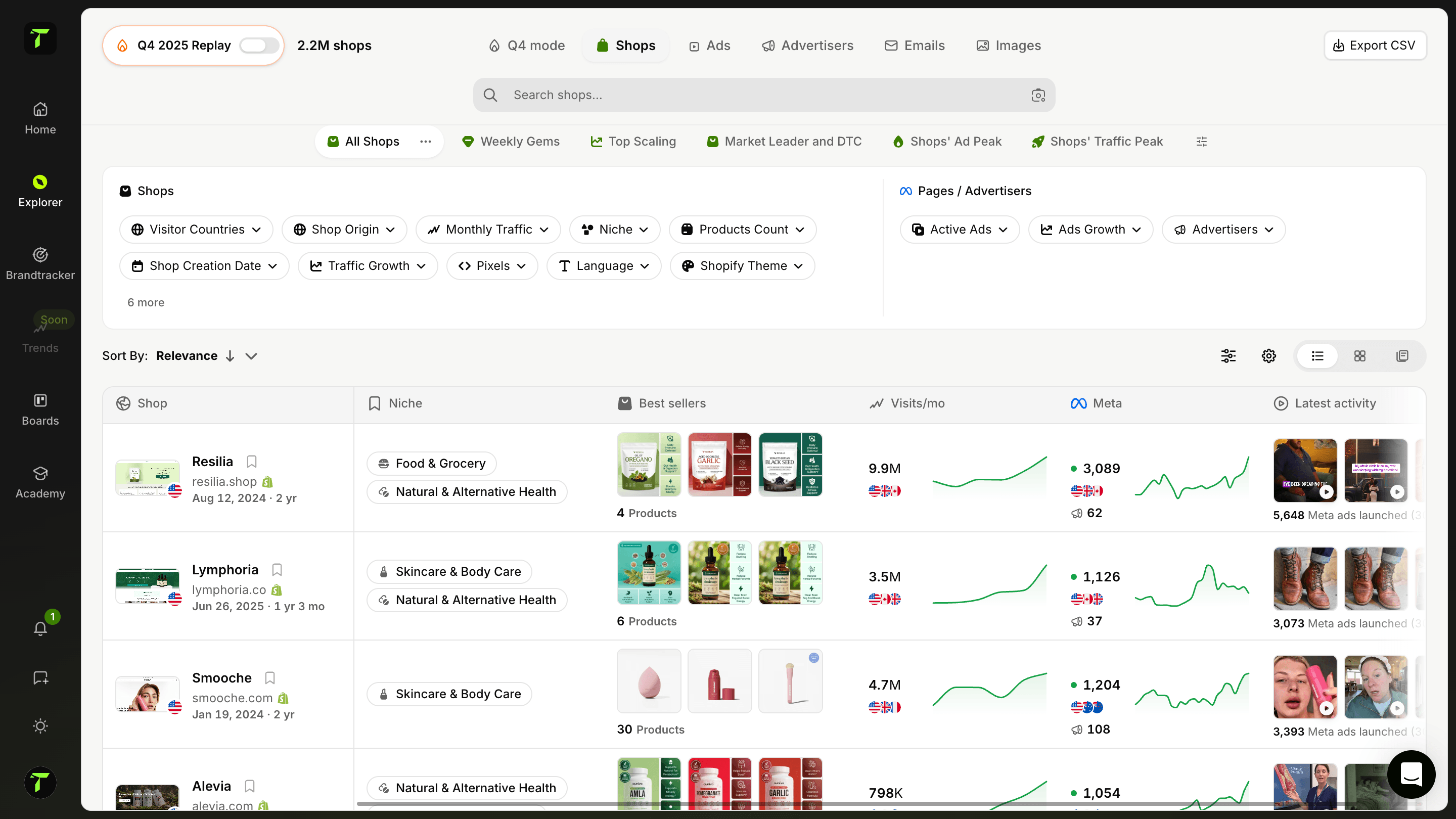
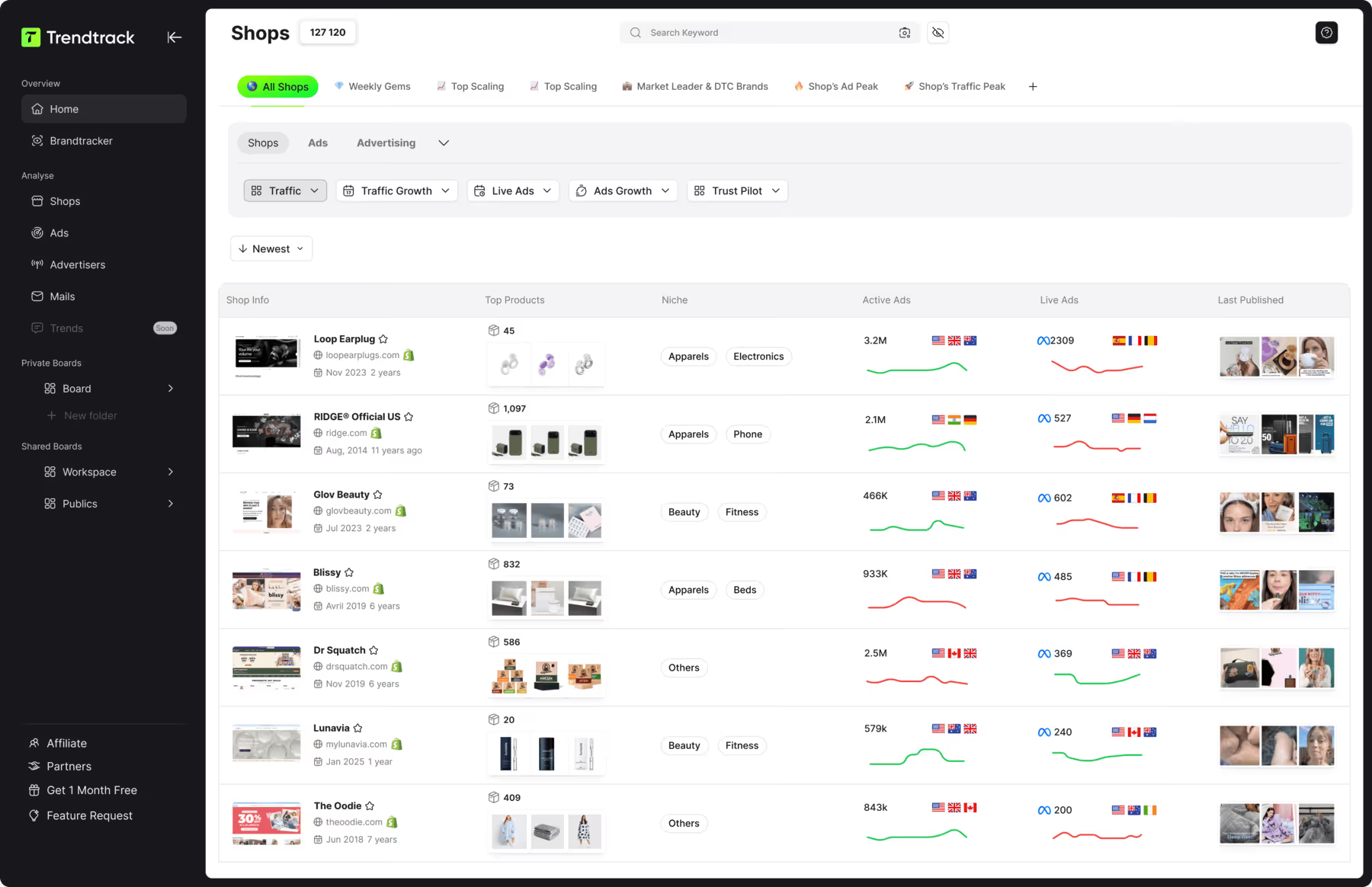
This is where Trendtrack available at app.trendtrack.io/en/sign-up changes the approach entirely. Its Shop Analytics tab reveals any shop's complete Google ad strategy including their full ad library, their top performing ads, the formats they scale across Search, Shopping, YouTube and Display, their landing pages and their headlines and copy.
In this article we explain how to analyze your competitors' Google Ads.
Why Analyze Your Competitors' Google Ads?
Competitor analysis is not about copying. It is about avoiding the cost of discovering what someone else already proved. Here is why you should analyze your competitors' Google Ads.
To avoid paying for the same lessons twice
The first reason is to avoid wasted testing budget. Every angle you test blindly costs money before you learn whether it works. Your competitors have already spent that budget. Observing which of their campaigns survive over months tells you what converts without you funding the experiment. In a market where clicks can exceed several euros this shortcut translates directly into preserved capital.
To identify which formats actually work
The second reason is to identify the winning formats. Knowing whether your competitors invest in Search, Shopping, YouTube or Display reveals where the money genuinely flows in your niche. A store scaling Shopping campaigns while ignoring Display tells you something specific about how customers buy in that category. Without this visibility you spread budget across formats hoping something sticks.
To extract messaging that already resonates
The third reason is to extract proven messaging. Headlines and ad copy that have run for months have survived real market testing. They reveal which benefits customers respond to, which objections need addressing and which angles trigger clicks. This is far more reliable than guessing at your value proposition from your own assumptions.
To understand their conversion strategy
The fourth reason is to study their landing pages. Traffic acquisition is only half the equation. Seeing where competitors send their paid clicks reveals their conversion logic including offer structure, page layout and the arguments they lead with. Many advertisers optimize ads endlessly while ignoring that their landing page is the actual bottleneck.
To spot opportunities they are missing
The fifth reason is to find the gaps. Competitor analysis reveals not only what they do but what they neglect. Keywords nobody bids on, formats left untouched and audiences underserved represent openings where competition is thin and costs are lower.
To time your entry correctly
The sixth reason is timing. Seeing a competitor suddenly scale a new campaign signals something is working. Reacting quickly matters far more than reacting perfectly.
What Free Tools Let You See Competitors' Google Ads?
Several free methods let you glimpse what competitors run though each shows only a fragment of the picture. Here are the free tools available.
| Tool | What it shows | Main limitation |
|---|---|---|
| Google Ads Transparency Center | Ads an advertiser currently runs by region | No performance data or duration context |
| Manual Google search | Who bids on your keywords right now | Snapshot only, no history |
| Google Keyword Planner | Competition level and estimated bids | Requires an active Ads account |
| Google Shopping tab | Products and prices competitors promote | Shopping campaigns only |
| Google Trends | Interest evolution on your keywords | No advertiser-level data |
| Competitor site inspection | Their tracking pixels and landing pages | Manual and time-consuming |
As the table shows the Google Ads Transparency Center is the most direct starting point. Launched to comply with regulatory requirements it lets you search any advertiser and see the ads they currently run filtered by region and format. It is genuinely useful for confirming that a competitor advertises and seeing their creatives. What it does not tell you is how long each ad has run, how much they invest or whether the campaign performs.
Manual searching on your own keywords costs nothing and shows exactly who competes for the traffic you want. Use incognito mode to avoid personalized results. The limitation is obvious: you see a single moment in time with no history and no way to know if that ad appeared yesterday or has been running profitably for eight months.
The Keyword Planner provides competition levels and bid estimates which helps assess whether a keyword is realistic for your budget. It requires an active Google Ads account and reveals nothing about specific competitors.
Inspecting competitor landing pages manually reveals their conversion approach and sometimes their tracking setup. It works but consumes enormous time when repeated across multiple competitors.
The common weakness of all these approaches is that they show existence rather than performance. You learn an ad exists without learning whether it makes money which is the only question that matters.
How to Analyze Competitors' Google Ads With Trendtrack?

Trendtrack consolidates in one view what free tools show in fragments. Here is how to analyze competitors' Google Ads with Trendtrack.
Search for the shop you want to analyze
Open the dedicated Google Ads tab in Shop Analytics
Explore their full ad library
Identify their top performing ads
Study the formats they scale
Extract their headlines and copy
Analyze their landing pages
Apply the patterns to your own campaigns
The first step is to search for the shop you want to study. Enter any store or domain and Trendtrack pulls its complete profile from a database of over 700,000 brand profiles updated every 24 hours.
The second step is to open the Google Ads tab within Shop Analytics. This dedicated section gives you complete visibility into that shop's Google advertising activity rather than isolated creatives.
The third step is to explore their full ad library. You see the entire history of what they have run rather than a snapshot of today. This history is what reveals patterns since campaigns that reappear repeatedly are almost certainly profitable.
The fourth step is to identify their top performing ads. Trendtrack surfaces which creatives perform best which immediately tells you where their budget actually converts.
The fifth step is to study the formats they scale across Search, Shopping, YouTube and Display. Knowing a competitor invests heavily in Shopping while ignoring Display tells you something concrete about how customers buy in your category.
The sixth step is to extract their headlines and copy. Messaging that has survived months of live testing reveals which benefits and objections genuinely move your market.
The seventh step is to analyze their landing pages to understand how they convert the traffic they pay for.
The eighth step is to apply the patterns rather than copying the ads. Extract the underlying logic and adapt it to your positioning.
What Should You Look for in a Competitor's Google Ads?
Knowing where to look matters more than looking everywhere. Here is what to look for in a competitor's Google Ads.
Ad duration since campaigns running for months are almost certainly profitable, making longevity the strongest performance signal available to you
Formats they scale across Search, Shopping, YouTube and Display which reveals where budget actually converts in your category
Recurring headlines that reappear across multiple campaigns indicating messaging they have tested and validated
The benefits they lead with rather than the features they list, showing which arguments genuinely move buyers in your market
Their landing page structure including offer placement, page length, social proof and the arguments they prioritize
Price positioning visible in Shopping campaigns which tells you where they sit in the market and how they justify it
Calls to action and the urgency mechanisms they deploy such as limited offers, free shipping thresholds or guarantees
Seasonal patterns in when campaigns launch and pause which reveals their understanding of demand cycles
Keywords they abandoned which can indicate terms that failed to convert and are worth avoiding
Gaps they leave open including formats untouched and audiences underserved where competition is thinner
Among these ad duration is by far the most reliable indicator. Anyone can launch a campaign but only profitable ones survive. An ad running continuously for six months has passed a market test no theoretical analysis can replicate. Prioritize studying these above everything else.
Landing pages are the second most valuable element and the most frequently overlooked. Advertisers obsess over creatives while ignoring that conversion happens after the click. Seeing where a competitor sends paid traffic reveals their entire conversion logic.
Finally look for gaps rather than only patterns. What competitors neglect often represents cheaper opportunities than competing head-on where everyone bids.
How to Turn Competitor Insights Into Better Campaigns?
Gathering competitor data is useless if it stays in a spreadsheet. The value comes from converting observations into decisions and that transition is where most advertisers stall.
Start by extracting patterns rather than copying ads. Duplicating a competitor's creative produces a weaker version of something the market has already seen. What you want is the underlying logic: which benefit they lead with, which objection they address first, which emotional trigger they rely on. Then express that logic through your own positioning and your own voice. The pattern transfers, the execution should not.
Next prioritize by evidence strength. Not all observations carry equal weight. An ad running continuously for eight months tells you far more than one launched last week. Build your test queue around what has demonstrably survived rather than around what looks interesting. This ordering alone prevents wasting budget on angles competitors are themselves still testing.
Then rebuild your landing pages before your ads. Most advertisers discover a competitor's messaging and immediately rewrite their headlines while sending that traffic to an unchanged page. Conversion happens after the click. If a competitor's landing page leads with a guarantee and yours buries shipping information at the bottom your ad improvements will not compensate.
Also attack the gaps rather than the strongholds. Competing directly on the keywords everyone bids for means paying premium prices against established advertisers with better quality scores. The formats they ignore and the audiences they neglect usually offer cheaper entry and less resistance.
Finally test one variable at a time. Changing your headline, your landing page and your format simultaneously makes the result impossible to interpret. Isolate each change so you learn something transferable rather than just observing a number move.
The goal is building your own repeatable playbook rather than permanently reacting to others. Competitor analysis accelerates that process, it does not replace it.
FAQ about competitor Google Ads analysis
Is it legal to analyze competitors' Google Ads?
Yes analyzing competitors' Google Ads is entirely legal. Ads are public by nature since they are displayed to anyone searching the relevant terms, and Google itself created the Ads Transparency Center specifically to make advertiser activity publicly accessible. What you cannot legally do is copy protected creative assets, use a competitor's trademark in your own ad text or reproduce their content directly. Observing, analyzing and drawing inspiration from public advertising is standard competitive intelligence practised across every industry. The distinction is straightforward: studying strategy is legitimate while duplicating protected material is not.
Can you see how much competitors spend on Google Ads?
Not with precision. No public tool gives you a competitor's exact budget since Google does not disclose that data. Some platforms provide estimates derived from visibility, keyword volumes and observed activity but these remain approximations that can be significantly off. What matters more than the exact figure is the direction and scale. Seeing which formats a competitor scales, which ads run longest and which campaigns they sustain over months tells you where their budget actually goes. That directional insight is genuinely actionable whereas a precise number you cannot verify is not.
How do I know if a competitor's ad is actually working?
Duration is the strongest available signal. An ad that has run continuously for several months has almost certainly proven profitable since no advertiser sustains a losing campaign indefinitely. Conversely an ad that appeared last week tells you nothing yet since it may simply be a test that fails next month. This is why access to full ad history matters far more than seeing what runs today. Trendtrack available at app.trendtrack.io/en/sign-up shows the complete ad library of any shop alongside its top performing ads which lets you identify what has survived market testing.
How often should I analyze my competitors?
A monthly review is sufficient for most businesses to spot meaningful shifts without consuming excessive time. Increase that frequency during key periods such as before a major seasonal push, when launching a new product or when you notice a sudden drop in your own performance. What you want to catch is change rather than status: a competitor suddenly scaling a new format, testing a different angle or abandoning a campaign they ran for months. Continuous monitoring matters more than depth. Trendtrack updates its brand profiles every 24 hours which keeps that monitoring current.
Should I copy my competitors' ads?
No and this is the most common mistake. Duplicating a creative produces a weaker version of something the market has already seen while making you look derivative. What you should extract instead is the underlying logic: which benefit they lead with, which objection they address, which emotional trigger they use and which format they scale. Then express that logic through your own positioning and your own voice. The pattern transfers, the execution should not. Copying also carries genuine legal risk if you reproduce protected creative assets or trademarked elements.
Which competitors should I analyze?
Focus on three types. First your direct competitors selling similar products to similar audiences since their findings transfer most readily to your situation. Second the market leaders in your category who have the budget to test extensively and whose validated approaches represent proven ground. Third adjacent players in related niches whose angles you can adapt before anyone in your own space does. Avoid spreading yourself across twenty competitors since depth beats breadth here. Three to five well-monitored competitors deliver more actionable insight than a superficial scan of an entire market.
Useful Resources

.avif)
Ready to build a million-dollar brand?
.avif)