Ecommerce Competitor Analysis
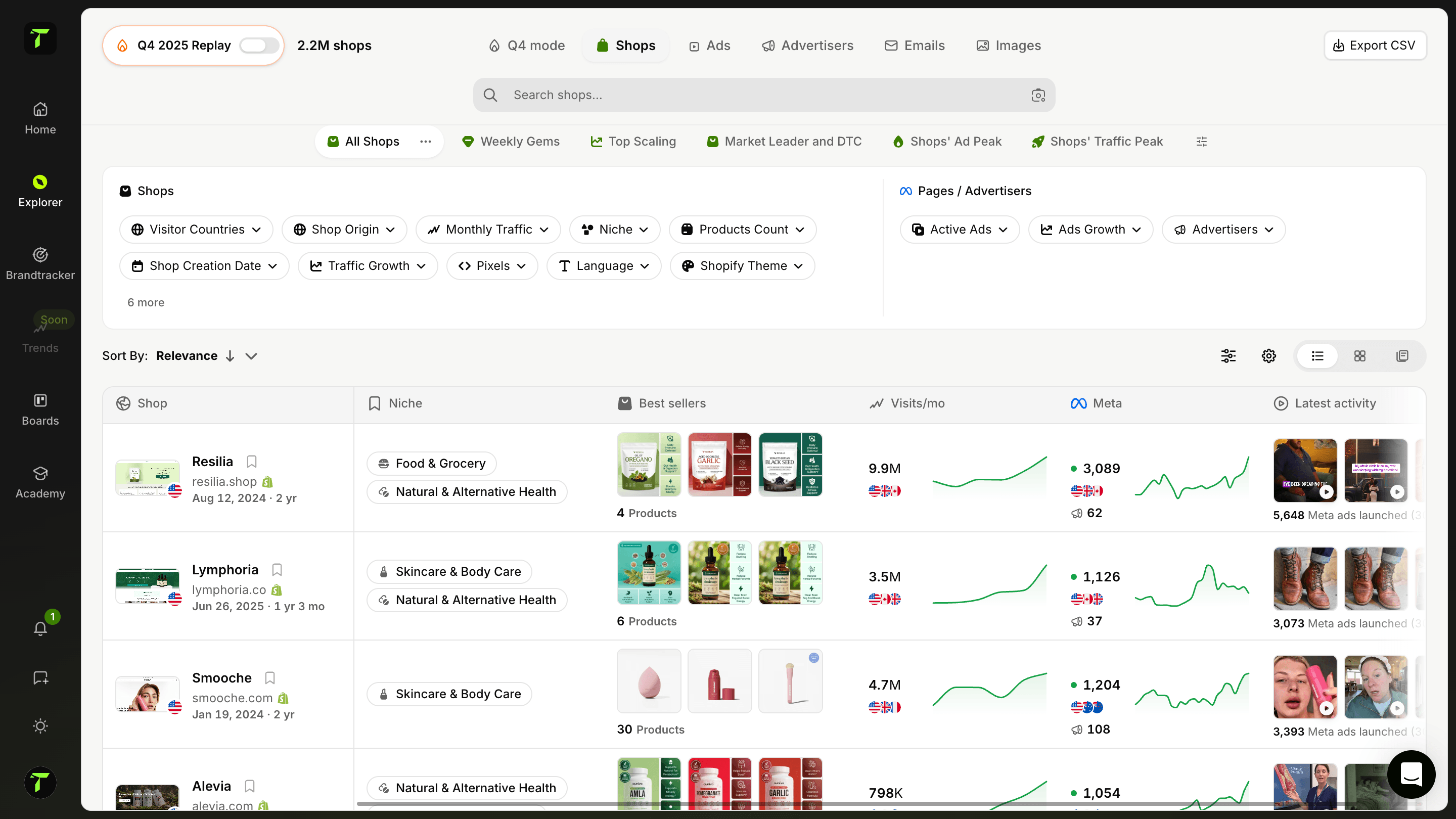
Analyze any ecommerce store in seconds. Get its estimated traffic, active ads, catalog size, Trustpilot rating, tech stack and best sellers in one report.
What is ecommerce competitor analysis?
Ecommerce competitor analysis is the process of studying how another online store attracts visitors, advertises its products, structures its catalog and builds customer trust. The goal is not to copy a competitor. It is to understand the signals behind its growth so you can make better decisions for your own store.
Looking at a homepage alone rarely tells the full story. A polished store may have little traffic, while a simple-looking store may run thousands of ads and generate millions of monthly visits. Trendtrack brings the most useful signals into one report: estimated traffic, active ads, catalog size, best sellers, Trustpilot rating, ecommerce platform and theme.
What does the Ecommerce Competitor Analysis tool show?
Enter a store domain and the tool builds an instant overview containing:
- Estimated monthly traffic and its recent trend;
- active ads, across the advertising platforms detected for the store;
- catalog size, based on the products identified;
- three best-selling products;
- Trustpilot rating and review count, when available;
- ecommerce platform and theme detected on the website.
These metrics become much more useful when read together. Traffic shows attention, ads show acquisition activity, the catalog shows the store's commercial structure, and reviews provide a signal of customer trust.
How to analyze any ecommerce store
Using the tool takes less than a minute:
- Enter the competitor's domain, such as example.com.
- Launch the analysis and wait for the report to load.
- Start with monthly traffic and its direction of travel.
- Compare that movement with active ads and catalog size.
- Review the best sellers, Trustpilot profile and detected technology.
Do not stop at the largest number on the screen. The purpose of the report is to form a coherent picture of the store, not to judge it from one isolated metric.
How to interpret traffic and growth
Estimated monthly traffic indicates the approximate number of visits a store receives. It is useful for comparing the relative size of competitors and spotting brands that may be gaining attention.
A rising traffic trend can signal successful acquisition, seasonality, a product launch or growing brand awareness. A decline does not automatically mean the business is failing: the store may be leaving a seasonal peak, reducing advertising or focusing on more profitable traffic.
Traffic is an estimate, not access to the competitor's private analytics. Use it as a directional signal and compare stores using the same method and period.
What active ads and catalog size reveal
A high number of active ads suggests that a store is testing or scaling multiple creatives, audiences, products or markets. A lower number may indicate a smaller operation, a concentrated campaign or greater reliance on organic acquisition.
Catalog size adds context. A store with 30 products and hundreds of active ads is probably concentrating spend on a small number of offers. A store with thousands of products may distribute its advertising across a much wider range.
Active ad count does not prove profitability. Some ads may be new tests, localized variations or low-budget campaigns. It is an activity signal that becomes stronger when combined with sustained traffic and long-running creatives.
What best sellers can teach you
Best sellers reveal where customer demand appears to concentrate. Look for patterns rather than isolated product names:
- repeated problems or benefits;
- similar price points;
- bundles or multipacks;
- consumable products that encourage repeat purchases;
- products that are easy to demonstrate in an ad.
You can use these patterns to refine your product research, pricing or merchandising. The objective is to understand why the offer may work, not to duplicate the product page.
Trustpilot, platform and theme: why they matter
The Trustpilot rating and review count give context about reputation. A high score supported by many reviews can reduce purchase anxiety. A weak score or recurring complaints may reveal opportunities to compete through better delivery, support or product quality.
The detected platform and theme show part of the store's technical foundation. Knowing that a competitor uses Shopify, for example, helps you evaluate comparable tools, layouts and customer journeys. The theme can also explain certain design patterns, although many stores heavily customize their storefront.
How to read all the signals together
The strongest insights come from combinations:
- Growing traffic + many active ads may indicate aggressive acquisition or scaling.
- Stable traffic + long-running ads may point to a mature, repeatable system.
- Small catalog + clear best sellers may reveal a focused hero-product strategy.
- Large review volume + strong traffic suggests an established brand with meaningful customer history.
- Many ads + falling traffic may indicate testing, seasonality or declining campaign efficiency.
Treat these as hypotheses to investigate, not final conclusions. Visit the store, examine its offers and then analyze its ads before deciding what the data means.
What competitor analysis cannot prove
Public and estimated data cannot reveal exact revenue, net profit, private conversion rates, inventory levels or campaign ROAS. A store can attract significant traffic and still have weak margins. Likewise, an active ad may be a test rather than a winner.
Use competitor analysis to reduce uncertainty, prioritize research and find questions worth answering. Your own product economics and customer data must still guide the final decision.
Go further with Trendtrack
The free analysis gives you a fast overview of any ecommerce store. Trendtrack lets you go deeper: explore complete catalogs, traffic sources and history, installed apps, similar stores, advertising timelines, landing pages, hooks and creative angles.
Continue your research with the Winning Product Finder and the Competitor Ads Finder to move from a store-level signal to the products and creatives behind it.
Frequently asked questions
Can't find the answer to your question?
Contact us by clicking here.
TrendTrack is the ecommerce intelligence platform built around one obsession: giving you the most accurate, most current market data available. Every store, every ad, every mail, every spend signal, updated every 24 hours. Because knowing what's winning in ecom right now is only useful if "right now" actually means right now.
Most tools show you what was working last month. We show you what's working today. Our infrastructure scans the entire Shopify and Meta ecosystem daily, 2 to 3 million new ads indexed every 24 hours. No delays, no editorial filters, no subjective picks. Just the market, live.
Anyone who makes ecom decisions and can't afford to be wrong. Beginners validating a product before spending a dollar. Operators whose ads are burning out and need fresh angles. Brands and agencies that need to see market shifts before they happen. If your decisions depend on knowing what's actually working right now, this is your tool.
It's one of the best ways to de-risk your first moves. Instead of guessing, you can see exactly which products are gaining traction, which ads are scaling, and which niches are heating up, all in real time. You're not betting on a hunch. You're betting on live market signals.
Yes. The fastest way to find a new angle is to see what's already working, across your niche and beyond. TrendTrack gives you access to millions of active creatives, ranked by performance signals, updated daily. The next winning hook is already running somewhere. We help you find it.
All our data comes directly from real sources, no invented numbers, no estimates pulled from thin air. Ad spend is sourced straight from Meta's own data. Store traffic is powered by SimilarWeb, the industry's most reliable traffic intelligence provider. Refreshed every 24 hours, it gives you the most accurate read of what's scaling right now, strong enough to spot winners, track emerging brands, and flag trends before they peak.
It depends on your plan. Each plan comes with its own access levels and usage capabilities. Before subscribing, we recommend checking our pricing page to make sure you pick the plan that fits your needs.
Yes. No commitment, no lock-in. Cancel directly from your account whenever you want.
Ready to build a million-dollar brand?
.avif)