Competitor Ads Finder
Find any ecommerce store's active ads in seconds. Compare its Meta, TikTok and Google activity, formats, oldest campaigns and latest creatives in one report.
What is a competitor ads finder?
A competitor ads finder shows the advertisements an ecommerce store is currently running across major platforms. Instead of searching several ad libraries separately, you can enter one store domain and review its presence on Meta, TikTok and Google in a single report.
Competitor ad research helps you understand how a brand attracts customers: which platforms it prioritizes, whether it relies on images or videos, how frequently it launches new creatives and which campaigns have remained active the longest.
The purpose is not to copy an ad. It is to identify patterns, messages and formats that can inform your own creative testing.
What does the Competitor Ads Finder show?
For each detected platform, the tool can display:
- the number of active ads;
- the split between image, video and dynamic ads;
- the oldest ad still running;
- the latest creatives, with their launch dates;
- a preview of the creative and an excerpt of its copy.
If no presence is detected on a platform, the report says so. This makes it easy to compare a store's activity across Meta, TikTok and Google without opening multiple tabs.
How to find any store's ads
- Enter the store domain, such as
example.com. - Launch the search.
- Compare the active ad count across platforms.
- Review the format breakdown for each channel.
- Inspect the oldest active ad and the latest creative launches.
Start with the overall mix before studying individual ads. The combination of platforms, formats and launch dates often reveals more than one creative viewed in isolation.
How to compare Meta, TikTok and Google ads
Each platform can play a different role in the acquisition strategy:
- Meta is often used for visual prospecting, retargeting and testing many creative variations.
- TikTok typically favors native-looking video, fast hooks and creator-led demonstrations.
- Google can capture existing demand through search, shopping, display and dynamic formats.
A brand active on all three platforms may have a diversified acquisition system. A store focused on one platform may have found a channel that fits its product, or it may still be early in its expansion.
No ads detected does not necessarily mean no advertising. The advertiser may use another domain, account or platform, or the campaign may not be active when the scan runs.
What does the number of active ads tell you?
Active ad count is a measure of advertising activity, not guaranteed performance. A large count may reflect:
- several products or markets;
- many creative variations;
- localized ads;
- audience or offer testing;
- a campaign being scaled.
A small count can still belong to a successful brand with a focused creative system. Always connect volume with longevity, formats and store-level traffic before drawing conclusions.
How to interpret ad formats
The format breakdown shows how a brand distributes its creatives between images, videos and dynamic ads.
A video-heavy mix may suggest that the product benefits from demonstrations, testimonials or before-and-after storytelling. A strong image share can indicate simple offers, visual products or a strategy based on fast creative iteration. Dynamic ads are often connected to larger catalogs, retargeting or automated product promotion.
Use the breakdown to generate testing hypotheses. If most established competitors in a niche rely on video, ask what the format explains that a static image cannot. If images dominate, examine the offer clarity, headline and visual hierarchy.
Why the oldest active ad matters
An ad that remains active for weeks or months is worth investigating. Advertisers usually stop creatives that clearly fail, so longevity can be a useful signal that an ad contributes to the account.
However, longevity is not proof of profitability. The ad may run on a small budget, support retargeting or remain active for brand purposes. Treat it as a prioritization signal: study its hook, offer, format and landing page before newer tests.
What the latest creatives reveal
The most recent ads show what a competitor is testing now. Compare them with older campaigns and look for:
- repeated hooks or claims;
- new offers and discounts;
- changes in visual style;
- new creators or customer profiles;
- seasonal messages;
- variations of the same core concept.
Repetition can be more informative than novelty. When a brand produces several variations around one angle, that angle may be important enough to keep testing.
A practical competitor ad research workflow
- Identify three to five relevant competitors.
- Compare their platform and format mixes.
- Prioritize long-running ads and repeated concepts.
- Write down the hook, problem, promise, proof and offer used by each ad.
- Visit the landing page and check whether the message continues after the click.
- Build original variations based on the underlying insight, not on the competitor's exact words or visuals.
This turns ad browsing into structured creative research rather than passive inspiration.
What competitor ad data cannot prove
Public ad activity cannot reveal exact spend, targeting, attribution, conversion rate or profit for every campaign. Active does not always mean successful, and inactive does not always mean failed.
Use the report to find strong research candidates. Validate the conclusions with ad longevity, store traffic, product economics and your own test results.
Go further with Trendtrack
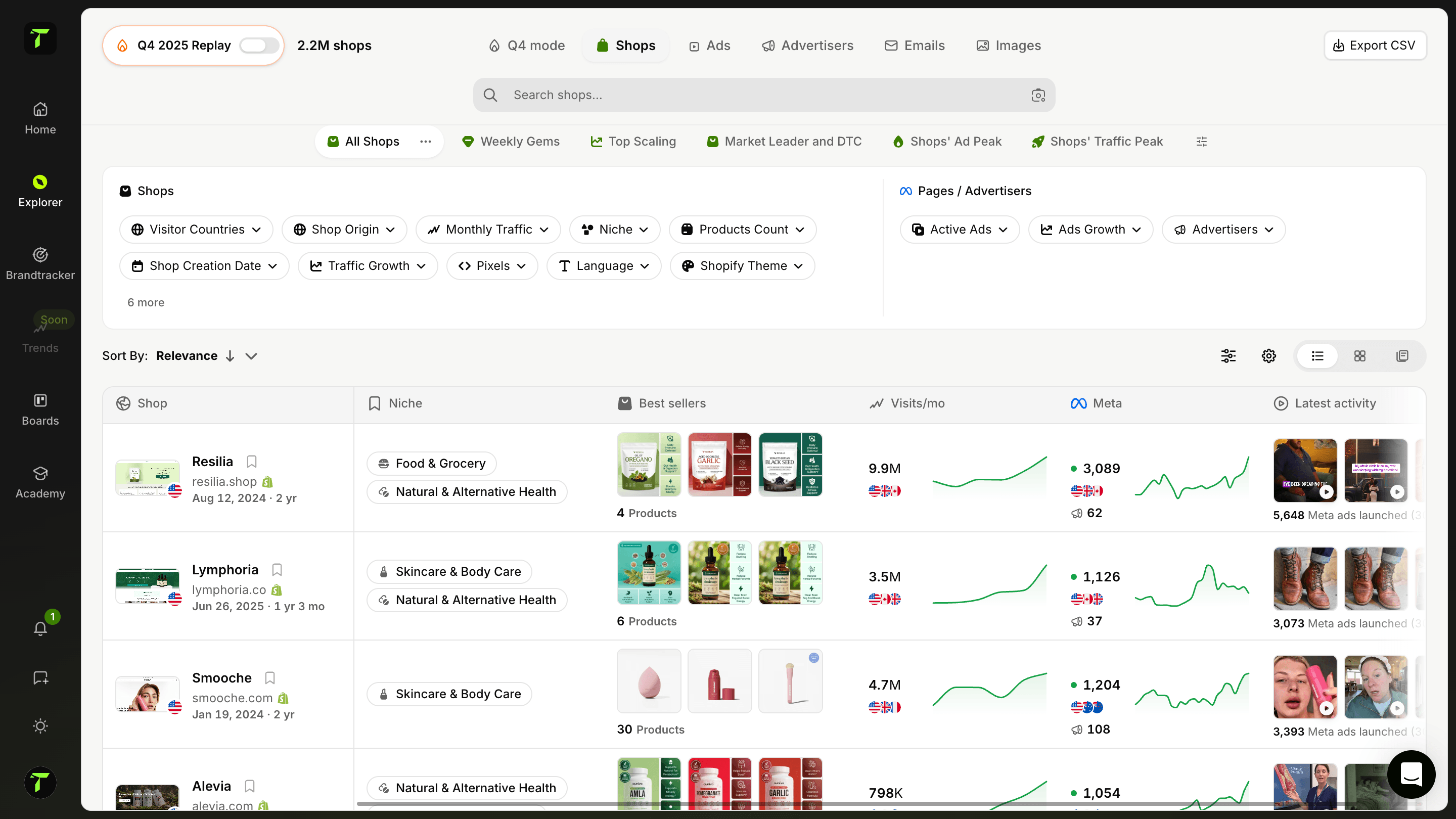
The free tool shows the latest creatives, format mix and campaign longevity for a store. Trendtrack unlocks the wider creative system: every detected ad, landing pages, hooks, angles, video transcriptions, targeting signals and testing timelines.
Combine it with the Ecommerce Competitor Analysis and Winning Product Finder to connect each creative with the store and product behind it.
Frequently asked questions
Can't find the answer to your question?
Contact us by clicking here.
TrendTrack is the ecommerce intelligence platform built around one obsession: giving you the most accurate, most current market data available. Every store, every ad, every mail, every spend signal, updated every 24 hours. Because knowing what's winning in ecom right now is only useful if "right now" actually means right now.
Most tools show you what was working last month. We show you what's working today. Our infrastructure scans the entire Shopify and Meta ecosystem daily, 2 to 3 million new ads indexed every 24 hours. No delays, no editorial filters, no subjective picks. Just the market, live.
Anyone who makes ecom decisions and can't afford to be wrong. Beginners validating a product before spending a dollar. Operators whose ads are burning out and need fresh angles. Brands and agencies that need to see market shifts before they happen. If your decisions depend on knowing what's actually working right now, this is your tool.
It's one of the best ways to de-risk your first moves. Instead of guessing, you can see exactly which products are gaining traction, which ads are scaling, and which niches are heating up, all in real time. You're not betting on a hunch. You're betting on live market signals.
Yes. The fastest way to find a new angle is to see what's already working, across your niche and beyond. TrendTrack gives you access to millions of active creatives, ranked by performance signals, updated daily. The next winning hook is already running somewhere. We help you find it.
All our data comes directly from real sources, no invented numbers, no estimates pulled from thin air. Ad spend is sourced straight from Meta's own data. Store traffic is powered by SimilarWeb, the industry's most reliable traffic intelligence provider. Refreshed every 24 hours, it gives you the most accurate read of what's scaling right now, strong enough to spot winners, track emerging brands, and flag trends before they peak.
It depends on your plan. Each plan comes with its own access levels and usage capabilities. Before subscribing, we recommend checking our pricing page to make sure you pick the plan that fits your needs.
Yes. No commitment, no lock-in. Cancel directly from your account whenever you want.
Ready to build a million-dollar brand?
.avif)