How can you use email marketing to maximize sales during Black Friday?



Black Friday falls on November 27, 2026, which leaves roughly eight weeks. Most stores will spend those weeks preparing creatives and raising ad budgets, then discover in late November that advertising costs have climbed to the point where acquisition barely breaks even. So how do you use email marketing to maximize sales during Black Friday?
The answer starts with an economic reality rather than a tactic. During Black Friday week, CPMs spike sharply across Meta, TikTok and Google as every advertiser bids simultaneously. Your acquisition cost rises precisely when you need volume most. Email operates on the opposite logic: once a subscriber is on your list, reaching them costs effectively nothing regardless of what the ad market is doing.
That asymmetry is why email consistently generates a disproportionate share of Black Friday revenue for stores that prepared it. The list you build in October is the margin you protect in November.
Four phases structure an effective campaign. Building and segmenting in the weeks before, since a list assembled in late November is too small to matter. Warming your audience with teasers and early access that create anticipation without revealing your offer. Executing during the period itself with a planned sequence rather than improvised sends. And extending through Cyber Monday and the days that follow, where a significant portion of revenue still sits.
Several elements determine whether the campaign works. Segmentation first, because a message speaking identically to a repeat buyer and to someone who never purchased wastes both. Timing next, since inbox competition peaks on the same days for everyone. Subject lines that survive a saturated inbox. And a sequence written in advance, because writing copy during Black Friday week means monitoring nothing while you type.
One mistake deserves flagging upfront. Most stores send too few emails during this period, not too many. Subscribers expect offers in late November, and a single send on Friday morning reaches only the fraction of your list that opened that hour.
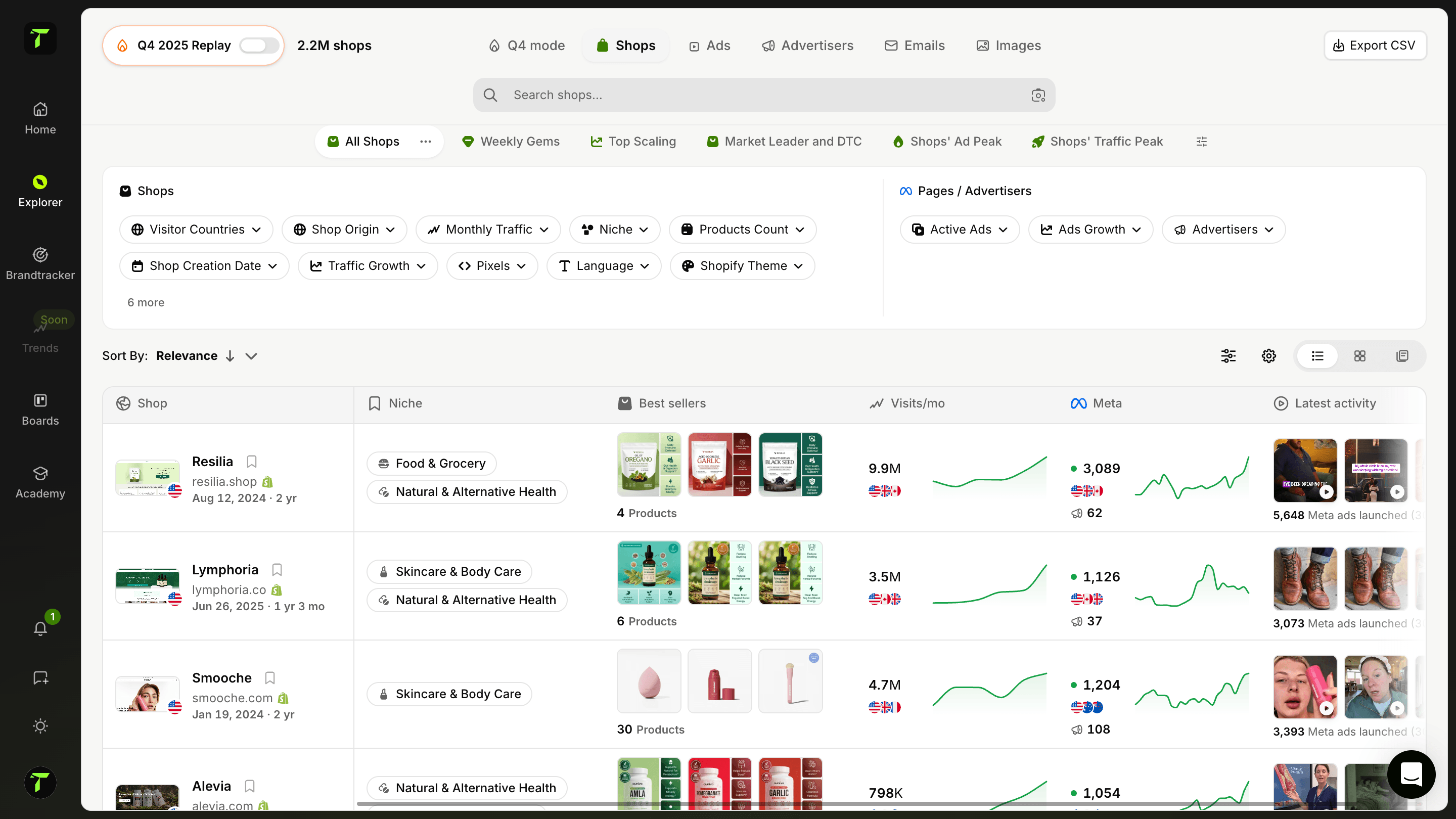
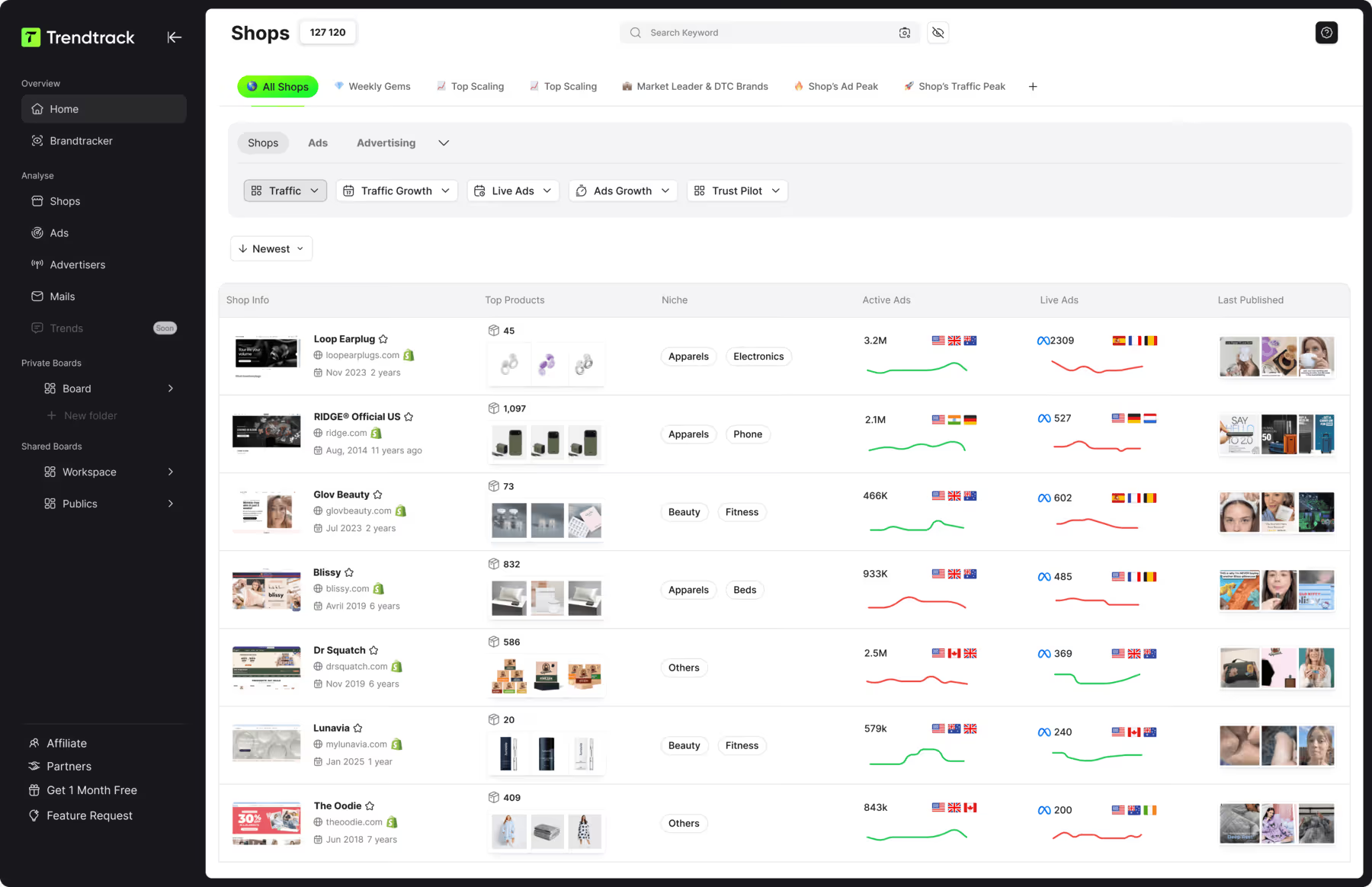
To see which offers and angles competitors are preparing, Trendtrack available at app.trendtrack.io/en/sign-up reveals their full ad activity across Meta, TikTok and Google, with 700,000+ brand profiles refreshed every 24 hours.
In this article we explain how to use email marketing to maximize your Black Friday sales.
Why Does Email Outperform Paid Ads During Black Friday?
Email does not outperform advertising because it is a better channel in general. It outperforms during this specific period because of what happens to advertising economics in late November. Here is why.
Advertising costs spike while email stays free
This is the structural reason and it explains most of the others. Every advertiser in your category raises budgets in the same two-week window, which drives auction prices up sharply across Meta, TikTok and Google. Your cost per thousand impressions climbs, your cost per click follows, and your acquisition cost rises precisely when you need volume.
Email operates outside that auction entirely. Sending to ten thousand subscribers costs the same in November as in June, which means your margin per order holds while your competitors' erodes.
You own the list, you rent the audience
An advertising audience belongs to the platform. Algorithm changes, policy updates, ad account suspensions and rising costs all sit outside your control, and a store depending entirely on paid acquisition has no fallback when one of them happens.
A subscriber list is an asset you own. It cannot be throttled by an algorithm change or frozen by a compliance review, which makes it the only acquisition channel genuinely resistant to platform risk.
Your subscribers already know you
Paid advertising during Black Friday mostly reaches cold audiences who need to be convinced of your existence, your credibility and your offer simultaneously, in a feed saturated with competing discounts.
Your email subscribers cleared those steps already. They visited your site, they chose to give you their address, and many bought before. Converting warm traffic requires a fraction of the persuasion cold traffic demands, which shows directly in the conversion rate gap between the two channels.
Timing is yours to control
Advertising delivery depends on the algorithm's pacing. You set a budget and the platform decides when your ads appear, which means your message arrives when the auction allows rather than when you intend.
With email you choose the exact hour. Launching early access on Wednesday evening, sending a reminder Friday at midday and pushing a final hours message Sunday at 8pm is a sequence you control precisely, which matters enormously when urgency drives the purchase.
Segmentation beats targeting
Ad platforms target by inferred signals. Your email list contains actual behaviour: what each subscriber bought, how much they spent, which category they browsed, when they last ordered.
That precision allows messages a targeting algorithm cannot replicate. A repeat customer receives a loyalty-framed offer, a cart abandoner receives a reminder on the exact product they left, and a dormant subscriber receives a reactivation angle.
The two work together rather than against each other
The point is not to abandon advertising. It is to use the cheaper period, meaning now, to convert paid traffic into subscribers, then let email carry the expensive period.
How to Build Your Email List Before Black Friday?
The list you build now determines what email can deliver in November. Here is how to grow it in the weeks remaining.
Install a capture form with a genuine incentive
Create a Black Friday waiting list
Run paid ads toward signup rather than toward sales
Add exit-intent capture on your key pages
Collect at checkout and after purchase
Use organic content and social channels
Clean your list before the period starts
The first step is to install a capture form with a real incentive. A discount code works, but early access to your Black Friday offer frequently converts better since it creates exclusivity without committing you on price.
The second step is to create a dedicated waiting list. A page announcing that subscribers get first access converts visitors who are not ready to buy today but will be in November. It also gives you a destination link to use across every channel.
The third step is to run paid ads toward signup. Acquiring an email now costs a fraction of what a sale will cost during Black Friday week, which makes this the most efficient use of advertising budget in October.
The fourth step is to add exit-intent capture on your product and collection pages, recovering visitors who would otherwise leave with nothing.
The fifth step is to collect at checkout and after purchase, since existing customers convert far better than cold subscribers.
The sixth step is to use your organic channels, directing social content, blog traffic and video descriptions toward your waiting list.
The seventh step is to clean your list by removing invalid addresses and long-term non-openers, which protects your deliverability when volume spikes.
How to Segment Your List for Black Friday?
Sending the same message to your entire list wastes most of it. A repeat customer and someone who signed up yesterday need different offers. Here is how to segment.
Table: Black Friday segments and their angle
| Segment | Angle to use | Priority |
|---|---|---|
| VIP and repeat buyers | Early access, loyalty framing | Highest |
| Recent buyers (90 days) | Complementary products, upsell | High |
| Cart abandoners | Reminder on the exact product left | High |
| Engaged non-buyers | Strongest discount, risk reversal | High |
| New subscribers | Brand introduction then offer | Medium |
| Dormant (6 months+) | Reactivation, win-back angle | Medium |
| Category browsers | Offer on the category viewed | Medium |
As the table shows VIP and repeat buyers deserve your first send. They already trust you, they convert at the highest rate, and giving them early access costs nothing while making the exclusivity real. A list of a few hundred loyal customers frequently outperforms thousands of cold subscribers.
Cart abandoners are the most immediately profitable segment. These people selected a product and stopped at the final step. A Black Friday discount applied to that exact item removes the only remaining friction, which is why this sequence consistently shows the highest conversion rate of the period.
Engaged non-buyers who open your emails without purchasing are worth your strongest offer. Price was likely their barrier, and Black Friday removes it. Adding risk reversal through free returns or a guarantee often tips them.
Dormant subscribers justify a distinct approach. Rather than a standard offer, acknowledge the absence directly and frame the message as a reason to come back.
Segmentation does not require complexity. Four or five segments handled properly outperform fifteen handled approximately.
What Email Sequence Should You Send During Black Friday?
A single email on Friday morning reaches only the fraction of your list that opened that hour. An effective campaign runs as a planned sequence across roughly ten days. Here is the structure.
| Timing | Objective | |
|---|---|---|
| Nov 17 to 19 | Teaser | Announce something is coming, no details |
| Nov 21 to 23 | Early access for VIP | Reward loyalty, spread order volume |
| Nov 24 | Offer reveal | Full details, clear deadline |
| Nov 26 | Pre-launch reminder | Build urgency before the peak |
| Nov 27 morning | Black Friday launch | Main send to full list |
| Nov 27 evening | Last hours of day one | Capture Friday-only shoppers |
| Nov 28 to 29 | Weekend reminder | Reach non-openers, highlight bestsellers |
| Nov 29 evening | Stock or time warning | Scarcity angle |
| Nov 30 | Cyber Monday | Distinct angle, not a repeat |
| Nov 30 evening | Final hours | Strongest urgency, typically a revenue spike |
As the table shows the sequence runs ten emails across two weeks, which feels excessive until you remember that subscribers expect offers during this period and that each send reaches a different portion of your list.
The teaser matters more than it appears. Announcing that something is coming without revealing it creates anticipation and lifts open rates on the launch email considerably.
The early access send serves two purposes. It rewards your best customers genuinely, and it spreads order volume across several days rather than concentrating it in a single afternoon that strains your logistics.
The final hours email on Cyber Monday evening typically generates one of the strongest spikes of the entire period. Procrastinators convert under deadline pressure, and this send exists specifically for them.
One rule applies throughout: resend to non-openers with a different subject line rather than assuming they declined.
How to Write Subject Lines That Get Opened?
During Black Friday week your subscribers receive dozens of promotional emails daily. The subject line decides whether yours is opened or deleted in a swipe. Here is what works.
Keep it short, since most inboxes cut around 40 characters on mobile
Lead with the specific offer rather than with your brand name
Use numbers because figures stand out visually in a list of text
Create a deadline with words like "ends tonight" or "last hours"
Personalize with the first name when your data supports it
Ask a question to break the pattern of declarative promotional lines
Avoid full capitals which trigger spam filters and read as shouting
Limit emojis to one placed at the start rather than scattered
Write the preview text deliberately since it doubles your visible space
Test two versions on a small portion of your list before the main send
Among these the specificity of the offer matters most. "Our Black Friday sale is live" says nothing that distinguishes you from the forty other emails saying the same thing. "40% off everything, 48 hours only" gives the subscriber a reason to open immediately.
The preview text is the most underused asset in email marketing. It appears next to your subject line in most inboxes and effectively doubles your pitch space, yet many stores leave it filled with "View this email in your browser". Treat it as a second subject line that completes the first.
Deadlines outperform discounts on the later sends in your sequence. By Sunday evening your audience has seen your offer three times already, so what moves them is the realization that it ends in hours rather than the percentage itself.
Finally, resend to non-openers with a genuinely different subject line rather than the same one. A subscriber who ignored one angle frequently opens another.
What Mistakes Should You Avoid in Your Black Friday Emails?
Some mistakes cost a few opens. Others cost the entire campaign. Here are the ones that matter.
Sending too few emails
This is the most common error and the most expensive. Most stores send one email on Friday morning, reaching only the fraction of their list that opened that hour.
Subscribers expect offers during this period, which is precisely why tolerance for frequency is higher in late November than at any other point in the year. A ten-email sequence across two weeks is not aggressive, it is standard. Sending one is leaving most of your revenue unclaimed.
Starting too late
Building a list in the final week does not work. A subscriber acquired on November 24 has no relationship with your brand and converts accordingly.
The list that generates revenue in November is the one built in September and October, when acquisition costs a fraction of what it will later.
Writing during the campaign
Improvising copy while your campaign runs means you are typing instead of monitoring performance, adjusting budgets and handling customer questions.
Write and load the entire sequence beforehand, with triggers set and rendering tested on mobile. During the week itself you should be reacting to data, not producing content.
Ignoring deliverability
A sudden volume spike from a sender with no recent history triggers spam filtering. If you normally send twice monthly and suddenly send daily, inbox providers notice.
Warm your sending volume progressively through October and clean your list of invalid addresses and long-term non-openers before the period starts.
Sending the same message to everyone
A repeat customer and a subscriber who never purchased need different angles. Blasting one identical message wastes your most valuable segment and underserves the rest.
Neglecting mobile rendering
Most subscribers open on a phone. A design that breaks on a small screen, a button too small to tap or a subject line cut mid-word costs conversions silently.
Failing to resend to non-openers
A subscriber who ignored your Friday email is not a subscriber who declined. Resending with a different subject line typically recovers a meaningful share of your list.
Discounting without checking margin
Revenue records mean nothing if each order loses money once acquisition, shipping and payment fees are counted. Calculate your real margin per product before setting your discount rather than after.
Stopping on Friday
A substantial portion of Black Friday period revenue arrives over the weekend and on Cyber Monday. Ending your sequence Friday evening abandons it.
Promising delivery you cannot meet
An unrealistic shipping promise generates complaints and refunds that outlast the revenue. State honest timelines, even when competitors do not.
To see what competitors are preparing, Trendtrack available at app.trendtrack.io/en/sign-up reveals their full ad activity across Meta, TikTok and Google.
FAQ about Black Friday email marketing
How many emails should I send during Black Friday?
More than you think. A complete sequence runs roughly ten emails across two weeks, from a teaser around November 17 through to the final hours message on Cyber Monday evening. That volume feels aggressive until you consider two things. Subscribers expect promotional emails during this specific period, so tolerance for frequency is considerably higher than in any other month. And each send reaches a different portion of your list, since open rates on any individual email rarely exceed a third. Sending one email on Friday morning means most of your subscribers never see your offer at all.
When should I start my Black Friday email campaign?
List building should start now, in October, since acquiring a subscriber costs a fraction of what it will in late November. The campaign sequence itself begins around November 17 with a teaser, followed by early access for your best customers between November 21 and 23. The offer reveal lands November 24, three days before Black Friday itself on November 27. Starting the sequence in the final week compresses everything into a window where inbox competition is at its peak, which measurably reduces your open rates.
What discount should I offer my email subscribers?
Calculate backwards from your margin rather than copying competitors. Take your real margin per product after shipping, payment fees and the higher acquisition costs typical of this period, then set a discount that keeps you profitable at volume. For your email list specifically, exclusivity often works better than depth: early access, a bundled offer or a gift with purchase can outperform a larger percentage because it rewards loyalty without eroding margin. A 20% discount that stays profitable beats a 50% one that loses money on every order.
How do I avoid landing in spam during Black Friday?
Three things matter. Warm your sending volume progressively through October rather than jumping from two emails monthly to daily sends, since inbox providers notice sudden changes from a sender with no recent history. Clean your list before the period starts by removing invalid addresses and subscribers who have not opened anything in six months, as engagement rates directly influence placement. And avoid the triggers that still matter: full capitals in subject lines, excessive exclamation marks and image-only emails with no text.

.avif)
Ready to build a million-dollar brand?
.avif)