Top 7 Winning Products to Launch for Halloween 2026 in E-Commerce



Halloween 2026 falls on Saturday, October 31, which leaves roughly four weeks. That window is tight and it shapes everything in this ranking: what follows is not a list of products requiring custom manufacturing but categories you can source quickly, ship light and sell at margin while demand peaks.
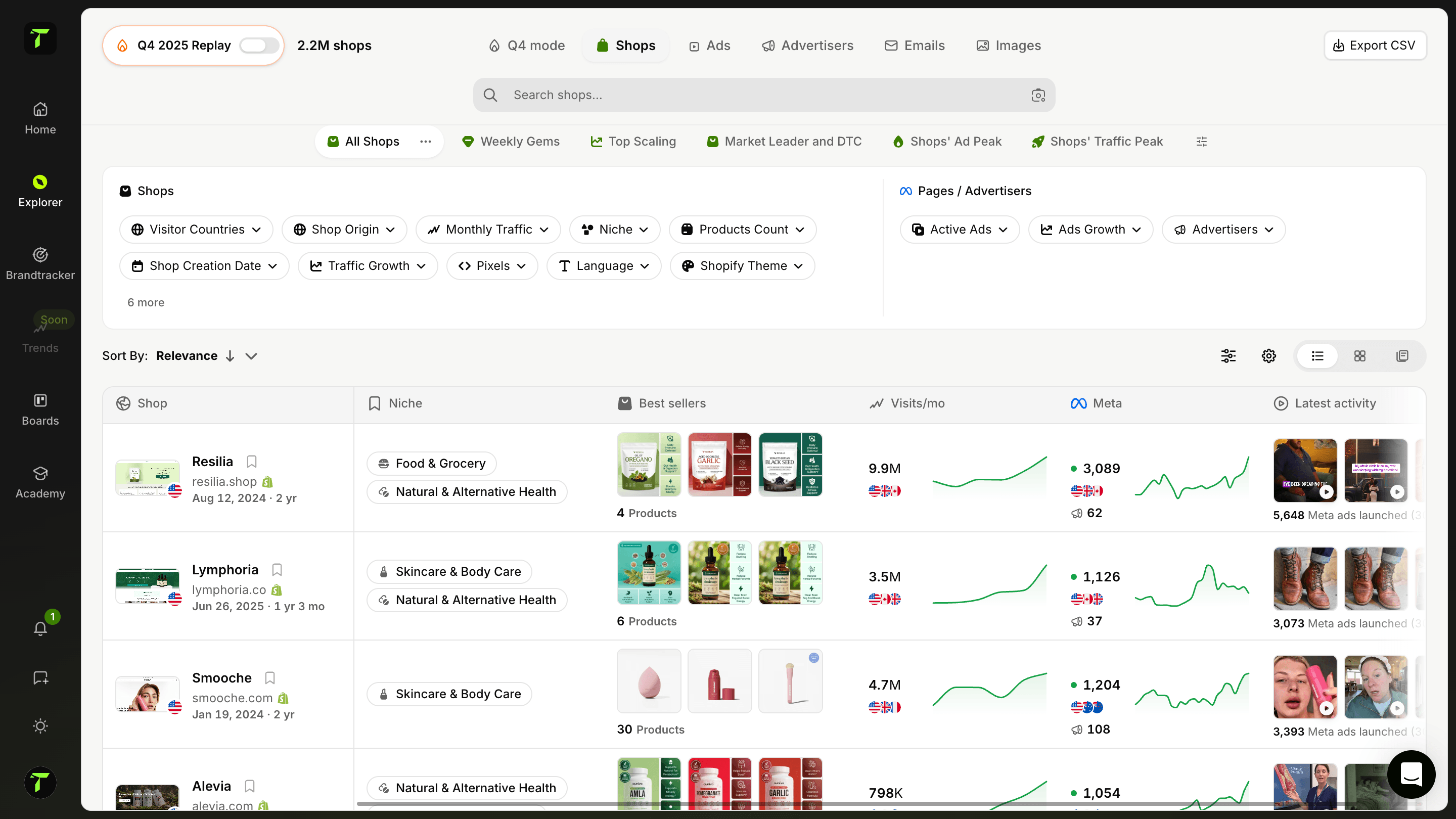
Most Halloween product lists published at this time of year rest on intuition or recycle the same costume ideas from previous seasons. We took a different approach. We queried Trendtrack's MCP directly, pulling live data on active ad counts, monthly traffic and 30-day growth across hundreds of thousands of brand profiles, then isolated the categories where advertisers are genuinely scaling right now.
The signals point somewhere unexpected. The single heaviest advertising investment in our extraction sits in decorative florals, with one brand running 1,543 active ads on an artificial flower set priced at 29.99 pounds. Gothic and seasonal decor absorbs far more budget than costumes themselves.
Countdown products show the strongest mainstream pull, with a Halloween countdown book at 2.99 dollars backed by 983 active ads, 11% traffic growth and over 5.5 million monthly visits. Cosplay wigs form a dense cluster across multiple brands, one holding 168 ads with 10% growth. Coloured contact lenses appear with 46 active ads on an 8 dollar product, a category almost entirely driven by this one night of the year.
Autumn candles sustain 201 ads at 32 dollars, DIY craft products post 24% growth at 7 euros, and statement costumes hold steady at 59 dollars with substantial traffic behind them.
What unites these seven is speed to market. Every category here is light, compact, non-perishable and sourceable without a three-month production run. That matters enormously when you have four weeks rather than four months.
One caveat before the ranking. Picking the product is the starting point, not the strategy. What determines your result is knowing which creatives and offers competitors are already scaling in that category, which you can check before committing a single euro of ad spend.
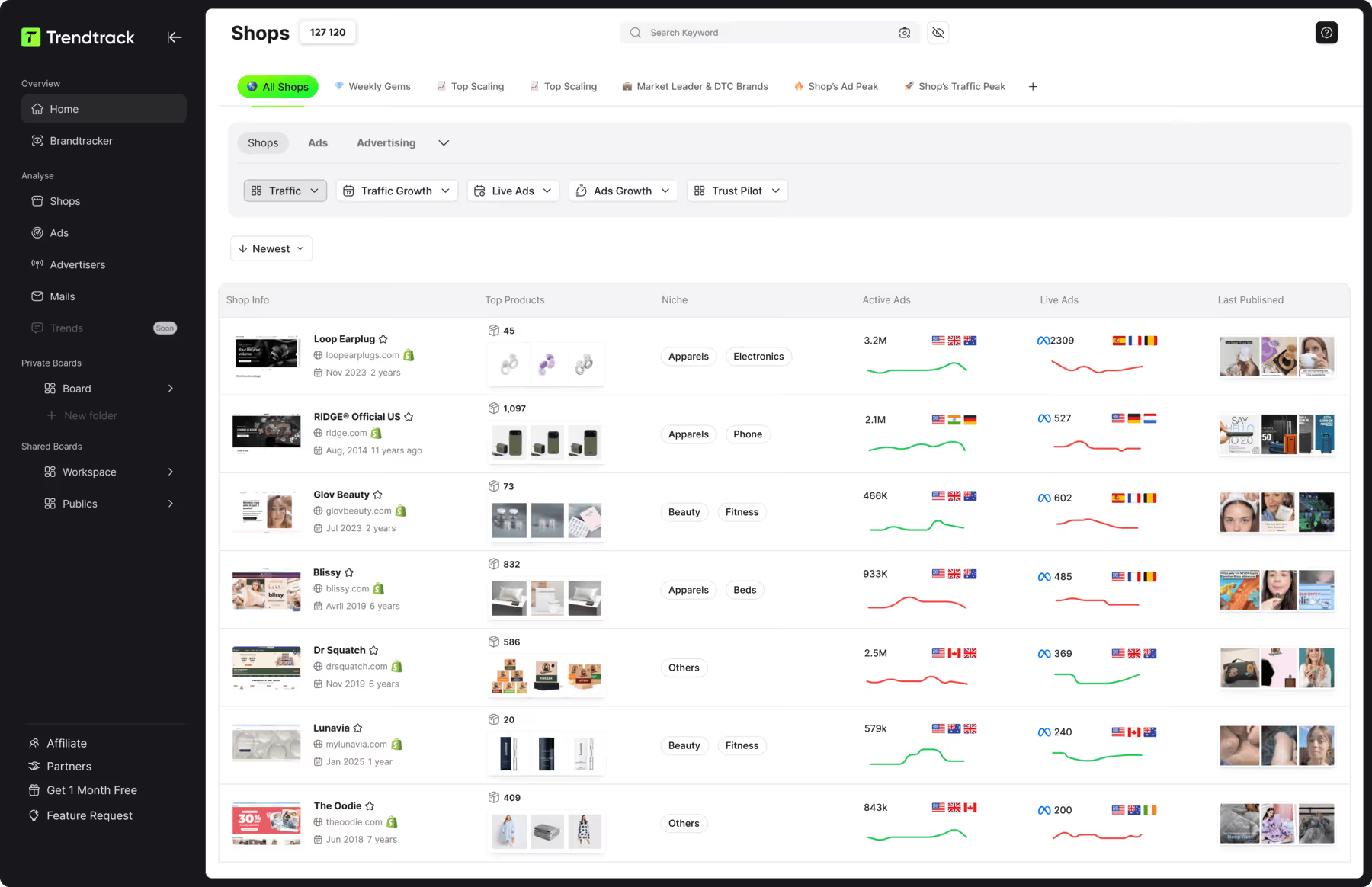
Trendtrack available at app.trendtrack.io/en/sign-up indexes 95 million TikToks and refreshes 700,000+ brand profiles every 24 hours, with full ad history preserved and an MCP integration connecting all of it to Claude or ChatGPT.
In this article we reveal the top 7 winning products to launch for Halloween 2026.
1. Coloured Contact Lenses

Coloured contact lenses top this ranking because no other product transforms a costume so completely for so little money. A full costume costs fifty dollars and reads as a costume. A pair of lenses costs ten and makes someone genuinely unsettling to look at.
Our Trendtrack data shows a brand running 46 active ads on a single lens pack priced at 8.02 dollars, drawing close to 232,000 monthly visits. The ad count looks modest against other categories in this ranking, and that is precisely the point: it signals a category where demand exists and competitive pressure has not yet saturated the space.
The economics are the strongest in this entire list. Cosmetic lenses source between 1 and 3 dollars per pair and retail between 10 and 30 dollars, which puts gross margin regularly above 80%. On a product weighing a few grams that ships in a padded envelope for under two euros, almost nothing erodes that margin.
The logistics are equally favourable. Lenses are tiny, light, non-fragile and have long shelf lives when stored properly. You can hold meaningful inventory in a drawer rather than a warehouse, which matters when you are launching four weeks out with limited capital.
The marketing writes itself. This product performs exceptionally well on short-form video because the transformation is instant and visual. A before-and-after clip lasting eight seconds communicates the entire value proposition without a word of explanation, which is exactly the format TikTok and Reels reward.
Demand is also highly concentrated and predictable. Searches spike sharply through October and collapse in November, which sounds like a drawback until you realise it means competition thins dramatically outside the window while buying intent inside it is extraordinarily high.
Two constraints require genuine attention.
Regulation is the serious one. Cosmetic contact lenses are classified as medical devices in the European Union, the United Kingdom and the United States. Selling them means meeting CE marking or FDA requirements, sourcing from certified manufacturers and providing proper usage and hygiene instructions. This is not a category where you source from an unverified supplier and hope. Verify your compliance obligations before ordering anything.
Timing is tight. With four weeks remaining, work with suppliers who can ship within days rather than placing an overseas order that arrives in November.
The angle that works is character specificity rather than generic colour packs: lenses tied to a recognisable look, sold as part of a complete transformation.
To see which creatives competitors are scaling in this category, Trendtrack available at app.trendtrack.io/en/sign-up reveals their full ad history.
2. Cosplay and Character Wigs

Cosplay wigs rank second because our data shows something unusual: not one dominant brand but a dense cluster of specialists all sustaining activity simultaneously. That pattern signals a market large enough to support multiple players rather than one winner taking everything.
The figures bear this out. One brand runs 168 active ads with 10% traffic growth over thirty days on a character wig priced around 7,430 yen. Another draws over 909,000 monthly visits on a wig retailing at 11 dollars. A third holds more than 212,000 monthly visits on a 17.10 dollar product.
That price spread between 11 and 50 dollars for comparable items reveals the category's defining quality. Wigs are not a commodity, they are a character. A generic black wig sells for ten dollars. The same wig sold as a specific recognisable look sells for thirty, and buyers pay the difference without hesitation.
The economics work well. Synthetic wigs source between 3 and 8 dollars and retail between 20 and 45 dollars, giving margins consistently above 70%. Compact, light and non-fragile, they ship cheaply and store easily.
What makes this category genuinely interesting is that demand extends well beyond Halloween. Conventions, cosplay communities, drag performance, theatre and content creation all sustain purchases year-round. Where coloured lenses collapse in November, wigs keep selling. You are launching into a seasonal peak within a market that continues afterwards, which changes the value of every customer you acquire this month.
The visual appeal suits short-form content perfectly. A transformation clip showing someone becoming a recognisable character performs reliably, and the cosplay community produces enormous volumes of organic content you can tap into rather than create from scratch.
Three constraints deserve attention.
Quality is visible immediately. A cheap wig looks cheap on camera, and this audience is discerning. Buyers compare fibre quality, cap construction and styling retention. A single poorly chosen supplier generates returns and reviews that outlast the season.
Licensing requires care. Selling a wig described as a specific copyrighted character carries intellectual property risk. Describe the product by its physical attributes rather than by a protected name.
Sizing and fit generate more support questions than you expect, so clear guidance reduces your post-purchase workload considerably.
The angle that works is depth within a fandom rather than breadth across many. A store serving one community credibly outperforms a generic catalogue every time.
3. Gothic and Seasonal Decorative Florals

This category carries the single heaviest advertising investment in our entire extraction, and it is the one most people would never guess. One brand runs 1,543 active ads on an artificial flower set priced at 29.99 pounds. That is more than fifteen times the ad volume behind the costume products in the same dataset.
A second brand in the category shows 16% traffic growth on an artificial fern priced at 19.98 dollars, and a third sustains 201 ads on a seasonal candle at 32 dollars.
The lesson is worth stating plainly. Most Halloween spending goes on atmosphere rather than on costumes. A costume is worn once by one person. Decor fills a house, gets photographed, appears in content and is bought in multiples. The buying behaviour is fundamentally different and considerably more profitable.
Artificial florals specifically occupy a sweet spot. Dark roses, dried-look arrangements, black and burgundy stems and gothic foliage carry an aesthetic that reads as seasonal in October and simply as interior design the rest of the year. Your inventory does not expire on November 1st, which is the single biggest risk in seasonal e-commerce.
The economics are solid. Artificial stems source between 2 and 8 dollars per bundle and retail between 20 and 40 dollars, giving margins around 70%. More importantly, this category drives multiple-unit orders naturally. Nobody buys one stem. A buyer decorating a mantelpiece takes three bundles, which lifts your average order value without additional acquisition cost.
The visual potential is exceptional. Decor photographs beautifully, performs strongly on Pinterest and Instagram, and generates abundant user content as buyers share their finished arrangements. That organic reach compounds in a way costume products rarely achieve.
Two constraints require planning.
Logistics are the weak point. Florals are bulky relative to their weight, which pushes shipments into higher volumetric weight brackets. Calculate your real shipping cost before setting your price rather than discovering it on your first fulfilment run. Flat-packing and compressible arrangements help considerably.
Perceived quality matters at this price. A buyer paying thirty pounds for artificial flowers returns anything that looks plastic in daylight. Source carefully and photograph honestly, because the gap between listing photos and reality drives returns in this category more than any other.
The angle that works is a defined aesthetic rather than a generic catalogue. A coherent gothic, dark academia or autumnal collection sells the whole arrangement, which is precisely what raises basket size.
4. Halloween Countdown Products
.jpeg)
This category shows the strongest mainstream pull in our entire extraction, and the numbers explain why. One brand runs 983 active ads on a Halloween countdown book priced at just 2.99 dollars, drawing over 5.5 million monthly visits with 11% traffic growth over thirty days.
A three dollar product sustaining nearly a thousand active creatives tells you something specific: the volume is enormous. Nobody funds that advertising weight on a three dollar item unless the sell-through rate is exceptional.
The mechanic behind it is borrowed directly from Christmas advent calendars, and it works for the same reason. A countdown turns a single-day event into a month-long ritual. Instead of buying one costume for one night, families engage with the season across thirty days, which multiplies both the emotional investment and the purchase opportunity.
That shift matters commercially. Countdown products are bought in early October rather than late, which means this category is already selling while costume demand has barely started. With four weeks remaining, that timing works in your favour rather than against it.
The format range is wide. Countdown books, advent-style boxes filled with small items, daily activity cards, treat calendars and sticker collections all fit the mechanic. The common thread is a numbered sequence of small, cheap components packaged as a single experience.
The economics depend on your approach. A countdown book is a printed product with margins above 70% and near-zero fulfilment complexity. A filled advent box costs more to assemble but commands 25 to 50 dollars, which absorbs acquisition costs far more comfortably than a three dollar item.
The audience is also the broadest in this ranking. This category sells to families with young children, a demographic that spends readily on seasonal experiences and buys repeatedly year after year. Acquiring that customer in October 2026 means a likely repeat purchase in 2027.
Two constraints matter.
The selling window is narrow and front-loaded. A countdown product sold on October 20 has lost most of its purpose. Your realistic window closes around mid-October, which makes this the most time-sensitive category in this list.
Assembly is labour-intensive for filled formats. Thirty compartments filled by hand across hundreds of orders consumes considerable time. Printed or digital formats avoid this entirely and remain viable on short notice.
The angle that works is a defined theme rather than generic spookiness: a story that unfolds, a character arc, a daily challenge. That narrative is what justifies the purchase over a bag of sweets.
5. Autumn Scented Candles

Candles rank fifth because they sell a season rather than a single night, and that distinction changes their commercial profile entirely.
Our data shows a brand running 201 active ads on an autumn-scented candle priced at 32 dollars. The ad count is moderate compared to decorative florals, but the price point tells the more interesting story: thirty-two dollars for a candle is premium positioning, and it holds.
That price is only possible because candles sell atmosphere rather than function. Nobody needs a candle. People buy the feeling of a particular season in their home, which is why naming and framing matter more here than in almost any other category. A product called "vanilla candle" sells for twelve dollars. The same wax sold as a specific autumn mood sells for thirty.
The economics follow accordingly. A quality candle costs between 4 and 10 dollars to produce or source, retailing between 25 and 40 dollars, giving margins consistently above 70%. More importantly, candles drive multiple-unit purchases naturally, since buyers scenting a home take two or three rather than one.
The seasonal profile is their real advantage in this ranking. Where costumes and lenses collapse on November 1st, autumn candles sell steadily from September through December, bridging Halloween into the Christmas gifting season without a break. Your October inventory does not become dead stock, it becomes November gift stock.
They also function as an excellent gift, which widens your audience considerably. A candle requires no sizing, no taste judgment and no knowledge of the recipient's preferences, which is exactly what makes gifting categories work.
Three constraints deserve attention.
Shipping is the weak point. Candles are heavy relative to their value and fragile in transit. Glass breaks, wax cracks in cold weather, and a damaged delivery costs you the product plus the return. Budget properly for protective packaging and factor shipping into your price before launch rather than after.
Scent cannot be photographed, which makes this category uniquely dependent on copy. Your description does the selling that images do elsewhere, so invest in evocative, specific writing rather than ingredient lists.
Regulatory requirements apply in the European Union, where candles require CLP labelling on allergens and safety warnings. Verify your supplier provides compliant labelling before ordering.
The angle that works is a named, specific scent world rather than a generic autumn range. Buyers remember and repurchase a scent with an identity, which is what builds a candle brand beyond one season.
6. Statement Costume Pieces
Costumes rank sixth rather than first, and that placement is deliberate. Our data shows a brand sustaining 100 active ads on a costume priced at 59 dollars with 2.7 million monthly visits, which is respectable but sits well below the advertising weight behind decor and countdown products in the same extraction.
The reason is instructive. The generic costume market is brutally competitive and dominated by established retailers with supply chains, warehousing and brand recognition you cannot match in four weeks. Competing on a vampire cape or a witch outfit means fighting on price against businesses structured to win that fight.
The viable path is the one that 59 dollar figure points toward: statement pieces rather than complete costumes.
A statement piece is a single standout item that transforms an outfit the buyer already owns. A dramatic cape, an elaborate mask, a pair of wings, an ornate collar, oversized jewellery, a character-defining accessory. The buyer supplies the base, you supply the element that makes it work.
This approach solves several problems simultaneously. Sizing becomes nearly irrelevant, which removes the main source of returns in apparel. Inventory complexity collapses since you hold one version rather than five sizes. And your margin improves because a distinctive accessory commands a price unrelated to its material cost.
The economics reflect this. Statement pieces source between 5 and 15 dollars and retail between 35 and 70 dollars, giving margins around 75%. The 59 dollar price point in our data sits comfortably in that range.
The marketing advantage is substantial too. A statement piece is inherently visual, which makes short-form video straightforward. A transformation clip showing a plain outfit becoming a character communicates the entire proposition in seconds, and that format consistently outperforms static product photography on TikTok and Reels.
Three constraints require planning.
The selling window is the tightest in this ranking. Costume purchases concentrate heavily in the final two weeks of October, which means your delivery promise becomes a conversion factor. A product arriving November 2nd is worthless, and the review that follows is damaging.
Quality shows under photography. Buyers post their costumes, which means anything that looks cheap on camera generates visible disappointment rather than quiet dissatisfaction.
Intellectual property applies to recognisable characters. Describe products by their visual attributes rather than by protected names.
The angle that works is a defined aesthetic rather than a broad catalogue: gothic, baroque, creature, ethereal. Buyers searching an aesthetic convert far better than buyers browsing costumes generally.
7. DIY and Craft Kits
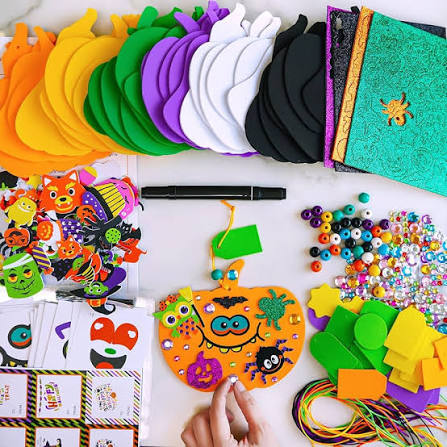
This category closes the ranking and shows the strongest growth signal of the entire extraction. A brand selling a DIY decorating product at 7 euros posts 24% traffic growth over thirty days with 131 active ads and over 2.4 million monthly visits.
Twenty-four percent growth on a seven euro item is a specific kind of signal. It indicates a category gaining momentum rather than one simply holding steady, which matters when you are entering with four weeks on the clock.
The mechanic behind DIY products differs fundamentally from everything else in this list. You are not selling a finished object, you are selling an activity. A pumpkin carving kit, a mask painting set, a decorate-your-own treat bag, a craft bundle for a Halloween party. The value sits in the experience rather than in the materials, which is precisely why margins hold despite low component costs.
That framing unlocks pricing freedom. A bag of craft supplies is worth five dollars. The same supplies packaged as a complete themed activity with instructions and a clear outcome sells for twenty-five, and buyers do not compare it to raw materials because they are not buying materials.
The audience is also the broadest in this ranking. Parents organising a party, teachers running classroom activities, hosts preparing a gathering, couples looking for a weekend project. That breadth gives you considerably more targeting options than a costume product aimed at one demographic.
The economics work well. Components source between 2 and 6 dollars and kits retail between 20 and 35 dollars, with margins around 75%. The logistics are favourable too: craft components are light, non-fragile, non-perishable and easy to pack flat.
Two further advantages deserve mention. DIY kits generate exceptional user content, since buyers photograph what they made rather than what they bought. And they bridge beyond Halloween naturally, with Christmas craft kits following immediately on the same audience and the same supply chain.
Three constraints require attention.
Assembly is labour-intensive. Packing twenty components into a box by hand across hundreds of orders consumes real time. Design your kit around the fewest components that still deliver the experience.
Instructions are part of the product. A kit with unclear guidance produces a frustrated buyer and a negative review, so budget for proper printed or digital instructions.
Safety matters for anything aimed at children, with age labelling and non-toxic materials required rather than optional in most markets.
The angle that works is a defined outcome rather than a bag of supplies: show exactly what the buyer will have made when they finish.
Useful Sources:

.avif)
Ready to build a million-dollar brand?
.avif)