ShipBob Review 2026: Pricing, Features



ShipBob appears on nearly every 3PL shortlist, and for good reason. Whether it fits your business depends on numbers that rarely make it onto the pricing page. So how good is ShipBob?
Start with the footprint, since it explains the positioning.
Over 60 fulfillment centers across the United States, Canada, the United Kingdom, the European Union and Australia. That network enables distributed inventory and two-day ground delivery across most of the US.
For a DTC brand shipping lightweight goods on Shopify, that reach is the strongest argument available in this category.
Now the pricing, and this is where most reviews stop too early.
Fulfillment starts around $5.00 for the first item picked and packed, plus $0.75 to $1.00 per additional item. Storage runs $5 to $40 per pallet monthly, with receiving at roughly $25 per hour.
Three costs deserve attention before you sign.
A $275 monthly minimum, which applies regardless of your volume.
Implementation starting at $975, absent from the headline pricing.
A 15 to 30% shipping rate markup, plus a 3% credit card surcharge on every invoice.
That last pair matters more than the per-order rate. A merchant comparing ShipBob on pick-and-pack alone will underestimate the total by a meaningful margin.
One structural note worth knowing. ShipBob operates partly as a 4PL, coordinating through partner warehouses rather than owning every facility, which can mean less direct control over daily operations.
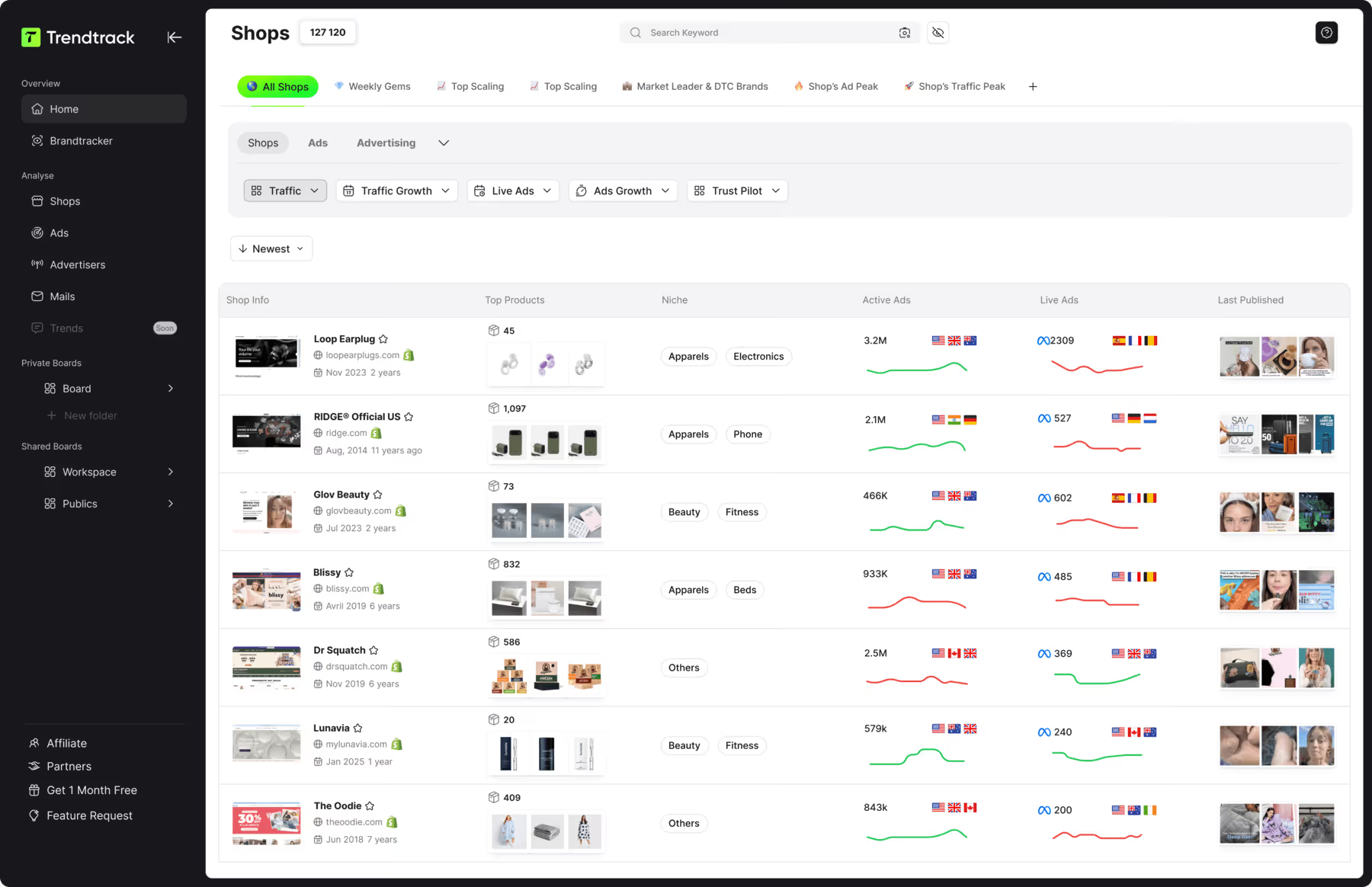
Before choosing any 3PL comes the decision upstream of it. At Trendtrack available at app.trendtrack.io/en/sign-up, we index 95 million TikToks and refresh 700,000+ brand profiles every 24 hours.
In this article we break down the features, the real cost and who ShipBob suits.
What Is ShipBob?
ShipBob is a third-party logistics provider built for direct-to-consumer ecommerce brands, combining a fulfillment network with a software layer.
That combination defines the product. Where a traditional 3PL stores and ships, ShipBob adds inventory management, order routing and analytics into a single dashboard.
The network is its defining asset. Over 60 fulfillment centers across the United States, Canada, the United Kingdom, the European Union and Australia.
That footprint enables distributed inventory, meaning you split stock across several locations so orders ship from the facility closest to the customer.
The practical effect is two-day ground delivery across most of the US without you operating a single warehouse.
One structural detail distinguishes ShipBob from providers that own everything they operate.
The company works partly as a 4PL, coordinating through partner warehouses alongside its own facilities. That model accelerated its geographic expansion considerably.
The trade-off is less direct control over daily execution, since performance depends on partners rather than solely on ShipBob’s own operations.
The target customer is specific. DTC brands shipping lightweight parcels, typically between 100 and 1,000 orders monthly, selling on Shopify or a comparable platform.
Heavy goods, oversized items and fragile products sit outside the positioning.
Integrations cover the major ecommerce platforms and marketplaces: Shopify, WooCommerce, BigCommerce, Amazon, eBay and others, with pre-built connections rather than custom development.
Beyond standard fulfillment, the platform supports B2B and retail distribution, kitting, and Amazon FBA preparation, which matters for brands running multiple channels.
One clarification for anyone comparing options: ShipBob charges a monthly platform minimum alongside per-order fees, which several competitors do not.
What Are ShipBob’s Main Features?
Six capabilities define the platform, and the first two explain its market position.
Distributed inventory
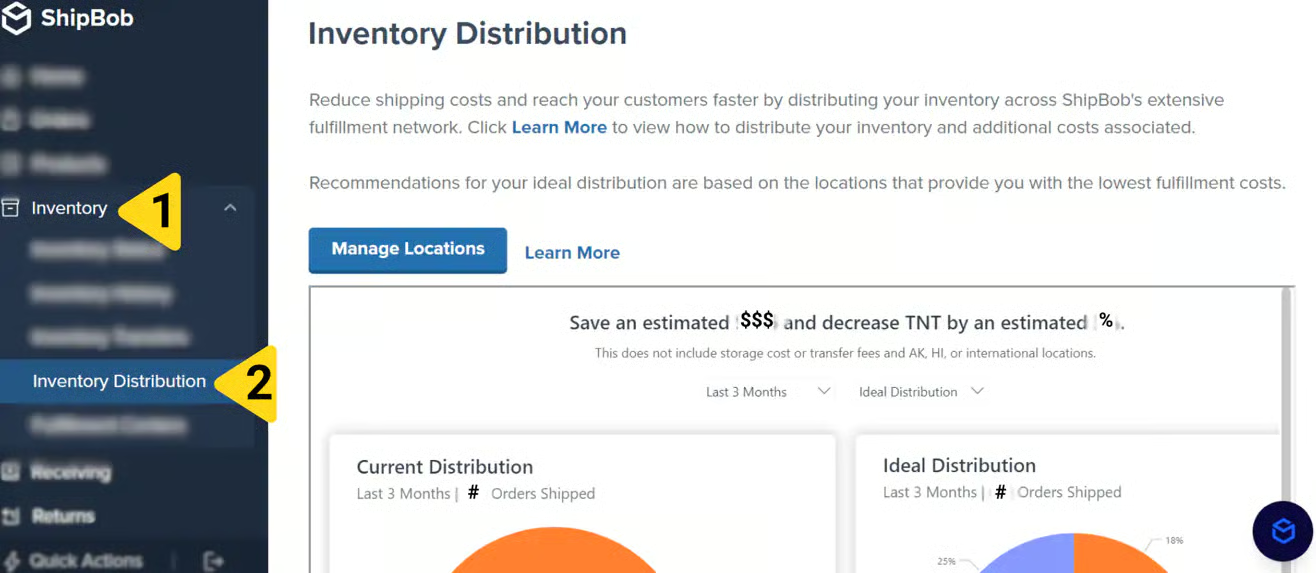
The strongest argument ShipBob offers.
You split stock across multiple fulfillment centers, and orders ship from the facility nearest the customer.
Two outcomes follow. Delivery times shorten without you operating warehouses, and shipping costs drop since parcels travel shorter distances through cheaper zones.
The trade-off is inventory fragmentation. The same SKU across five locations complicates forecasting, and a stockout in one region while another holds surplus is a real operational problem.
Two-day ground delivery

ShipBob markets two-day coverage across most of the US, achieved through distributed inventory rather than express shipping.
That distinction matters commercially. You offer competitive delivery at ground rates instead of paying air freight premiums, which is what makes the promise sustainable.
The merchant dashboard
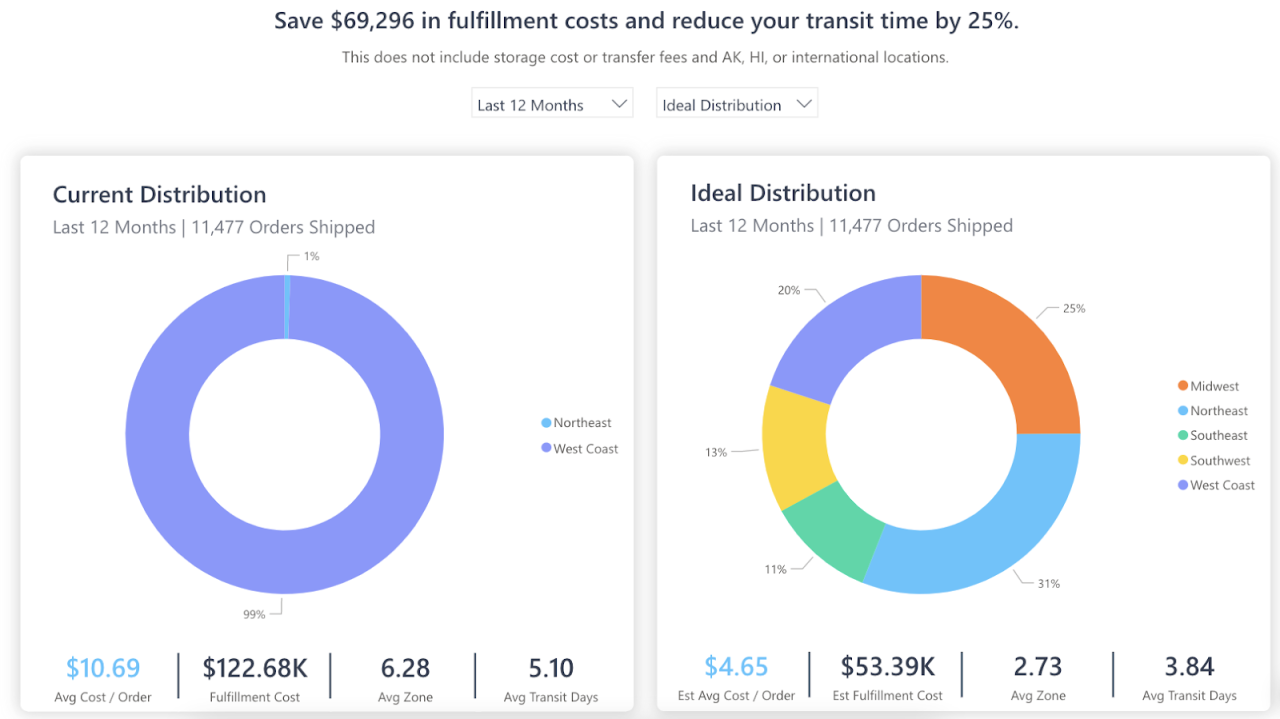
Inventory levels, order status, shipping performance and fulfillment costs sit in one interface.
The analytics layer goes further than most 3PLs provide, with data on fulfillment speed, shipping spend by zone and inventory turnover.
For operators used to requesting reports from a warehouse, having it continuously available changes how decisions get made.
Multi-channel fulfillment
Pre-built integrations connect Shopify, WooCommerce, BigCommerce, Amazon, eBay and other platforms without custom development.
Orders flow in automatically from every channel into one fulfillment queue, which removes the reconciliation work multi-channel sellers otherwise carry.
B2B and retail distribution
Beyond DTC parcels, ShipBob handles wholesale orders, retail distribution and Amazon FBA preparation.
That breadth matters for brands selling direct and through retail simultaneously, since running two fulfillment relationships doubles your coordination burden.
Kitting and assembly are also supported, covering bundles and subscription boxes.
Returns processing
Returns are handled through the same platform, with items inspected and restocked where condition allows.
This is the function merchants evaluate last and regret underestimating, since returns volume scales directly with growth.
One note across the feature set: everything above assumes standard parcel dimensions. Heavy, oversized or fragile goods fall outside ShipBob’s operational design
How Much Does ShipBob Cost?
ShipBob does not publish a rate card. Pricing is quoted individually, and you request it through a form on their site.
That opacity is standard in the 3PL category, and it is also where comparison becomes difficult.
What you can establish before the quote are the reported ranges.
Fulfillment runs around $5.00 for the first item picked and packed, plus $0.75 to $1.00 per additional item in the same order.
Storage falls between $5 and $40 per pallet monthly, depending on location and volume.
Receiving is billed at roughly $25 per hour of warehouse labor.
Three costs matter more than those rates, and none appear on the pricing page.
A $275 monthly minimum applies regardless of your volume, which means low-volume months cost the same as busy ones.
Implementation starts at $975, charged before you ship a single order.
A 15 to 30% markup on shipping rates, plus a 3% credit card surcharge on every invoice.
That last pair is where most comparisons break down. A merchant evaluating ShipBob on pick-and-pack alone will underestimate the total by a substantial margin, since shipping is typically your largest fulfillment line.
Three questions to ask when you request your quote.
What is the shipping markup specifically? Are there reserve or minimum volume clauses? What are the exit terms and notice period?
Compare on total cost per order fulfilled, never on individual line items.
What Are ShipBob’s Limitations?
Several constraints deserve weighing before you commit.
No published pricing, quote required for every comparison
A $275 monthly minimum regardless of volume
Implementation from $975, absent from headline pricing
A 15 to 30% shipping markup on carrier rates
A 3% credit card surcharge on every invoice
Partial 4PL model, with less control over partner warehouses
Standard parcels only, heavy and oversized goods excluded
Inventory fragmentation across distributed locations
Inconsistent performance reported between facilities
Among these, the shipping markup causes the most underestimation, and the reason is structural.
Shipping is typically your largest fulfillment line, larger than pick and pack and storage combined.
A merchant comparing providers on per-order rates while ignoring a 15 to 30% uplift on the biggest cost component will reach the wrong conclusion. Ask for the markup explicitly and model it against your actual parcel mix.
The 4PL element deserves equal attention, since it is rarely discussed.
ShipBob coordinates through partner warehouses alongside its own facilities, which accelerated its geographic expansion considerably.
The consequence appears in merchant reviews: performance varies by location. Your experience depends partly on which facility handles your inventory, and you have limited influence over that.
Ask which specific centers would serve you, and request performance data for those rather than network averages.
Inventory fragmentation is the operational cost of distributed stock. The same SKU across five locations complicates forecasting, and a stockout in one region while another holds surplus is a recurring frustration.
Product fit closes the list. ShipBob is built for standard DTC parcels. Heavy items, oversized goods and fragile products belong with a specialist.
Conclusion: ShipBob Review
ShipBob is a strong provider with costs that hide below the surface, and both halves of that sentence should guide your decision.
What it does well is clear. Over 60 fulfillment centers across five countries enable distributed inventory and two-day ground delivery across most of the US, without you operating a single warehouse.
The analytics layer exceeds what most 3PLs provide, and the multi-channel integrations remove reconciliation work for brands selling across Shopify, Amazon and retail simultaneously.
For a lightweight DTC brand shipping standard parcels at consistent volume, that combination is difficult to match.
The costs deserve equal attention, since ShipBob publishes no rate card.
Fulfillment runs around $5.00 for the first item plus $0.75 to $1.00 per additional one, with storage at $5 to $40 per pallet and receiving near $25 per hour.
Three charges matter more and appear on no pricing page. A $275 monthly minimum, implementation from $975, and a 15 to 30% shipping markup alongside a 3% credit card surcharge.
That last pair causes the most underestimation. Shipping is typically your largest fulfillment line, and a merchant comparing providers on pick-and-pack alone reaches the wrong conclusion.
Two structural points close the assessment.
The partial 4PL model means partner warehouses handle some inventory, and merchant reports show performance varying by facility. Ask which centers would serve you and request their specific data.
Product fit disqualifies heavy, oversized and fragile goods regardless of everything above.
When you request your quote, ask three questions: what is the shipping markup, are there reserve clauses, and what are the exit terms?
Compare on total cost per order fulfilled, never on line items.
One decision sits upstream of any provider choice. Your product determines which 3PL fits, and no fulfillment partner corrects a mismatch between what you sell and who stores it.
At Trendtrack available at app.trendtrack.io/en/sign-up, we index 95 million TikToks and refresh 700,000+ brand profiles every 24 hours.
Useful Resources


Ready to build a million-dollar brand?