Organic Search vs. Paid Search: Where Should You Invest For Your E-commerce site?



In e-commerce, traffic is the lifeblood of your business. Without visibility, even the best products won’t sell. But when it comes to acquiring that traffic, every entrepreneur faces the same question: should you invest in organic search (SEO) or paid search (SEA)?
On one side, organic search offers long-term growth. By ranking your product pages and content on Google, you can generate consistent, free traffic without paying for every click. On the other side, paid search allows you to appear instantly at the top of search results, giving you immediate visibility and faster results but at a cost.
The challenge is that both channels have their advantages, limitations, and strategic roles. Some brands rely heavily on paid ads to scale quickly, while others build sustainable growth through SEO. In reality, the most successful e-commerce businesses understand how to balance both.
Choosing where to invest is not just a matter of budget. It depends on your stage of growth, competition, margins, and long-term vision. Investing in the wrong channel or at the wrong time can slow down your growth or reduce your profitability.
In this guide, we’ll break down the differences between organic search and paid search, explore their strengths and weaknesses, and help you understand where you should invest to maximize your e-commerce performance.
What Is Organic Search in E-Commerce?
In e-commerce, organic search refers to the traffic that comes to your online store through unpaid search engine results. When a user types a query on Google and clicks on a non-sponsored result, that visit is considered organic traffic.
Unlike paid search, where you pay for each click, organic search relies on Search Engine Optimization (SEO) to rank your website, product pages, and content higher in search results. The goal is simple: appear in front of your ideal customers when they are actively searching for products or information related to your niche.
Organic search is one of the most powerful acquisition channels in e-commerce because it allows you to generate consistent and scalable traffic without paying for every visitor.
At the core of organic search lies the concept of keywords. These are the words and phrases users type into search engines. By optimizing your website around relevant keywords, you increase your chances of appearing in search results.
For example, if you sell running shoes, you might want to rank for keywords such as “best running shoes for beginners” or “men’s black running shoes.” When your pages are properly optimized, search engines understand their relevance and display them to users searching for those terms.
Organic search in e-commerce is not limited to product pages. It also includes:
Category pages (e.g., “men’s sneakers”)
Blog content (e.g., buying guides, comparisons, tips)
Landing pages optimized for specific keywords
This multi-layered approach allows you to capture traffic at different stages of the customer journey, from information gathering to purchase intent.
One of the biggest advantages of organic search is its ability to generate high-intent traffic. Users who search for specific product-related queries are often already interested in buying. This means that organic traffic can lead to higher conversion rates compared to more passive acquisition channels.
For example, someone searching “buy black leather couch online” is much closer to making a purchase than someone scrolling through social media. By ranking for this type of keyword, you attract users who are actively looking for your product.
Another key strength of organic search is its long-term impact. Unlike paid ads, which stop generating traffic as soon as you stop spending, SEO continues to drive traffic over time. A well-optimized product page or blog article can generate visits for months or even years.
This makes organic search a high-leverage channel. The effort you invest today can continue to produce results long after the initial work is done.
However, organic search also requires time and consistency. Ranking on Google does not happen overnight. It involves optimizing your website structure, creating high-quality content, building backlinks, and continuously improving your pages.
This is why SEO is often considered a long-term investment rather than a quick-win strategy.
Another important aspect of organic search is trust and credibility. Users tend to trust organic results more than paid ads because they perceive them as more relevant and less promotional. Appearing at the top of organic results can therefore strengthen your brand’s authority and increase customer confidence.
Organic search also plays a key role in reducing customer acquisition costs. While SEO requires time and resources, it does not involve paying for each click. As your rankings improve, the cost per visitor decreases, making it one of the most cost-effective channels in the long run.
For e-commerce businesses, organic search is not just about traffic it’s about building a sustainable growth engine. By consistently ranking for relevant keywords, you create a steady flow of potential customers discovering your products naturally.
It is also important to note that organic search works best when combined with a broader strategy. For example, analyzing competitors, identifying trending products, and understanding market demand can significantly improve your SEO results.
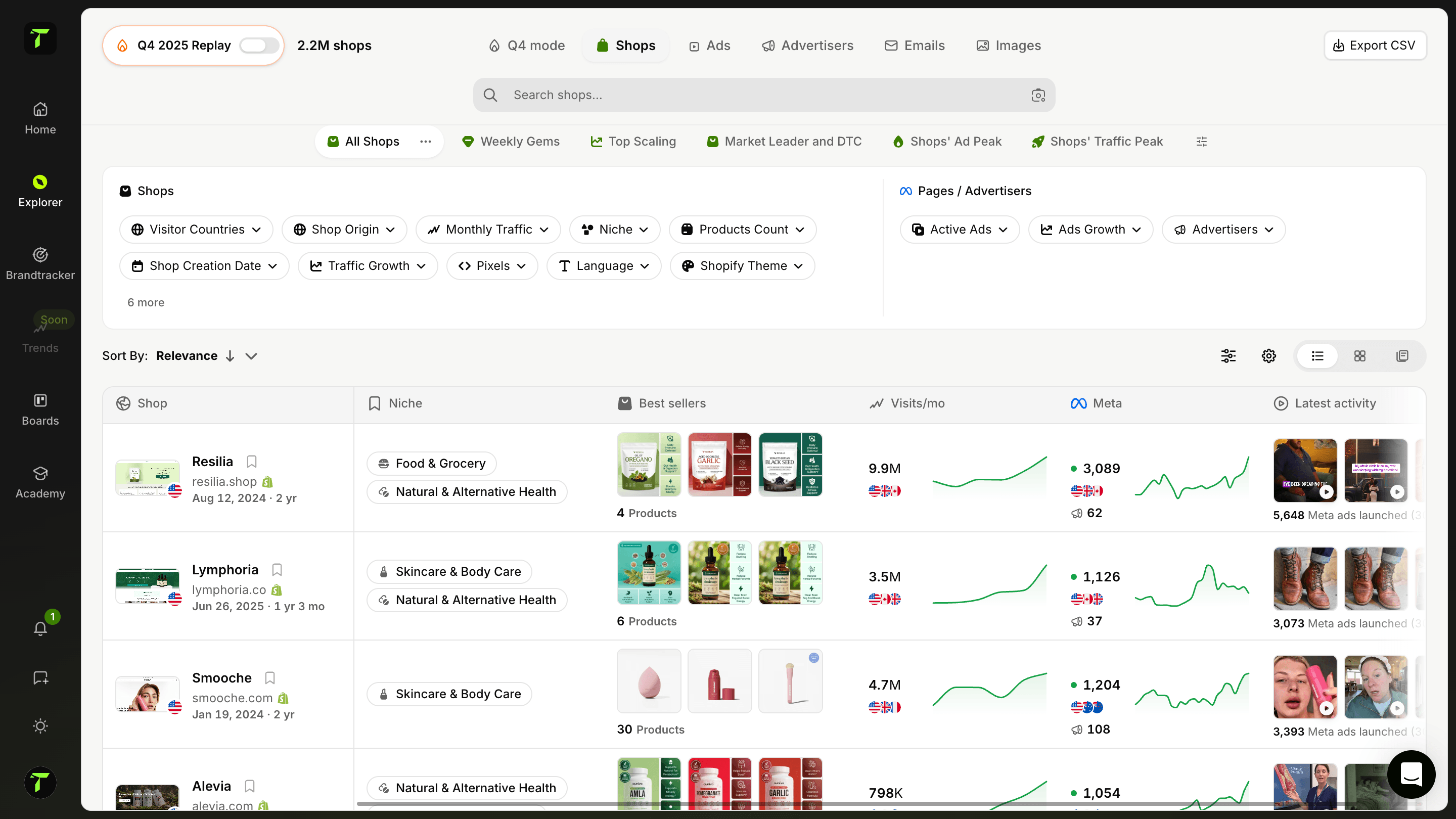
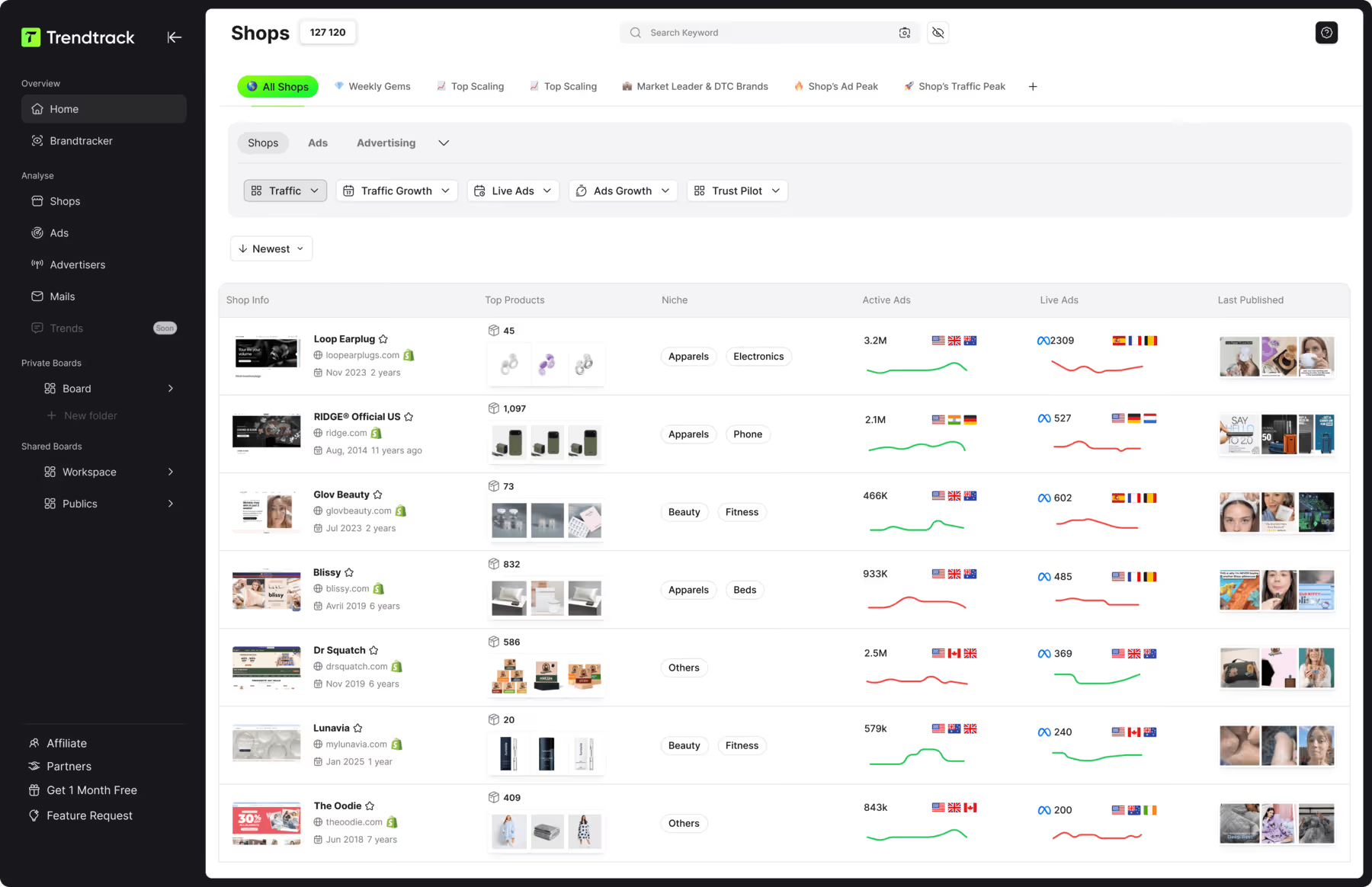
This is where tools like TrendTrack can complement your organic strategy. By identifying high-demand keywords, analyzing competitors, and uncovering market opportunities, you can optimize your SEO efforts more effectively and target the most valuable search queries.
Ultimately, organic search is one of the most powerful and scalable acquisition channels available to e-commerce businesses. It allows you to attract high-quality traffic, reduce dependency on paid advertising, and build long-term visibility in your market.
For any e-commerce brand aiming for sustainable growth, investing in organic search is not optional it’s essential.
What Is Paid Search (SEA) in E-Commerce?
In e-commerce, paid search (SEA – Search Engine Advertising) refers to all the traffic you acquire by paying to appear in search engine results. Unlike organic search, where your visibility depends on SEO, paid search allows you to position your products and pages instantly at the top of search results through advertising platforms like Google Ads.
When a user types a query such as “buy running shoes,” the first results they see are often sponsored listings. These are paid placements, and every time a user clicks on one of these ads, the advertiser pays a fee this is known as cost per click (CPC).
Paid search is one of the fastest ways to generate traffic and sales for an e-commerce store because it provides immediate visibility. As soon as your campaigns are live, your products can appear in front of users who are actively searching for what you sell.
At the heart of paid search is the concept of keyword bidding. Advertisers select keywords they want to target and bid on them. The higher your bid combined with the relevance and quality of your ad the more likely your ad is to appear in a top position.
However, it’s not just about bidding the highest amount. Platforms like Google Ads use a system that considers both your bid and your Quality Score, which is based on factors such as:
Ad relevance to the keyword
Click-through rate (CTR)
Landing page experience
This means that well-optimized campaigns can outperform competitors even with lower bids.
Paid search in e-commerce typically includes several types of campaigns:
Search ads, which appear in text format on search engine results pages
Shopping ads, which display product images, prices, and store names
Performance Max campaigns, which distribute ads across multiple Google channels
Among these, Google Shopping ads are particularly powerful for e-commerce because they showcase your products visually and attract users with strong purchase intent.
One of the biggest advantages of paid search is its ability to target high-intent users. Unlike social media ads, which interrupt users during browsing, search ads appear when users are actively looking for a product. This means the traffic generated through paid search often has a higher likelihood of converting.
For example, a user searching “buy black leather couch online” is already close to making a purchase. By appearing at the top of the results, your store can capture that demand immediately.
Another major strength of paid search is its scalability and control. You can:
Adjust your budget at any time
Target specific keywords, locations, and audiences
Test different ads and landing pages
Optimize campaigns based on real-time performance data
This level of control allows e-commerce businesses to quickly identify what works and scale profitable campaigns.
Paid search is also an excellent tool for testing products and markets. Before investing heavily in SEO or inventory, you can launch campaigns to validate demand for a product. If the campaign generates sales at a profitable cost, it confirms that the product has potential.
However, despite its advantages, paid search comes with a key limitation: it requires continuous investment. As soon as you stop spending, your traffic disappears. This makes it fundamentally different from organic search, where results can persist over time.
Another challenge is the increasing cost of advertising. In competitive niches, CPC can rise significantly, which reduces margins if campaigns are not optimized properly. This is why tracking metrics like ROAS (Return on Ad Spend) and conversion rate is essential.
Paid search also requires ongoing optimization. Launching campaigns is just the beginning you need to continuously refine your keyword targeting, ad creatives, and landing pages to maintain profitability.
To maximize the effectiveness of paid search, it’s important to combine it with a strong understanding of your market. Knowing which keywords convert, which products perform best, and how competitors position themselves can significantly improve campaign results.
This is where tools like TrendTrack can play a key role. By identifying high-demand keywords, analyzing competitors, and uncovering market trends, you can build more effective paid campaigns and reduce wasted ad spend.
Ultimately, paid search is a powerful acquisition channel for e-commerce businesses that want fast results, precise targeting, and scalable growth. It allows you to capture demand instantly and generate sales quickly.
However, to build a sustainable business, it should be used strategically often in combination with organic search to balance short-term performance with long-term growth.
Organic Search vs Paid Search: What Are the Key Differences?
When it comes to growing an e-commerce business, both organic search (SEO) and paid search (SEA) play a crucial role. However, they operate very differently and serve distinct purposes in a growth strategy. Understanding these differences is essential if you want to allocate your resources efficiently and maximize your profitability.
Organic Search (SEO)
Organic search is based on your ability to rank naturally on search engines without paying for clicks. It relies on optimizing your website, product pages, and content around relevant keywords so that search engines like Google understand your relevance and display your pages to users.
One of the biggest advantages of organic search is its long-term sustainability. Once your pages rank, they can generate traffic continuously without requiring direct payment for each visit. This makes SEO one of the most cost-efficient acquisition channels over time.
Organic search is particularly powerful for building brand authority and trust. Users tend to trust organic results more than ads because they perceive them as more authentic and less promotional. Appearing at the top of organic results signals credibility and expertise in your niche.
However, SEO requires time, consistency, and strategic execution. It often takes weeks or months to see significant results, especially in competitive markets. It involves content creation, technical optimization, and often link-building efforts.
In short, organic search is a long-term growth engine that compounds over time but requires patience and continuous optimization.
Paid Search (SEA)
Paid search, on the other hand, is based on advertising. You pay to appear at the top of search results through platforms like Google Ads. This allows you to generate traffic instantly as soon as your campaigns go live.
The main advantage of paid search is speed. Unlike SEO, you don’t need to wait for rankings to improve. You can immediately position your products in front of high-intent users who are actively searching for what you sell.
Paid search also offers a high level of control and flexibility. You can choose your keywords, adjust your budget, target specific audiences, and optimize campaigns in real time. This makes it ideal for testing new products, validating markets, or scaling quickly.
However, the main limitation of paid search is that it is dependent on budget. As soon as you stop spending, your visibility disappears. Additionally, in competitive niches, the cost per click can become expensive, which can impact profitability if campaigns are not optimized.
In essence, paid search is a short-term performance lever that delivers fast results but requires ongoing investment.
Key Differences Between Organic Search and Paid Search
To better understand how these two channels compare, here is a summary of their main differences:
| Criteria | Organic Search (SEO) | Paid Search (SEA) |
|---|---|---|
| Cost per click | Free (no direct cost per click) | Paid (CPC model) |
| Time to results | Slow (weeks to months) | Immediate |
| Sustainability | Long-term, compounding traffic | Stops when budget stops |
| Trust & credibility | High (perceived as more authentic) | Lower (ads are identified as sponsored) |
| Scalability | Gradual, requires effort | Fast and scalable with budget |
| Control | Limited (depends on algorithms) | High (full campaign control) |
| Testing capability | Slower to test | Fast testing and validation |
| ROI over time | Very high in the long run | Depends on campaign optimization |
Choosing Between SEO and SEA
The key takeaway is that organic search and paid search are not competitors they are complementary.
SEO helps you build a strong foundation and reduce your dependence on paid traffic over time. Paid search allows you to generate immediate results and test strategies quickly.
The most successful e-commerce businesses combine both approaches. They use paid search to capture demand quickly and validate opportunities, while investing in organic search to build a sustainable and scalable traffic source.
Understanding the differences between these two channels allows you to make smarter decisions about where to invest your time and budget.
When Should You Invest in Organic Search vs Paid Search for E-Commerce?
In e-commerce, the question is rarely whether you should choose organic search (SEO) or paid search (SEA). The real question is when and how to invest in each channel based on your business stage, resources, and objectives.
There is no universal answer, because the right strategy depends on several factors: your budget, your margins, your competition, and your growth ambitions. However, there are clear situations where one channel should be prioritized over the other.
When launching a new e-commerce store, paid search is often the most effective starting point. At this stage, your website has no authority, no SEO rankings, and no organic traffic. Relying on SEO alone would mean waiting months before seeing results.
Paid search allows you to generate traffic immediately. You can test your product, validate demand, and understand whether your offer resonates with your target audience. It also helps you collect valuable data, such as which keywords convert best, which products perform, and what your customer acquisition cost looks like.
This phase is crucial because it reduces uncertainty. Instead of guessing whether a product will work, you can quickly determine if your business model is viable.
However, investing in paid search does not mean spending blindly. One of the smartest approaches is to run testing campaigns. You launch ads with a controlled budget, analyze performance, and calculate whether your campaigns are profitable.
Key questions to ask during this phase include:
What is my average cost per click (CPC)?
What is my conversion rate?
Am I profitable after advertising costs?
If your campaigns are profitable, you can scale them. If not, you need to adjust your product, pricing, or offer.
On the other hand, organic search becomes increasingly important as your business grows. Once you have validated your products and identified profitable keywords, investing in SEO allows you to reduce your dependency on paid traffic.
SEO is particularly relevant when you want to build a long-term and sustainable acquisition channel. While it takes time to produce results, it creates compounding benefits. A well-ranked page can generate traffic for months or even years without additional cost per click.
Organic search is also essential when your CPC becomes too high. In competitive niches, paid ads can become expensive, which puts pressure on your margins. By developing an SEO strategy, you can continue to attract traffic without relying solely on advertising spend.
Another important factor to consider is where your audience is searching. If your target customers actively search for your products on Google, SEO becomes a powerful lever. If search volume is low or your product is more discovery-driven, paid search (or even social ads) may play a bigger role.
In reality, the most effective approach is not to choose one channel over the other, but to use both strategically.
Paid search is ideal for:
Launching a new product or store
Testing market demand quickly
Generating immediate sales
Scaling fast when campaigns are profitable
Organic search is ideal for:
Building long-term visibility
Reducing acquisition costs over time
Capturing consistent, high-intent traffic
Strengthening brand authority
Another key element is your business objectives. If your goal is rapid growth and quick revenue, paid search is often the fastest way to achieve it. If your goal is long-term profitability and independence from ad platforms, SEO becomes essential.
It’s also important to understand that both channels can feed each other. Data from paid campaigns can help you identify high-performing keywords, which you can then target in your SEO strategy. Conversely, strong SEO performance can reduce your reliance on paid ads and improve your overall profitability.
Finally, your decision should always be guided by data, not assumptions. Instead of guessing which channel will work best, test both approaches, measure performance, and adapt your strategy accordingly.
In e-commerce, flexibility is key. Markets evolve, competition changes, and customer behavior shifts. The brands that succeed are those that continuously adjust their acquisition strategy based on real performance data.
Ultimately, investing in organic search or paid search is not about choosing one over the other it’s about understanding when each channel creates the most value for your business.
How to Combine Organic and Paid Search for Maximum E-Commerce Growth?
In e-commerce, the most effective growth strategies rarely rely on a single acquisition channel. While some brands try to choose between organic search (SEO) and paid search (SEA), the reality is that the strongest businesses combine both to create a scalable and profitable ecosystem.
Each channel has its own strengths. Paid search delivers immediate traffic and allows you to test quickly, while organic search builds long-term visibility and reduces acquisition costs over time. When used together, they create a powerful synergy that maximizes both short-term performance and long-term growth.
The first step to combining SEO and SEA effectively is to understand their roles in your strategy.
Paid search acts as a testing and acceleration channel. It allows you to quickly identify which products, keywords, and offers perform best. Instead of waiting months for SEO results, you can launch campaigns and immediately gather data on what converts.
This data is extremely valuable because it removes guesswork. You can identify high-performing keywords, understand customer behavior, and validate product-market fit.
Once you have this information, you can integrate it into your organic strategy. Instead of creating content blindly, you focus your SEO efforts on keywords that have already proven to generate sales. This significantly increases the efficiency of your SEO work.
For example, if you discover through paid campaigns that a keyword like “ergonomic office chair for back pain” converts well, you can create optimized product pages or blog content targeting that exact keyword. Over time, as your page ranks organically, you reduce your dependence on paid traffic for that query.
Another powerful way to combine both channels is through SERP domination. This means appearing both in paid ads and organic results for the same keyword. When users see your brand multiple times on the same search page, it increases trust and significantly improves your chances of getting the click.
This strategy is particularly effective for high-intent keywords, where competition is strong and visibility is crucial.
Combining SEO and SEA also allows you to cover the entire customer journey. Paid search is highly effective for transactional queries, where users are ready to buy. Organic search, on the other hand, is ideal for informational and commercial queries, such as product comparisons or buying guides.
By creating content for different stages of the funnel, you can attract users earlier in their journey and guide them toward conversion. For example, a blog article optimized for “best office chairs for back pain” can bring in organic traffic, while paid ads target users searching “buy ergonomic office chair.”
Another important benefit of this combined approach is budget optimization. Paid search can become expensive, especially in competitive markets with high CPC. By building strong organic rankings, you can gradually reduce your reliance on paid ads for certain keywords.
At the same time, you can allocate your advertising budget more strategically. Instead of bidding on every keyword, you can focus on those where organic ranking is difficult or where immediate visibility is required.
This creates a more balanced and sustainable acquisition strategy.
It’s also important to continuously analyze performance across both channels. Metrics such as conversion rate, cost per acquisition, and return on ad spend (ROAS) should guide your decisions.
For example, if a keyword performs well in paid search but is too expensive, it may be a strong candidate for SEO investment. Conversely, if a keyword is difficult to rank for organically, paid search can help you capture that traffic immediately.
Tools like TrendTrack can further enhance this strategy by helping you identify high-demand keywords, analyze competitors, and discover market opportunities. By combining these insights with your SEO and SEA data, you can build a more precise and effective growth plan.
Ultimately, combining organic and paid search is about creating a feedback loop. Paid search provides fast data and immediate results, while organic search builds long-term value and reduces costs.
Together, they allow you to move faster, make smarter decisions, and scale your e-commerce business more efficiently.
The brands that succeed in today’s competitive environment are not those that choose one channel over the other, but those that understand how to leverage both strategically to maximize growth and profitability.
Conclusion
In conclusion, choosing between organic search (SEO) and paid search (SEA) is not about picking a winner — it’s about understanding how each channel fits into your overall growth strategy.
Paid search offers speed, control, and immediate results. It allows you to test products, validate your market, and generate sales quickly. Organic search, on the other hand, builds a long-term acquisition engine that drives consistent traffic, reduces dependency on ads, and improves profitability over time.
The most successful e-commerce businesses don’t rely on just one channel. They use paid search to capture demand and gather data, then leverage that data to strengthen their SEO strategy and build sustainable growth.
Your investment should always depend on your situation: your budget, your margins, your competition, and your stage of development. If you’re just starting, paid search can help you move fast. If you’re scaling, SEO becomes essential to reduce costs and stabilize your growth.
Ultimately, the key is not choosing between SEO and SEA, but learning how to combine them intelligently to create a balanced, data-driven strategy.
In e-commerce, growth comes from leveraging the right channels at the right time and mastering both organic and paid search is what separates average stores from truly scalable businesses.
Useful Sources:

.avif)
Ready to build a million-dollar brand?
.avif)