What Is Return on Ad Spend (ROAS)?


In e-commerce, running ads without understanding your numbers is one of the fastest ways to lose money.
You can generate thousands in revenue, see strong traffic growth, and still silently destroy your margins. That’s why understanding Return on Ad Spend (ROAS) is essential for anyone investing in paid traffic.
ROAS answers a simple but critical question:
For every dollar you spend on advertising, how much revenue do you generate?
Whether you’re running Google Ads, Meta Ads, TikTok campaigns, or influencer collaborations, ROAS helps you measure advertising efficiency. It tells you if your campaigns are scalable or unsustainable.
But here’s the catch: a “good” ROAS is not universal. It depends on your product margins, operational costs, and break-even point.
In this guide, we’ll break down what ROAS really means, how to calculate it properly, how it differs from ROI, and how to use it strategically to scale your e-commerce business without risking profitability.
Because in paid advertising, growth without clarity is gambling.
ROAS brings discipline to your scaling decisions.
How Do You Calculate ROAS in E-Commerce?
Understanding ROAS (Return on Ad Spend) is essential if you run paid campaigns on Google Ads, Meta Ads, TikTok Ads, or any other advertising platform.
Unlike ROI, which measures overall profitability, ROAS focuses strictly on advertising efficiency.
The formula is simple:
ROAS = Revenue Generated from Ads ÷ Ad Spend
That’s it.
But the simplicity of the formula doesn’t mean interpretation is simple. Let’s break it down step by step.
Step 1: Identify Revenue Generated from Ads
First, determine how much revenue was directly generated from your advertising campaigns.
For example:
- You run Meta Ads for one month.
- The campaigns generate $20,000 in tracked revenue.
This number must be accurate. Make sure:
- Conversion tracking is correctly installed.
- You’re using consistent attribution windows.
- You’re not mixing organic and paid revenue.
Only revenue directly attributable to the ad spend should be included.
Step 2: Calculate Total Ad Spend
Next, determine how much you actually spent on advertising during the same period.
For example:
- You spent $5,000 on Meta Ads.
Your ad spend must include:
- Media buying costs
- Platform fees (if applicable)
- Agency fees (if you include them in your ad investment)
Clarity here is crucial.
Step 3: Apply the ROAS Formula
Using the example:
Revenue = $20,000
Ad Spend = $5,000
ROAS = 20,000 ÷ 5,000 = 4
This means your ROAS is 4x, or 400%.
For every $1 spent on ads, you generated $4 in revenue.
That sounds great but here’s the important nuance.
Step 4: Compare ROAS to Your Break-Even Point
A 4x ROAS is not automatically profitable.
To know if your campaigns are sustainable, you must calculate your break-even ROAS.
Break-even ROAS depends on:
- Product cost (COGS)
- Shipping
- Payment fees
- Operational expenses
- Desired profit margin
For example:
If your product sells for $100
And your total non-ad costs equal $70
You only have $30 available for advertising.
Your break-even ROAS would be:
100 ÷ 30 = 3.33
This means you need at least a 3.33x ROAS just to avoid losing money.
If your campaign generates 4x ROAS, you are profitable.
If it generates 2.5x, you are losing money even though revenue looks strong.
This is where many e-commerce founders make mistakes.
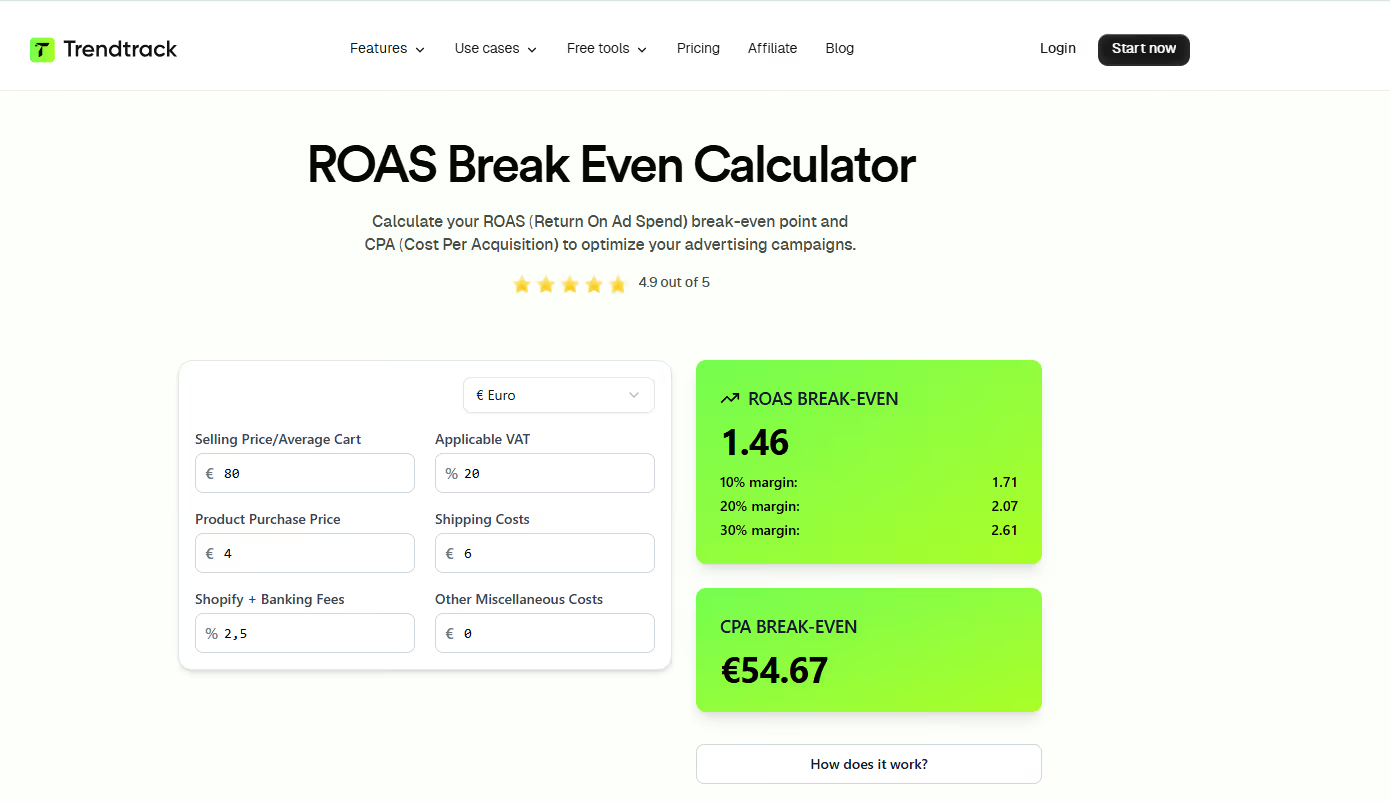
Step 5: Use a ROAS Break-Even Calculator
Calculating break-even ROAS manually can become complex, especially when you include:
- Discounts
- Shipping variations
- Bundles
- Payment processing fees
- Warehousing costs
To simplify this, we provide a free ROAS Break-Even Calculator at TrendTrack:
👉 /tools/roas-break-even-calculator
With this tool, you can:
- Input product cost
- Add operational expenses
- Adjust selling price
- Instantly calculate your required ROAS
- Determine maximum allowable CPA
This eliminates guesswork.
Instead of asking “Is 3x ROAS good?”, you ask:
“Is 3x above my break-even threshold?”
That’s the strategic difference.
Step 6: Analyze ROAS by Campaign and Channel
Advanced e-commerce brands don’t calculate global ROAS only.
They break it down by:
- Google Search campaigns
- Google Shopping
- Meta prospecting
- Meta retargeting
- TikTok ads
- Influencer traffic
Granular ROAS tracking reveals where real scalability lies.
If one campaign produces 5x ROAS and another produces 1.8x, budget allocation should reflect that.
Step 7: Remember ROAS Is Not ROI
ROAS measures advertising efficiency only.
It does not account for:
- Product development costs
- Fixed overhead
- Software subscriptions
- Long-term customer lifetime value
You can have strong ROAS but weak overall profitability if margins are thin.
ROAS helps you scale ads.
ROI helps you scale your business.
Ultimately, calculating ROAS in e-commerce is simple mathematically — but strategic in application.
Track accurate revenue.
Measure real ad spend.
Compare results to break-even.
Use tools to eliminate uncertainty.
Scale only when numbers justify it.
Because in paid acquisition, revenue is visible.
But margin discipline is what protects your business long term.
What Is a Good ROAS for an E-Commerce Business?
When e-commerce founders ask, “What is a good ROAS?”, they’re often looking for a universal number 2x, 3x, 4x, 5x.
But the truth is simple: a good ROAS depends entirely on your margins and break-even point.
ROAS (Return on Ad Spend) measures how much revenue you generate for every dollar spent on ads. However, revenue alone doesn’t determine profitability. If your margins are thin, even a seemingly strong ROAS may not be sustainable.
Let’s break it down logically.
If you sell a product for $100 and your total non-ad costs (COGS, shipping, fees, packaging) equal $70, you only have $30 available for advertising and profit. Your break-even ROAS would be:
100 ÷ 30 = 3.33x
This means you need at least a 3.33 ROAS just to avoid losing money.
In this scenario:
- 2x ROAS = losing money
- 3.3x ROAS = breaking even
- 4x ROAS = profitable
- 5x ROAS = highly scalable
So instead of asking “Is 4x good?”, you should ask: “Is 4x above my break-even?”
For many physical product e-commerce brands, a good ROAS typically starts around 3x to 4x. This usually allows enough margin buffer to cover volatility, refunds, creative testing, and scaling inefficiencies.
A 5x ROAS or higher is considered strong, especially at scale. However, extremely high ROAS numbers often occur at small budgets or in retargeting campaigns. Maintaining 6x or 7x ROAS while spending aggressively is rare in competitive markets.
Dropshipping stores often require higher ROAS thresholds because product costs and shipping reduce margin flexibility. In these cases, 4x–5x may be necessary to stay comfortable.
Premium brands with strong pricing power may survive at lower ROAS because their margins are larger. For example, if your product costs $20 and sells for $120, your break-even ROAS may be closer to 1.5–2x. In that case, a 3x ROAS becomes extremely profitable.
Another important factor is growth stage.
Early-stage brands may accept lower ROAS temporarily to collect data and build customer lifetime value (LTV). Established brands with strong retention systems can afford slightly lower first-purchase ROAS because repeat purchases increase long-term profitability.
This is why ROAS must be evaluated alongside LTV.
If customers purchase repeatedly, your allowable acquisition cost increases. A 2.5x ROAS might be sustainable if repeat purchases push lifetime ROI significantly higher.
You must also consider channel differences.
- Google Search often produces lower ROAS but higher intent.
- Retargeting campaigns often generate very high ROAS.
- Prospecting campaigns usually have lower initial ROAS but drive volume.
Judging ROAS without context can lead to poor budget decisions.
Ultimately, a “good” ROAS is one that:
- Exceeds your break-even threshold
- Provides margin stability
- Allows reinvestment into growth
- Remains sustainable as budget increases
For many e-commerce businesses, targeting 4x or higher is a safe strategic benchmark but only if it aligns with your cost structure.
ROAS is not about chasing high numbers.
It’s about knowing your margins and scaling responsibly.
Because in paid advertising, high revenue feels good.
But profitable ROAS keeps your business alive.
How Can You Improve ROAS Without Increasing Your Ad Budget?
Improving ROAS in e-commerce doesn’t always require spending more money. In fact, the smartest brands often increase profitability by optimizing what they already have.
If ROAS equals revenue divided by ad spend, you have two ways to improve it:
- Increase revenue from the same traffic
- Reduce inefficiencies within your campaigns
Let’s break down the most strategic levers.
First, improve your conversion rate.
If you are already paying for traffic, increasing your store’s conversion rate immediately boosts ROAS. For example, if you spend $5,000 on ads and generate $20,000 in revenue, your ROAS is 4x. If you improve your conversion rate and revenue increases to $25,000 with the same ad spend, your ROAS jumps to 5x — without spending an extra dollar.
Focus on:
- Clear value propositions
- Strong product page copy
- High-quality visuals and videos
- Social proof and reviews
- Faster loading speeds
- Clear shipping and return policies
Small improvements in trust and clarity compound quickly.
Second, increase average order value (AOV).
If each customer spends more per transaction, revenue increases while ad spend remains stable. You can raise AOV through:
- Bundles
- Quantity discounts
- Upsells and cross-sells
- Free shipping thresholds
- Post-purchase offers
If your AOV increases from $50 to $65 and your CPA stays constant, your ROAS improves automatically.
Higher basket size protects margins.
Third, optimize audience targeting.
Poor targeting wastes budget. Analyze which campaigns, ad sets, or keywords generate the highest conversion rates and allocate budget more efficiently.
Pause underperforming segments.
Double down on profitable ones.
Refinement increases efficiency without raising spend.
Fourth, improve creative performance.
On platforms like Meta and TikTok, creative quality directly influences ROAS. Strong hooks, clear messaging, and authentic user-generated content reduce cost per acquisition.
Creative fatigue is a common ROAS killer. If performance declines, it may not be your product it may be your ad content.
Testing new angles often restores efficiency quickly.
Fifth, focus on retargeting.
Retargeting campaigns usually generate higher ROAS than cold traffic campaigns. Website visitors, cart abandoners, and video viewers already showed interest.
Allocating part of your budget to structured retargeting sequences increases conversion probability.
Sixth, optimize your pricing and positioning.
If your product is underpriced relative to perceived value, you limit ROAS potential. Strategic pricing adjustments, improved branding, and stronger positioning can justify higher selling prices — which directly increases revenue per sale.
Even a small price increase can significantly improve profitability if conversion rate remains stable.
Seventh, reduce checkout friction.
Long forms, unexpected shipping costs, slow checkout flow, or missing payment methods reduce conversion rate. Offering Apple Pay, Google Pay, Shop Pay, and other fast checkout options improves completion rates.
Better checkout equals higher ROAS.
Eighth, improve customer lifetime value (LTV).
While ROAS measures short-term ad efficiency, increasing retention improves long-term returns. Email flows, loyalty programs, and subscription models increase total revenue generated from each acquired customer.
Even if first-purchase ROAS is moderate, strong retention increases overall profitability.
Ultimately, improving ROAS without increasing ad spend requires discipline and optimization.
Increase revenue per visitor.
Improve conversion efficiency.
Refine targeting.
Enhance creatives.
Raise AOV.
Strengthen retention.
FAQs about ROAS in E-Commerce
What Is ROAS in E-Commerce?
ROAS (Return on Ad Spend) measures how much revenue you generate for every dollar spent on advertising. It is calculated by dividing revenue generated from ads by total ad spend. If you spend $1,000 on ads and generate $4,000 in revenue, your ROAS is 4x. ROAS focuses strictly on advertising performance, not overall business profitability.
What Is a Good ROAS for an Online Store?
A “good” ROAS depends on your profit margins and break-even point. For many physical product e-commerce brands, a ROAS between 3x and 5x is considered healthy. However, the most important benchmark is whether your ROAS exceeds your break-even threshold. A 4x ROAS may be profitable for one store and unprofitable for another, depending on costs.
What Is the Difference Between ROAS and ROI in E-Commerce?
ROAS measures advertising efficiency, while ROI (Return on Investment) measures overall profitability.
ROAS focuses only on revenue generated from ads divided by ad spend. It does not include product costs, operational expenses, software subscriptions, or overhead.
ROI, on the other hand, includes all business costs and calculates net profit relative to total investment. You can have a strong ROAS but weak ROI if your margins are thin. ROAS helps you evaluate campaign performance, while ROI determines long-term sustainability.
How Do You Calculate Break-Even ROAS?
Break-even ROAS is the minimum ROAS required to avoid losing money. It is calculated by dividing your selling price by the amount available for advertising after deducting all non-ad costs (COGS, shipping, fees). Knowing your break-even ROAS allows you to scale campaigns safely without risking profitability.
Can You Scale with a Low ROAS?
Scaling with a low ROAS is risky unless your margins are very high or your customer lifetime value (LTV) compensates over time. If your ROAS is below break-even, increasing ad spend will increase losses. Sustainable scaling requires margin clarity and stable performance metrics.
Why Is ROAS Important for Paid Advertising?
ROAS is essential because it measures the efficiency of your ad spend. Without tracking ROAS, you cannot determine whether your campaigns are scalable. It provides immediate insight into which channels, creatives, and audiences are generating the highest revenue relative to cost.
Should You Focus Only on ROAS?
No. While ROAS is critical for campaign optimization, it should be analyzed alongside ROI, contribution margin, and customer lifetime value. Focusing only on ROAS can lead to short-term optimization at the expense of long-term profitability.
Useful Sources:
- TrendTrack – E-commerce Competitive Intelligence Tool
- Break-Even Point In E-commerce: Definition, Examples
- What Is Benchmarking in Ecommerce?
- What Is Return on Investment (ROI) for E-commerce?
- ROAS Break Even Calculator

.avif)
Ready to build a million-dollar brand?
.avif)