Top 5 Essential E-commerce Extensions in 2026



In the fast-evolving world of e-commerce, the difference between an average store and a high-performing one often comes down to the tools you use. Platforms like Shopify already provide a strong foundation for launching an online business, but to truly scale, merchants rely on extensions and specialized tools that improve decision-making, optimize marketing, and reveal market opportunities.
In 2026, competition in online retail is stronger than ever. Thousands of new stores appear every day, which means entrepreneurs must work smarter by leveraging tools that provide data, automation, and competitive insights. From competitor analysis to marketing optimization and store management, the right extensions can dramatically improve how efficiently an e-commerce business operates.
Some extensions help you discover winning products, others optimize your advertising performance, while some allow you to analyze competitors and identify opportunities in your niche. The most successful e-merchants rarely rely on intuition alone they use data-driven tools that allow them to move faster than the market.
In this article, we will explore the Top 5 essential e-commerce extensions in 2026 that can help entrepreneurs build, analyze, and scale their online stores more effectively. These tools have become indispensable for modern e-commerce businesses looking to stay competitive in an increasingly data-driven market.
1. TrendTrack
In today’s data-driven e-commerce ecosystem, the stores that scale the fastest are not necessarily the ones with the biggest budgets. They are the ones that understand their market better than anyone else. This means analyzing competitors, identifying winning strategies, discovering trending products, and spotting opportunities before they become saturated.
This is exactly the role of TrendTrack, one of the most powerful competitive intelligence tools available for e-commerce entrepreneurs in 2026.

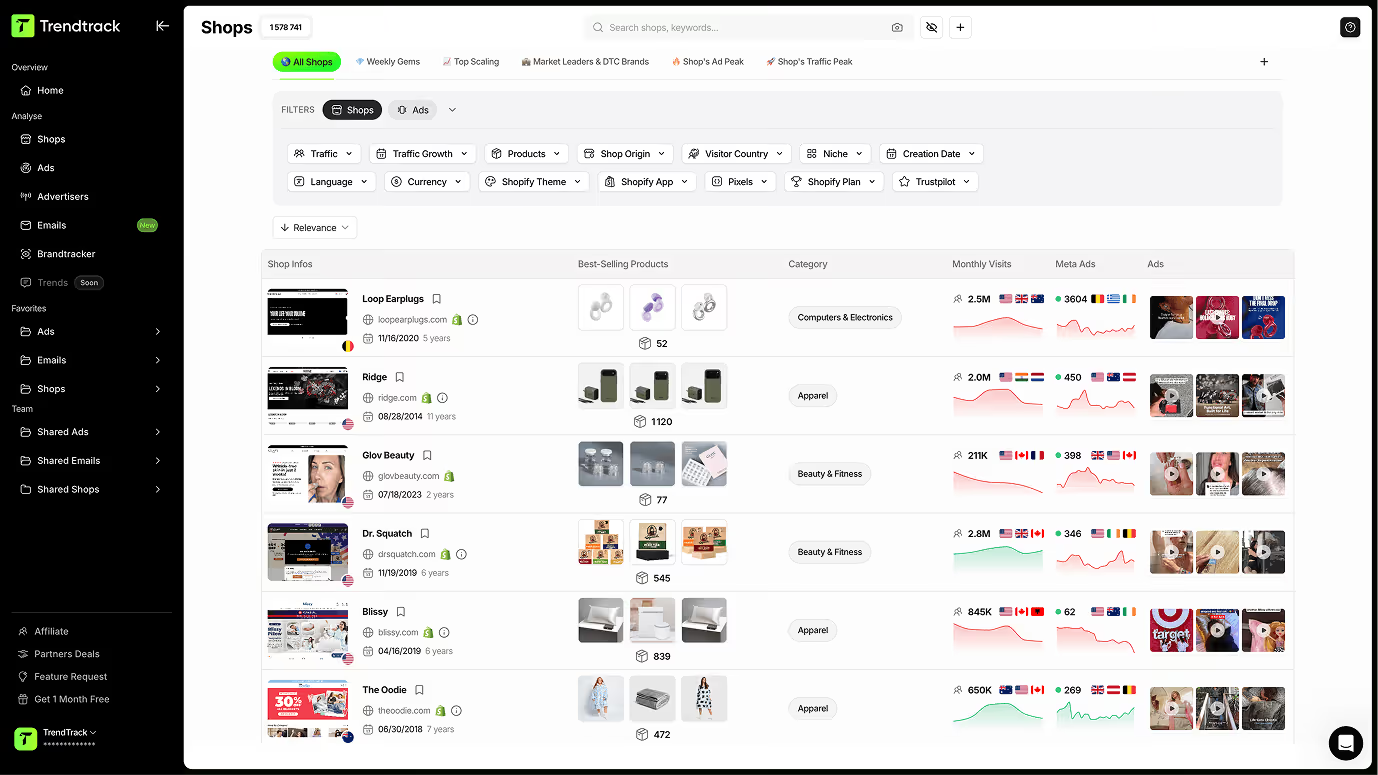
Unlike many extensions that only focus on product discovery, TrendTrack provides a complete market analysis platform that allows e-merchants to understand their niche deeply and make strategic decisions based on real data.
A Complete Competitive Intelligence Platform
TrendTrack was built specifically for e-commerce entrepreneurs who want to analyze their market intelligently. Instead of randomly testing products or copying competitors blindly, users can study the competitive landscape and identify real opportunities for growth.
The platform allows merchants to explore thousands of stores, detect emerging brands, and analyze the strategies used by successful competitors. This provides a much clearer view of the market and helps entrepreneurs avoid entering saturated niches.
By using TrendTrack, store owners can move from intuition to data-driven strategy, which significantly increases the chances of building a profitable e-commerce business.
Deep Insights Into Competitor Strategies
One of the most powerful aspects of TrendTrack is its ability to reveal the full strategy of competitor stores.
Entrepreneurs can analyze different aspects of competing brands, such as:
Traffic performance and store growth signals
Best-selling products
Advertising strategies
Market trends
Competitor positioning within a niche
This level of insight allows e-merchants to identify what works in their market and adapt their own strategy accordingly.
For example, if several competitors are scaling aggressively through Meta ads, TrendTrack allows users to detect those patterns early. This can reveal products or niches that are currently experiencing strong demand.
Discover Winning Stores and Market Opportunities
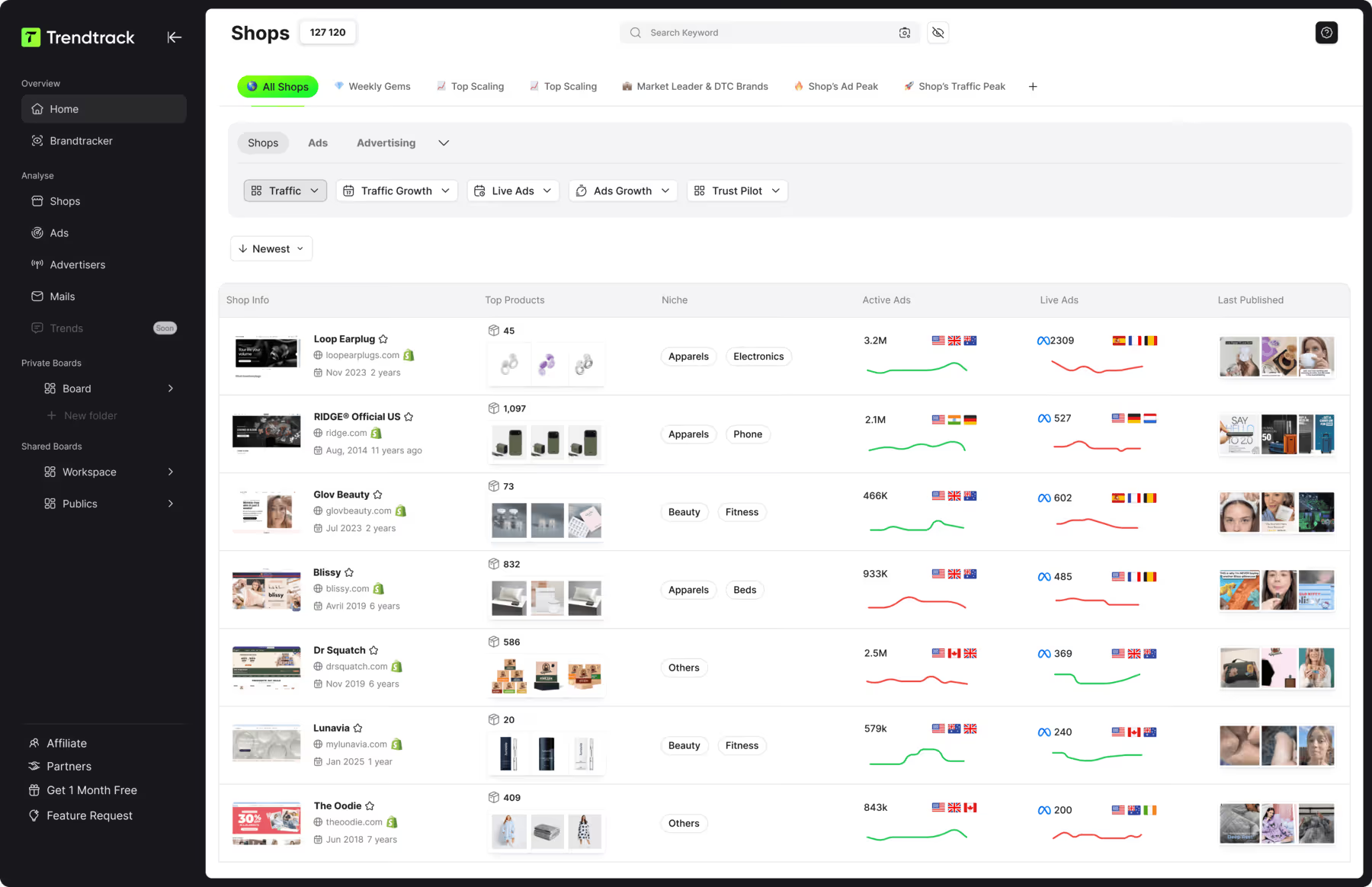
TrendTrack also provides access to Trending Shops, a feature that allows users to explore thousands of high-performing stores every month.
Instead of manually searching for competitors, entrepreneurs can discover stores that are currently scaling, experiencing traffic spikes, or gaining traction in specific markets.
This feature is extremely valuable for:
Product research
Market validation
Competitive benchmarking
Discovering new niches
By studying successful stores, entrepreneurs can better understand what customers are buying and which strategies are currently working.
Key Features of TrendTrack
TrendTrack offers a wide range of features designed to help entrepreneurs analyze the e-commerce ecosystem.
| Feature | Description | Advantage |
|---|---|---|
| Trending Shops | Explore thousands of successful e-commerce stores | Discover competitors and market opportunities |
| Smart Segments | Identify scaling stores and traffic peaks | Detect fast-growing brands early |
| Trending Ads | Analyze competitor advertising campaigns | Understand which ads and products are performing |
| Brand Tracker | Track competitor brands and monitor their growth | Follow market leaders and emerging players |
| Store Analytics | Analyze store performance and strategies | Benchmark your store against competitors |
| Advanced Filters | Filter stores by niche, growth, or strategy | Save time and focus on relevant competitors |
Together, these features provide a complete overview of the competitive landscape.
Instead of relying on isolated data points, entrepreneurs can see the broader dynamics of their market.
A Tool Built for Strategic Decision-Making
Many e-commerce tools focus on only one aspect of the business, such as product research or ad spying. TrendTrack takes a different approach by combining multiple sources of data into a centralized intelligence platform.
This allows entrepreneurs to:
Identify promising niches
Detect competitors scaling aggressively
Analyze advertising strategies
Validate product demand
Monitor market evolution
By consolidating all these insights into one dashboard, TrendTrack saves time and helps entrepreneurs make faster and smarter decisions.
TrendTrack Pricing
TrendTrack offers several pricing tiers depending on the level of market analysis required.
| Plan | Price (Yearly Billing) | Key Features |
|---|---|---|
| Starter | $42/month | Explore 10,000 shops per month, smart segments, advanced filters, brand tracking (2 brands) |
| Pro | $63/month | Unlimited shop exploration, full Meta Ads library, track up to 30 brands |
| Business | $105/month | Unlimited brand tracking, unlimited ad usage, designed for large-scale operators |
Each plan is designed for different levels of e-commerce entrepreneurs, from beginners exploring their first niches to experienced operators managing multiple brands.
2. Klaviyo – The Leading Email Marketing Tool for E-Commerce Growth
In the world of e-commerce, acquiring customers is only one part of the equation. The real profitability of an online store often comes from customer retention and repeat purchases. While many brands invest heavily in paid advertising to attract new visitors, the most successful e-commerce businesses also build strong relationships with their existing customers.
This is where email marketing becomes one of the most powerful growth channels available. Among the tools designed specifically for this purpose, Klaviyo has established itself as one of the leading platforms for e-commerce brands.

Klaviyo is an advanced email and SMS marketing platform designed to help online stores create personalized communication with their customers. Unlike traditional email marketing tools that simply allow you to send newsletters, Klaviyo focuses on data-driven marketing automation. It integrates directly with e-commerce platforms such as Shopify and collects customer data in order to create highly targeted campaigns.
One of the main strengths of Klaviyo is its ability to centralize customer behavior data. Every interaction that customers have with a store can be tracked and used to improve marketing performance. For example, Klaviyo can analyze information such as browsing activity, purchase history, cart abandonment behavior, and engagement with previous campaigns.
By using this data, merchants can send personalized messages that are far more relevant to each customer. Instead of sending the same email to an entire mailing list, Klaviyo allows brands to segment their audience and create targeted campaigns that respond to specific customer behaviors.
Segmentation is one of the most powerful features of the platform. With Klaviyo, businesses can divide their customers into different groups based on various criteria such as purchase frequency, average order value, location, or product preferences. This allows brands to send messages that feel much more personalized and therefore significantly improve conversion rates.
For example, a store could create a segment of customers who purchased a specific product and send them complementary product recommendations. Another segment could target visitors who abandoned their cart but did not complete their purchase.
This level of personalization transforms email marketing from a simple communication channel into a powerful revenue driver for e-commerce stores.
Klaviyo Pricing

| Plan | Prix (à partir de) | Volume inclus | Principales fonctionnalités |
|---|---|---|---|
| Gratuit | 0 $ / mois | 500 e-mails / mois + 150 crédits SMS/MMS | Tableaux de bord de reporting, segmentation multicanale, IA générative pour créer du contenu, support e-mail pendant 60 jours |
| E-mails | 45 $ / mois | 15 000 e-mails / mois | Profils clients avec données historiques illimitées, +350 intégrations, reporting intégré, IA générative, segmentation multicanale, support e-mail |
| E-mails + messages mobiles | 70 $ / mois | 15 000 e-mails + 2 500 crédits mobile / mois | Marketing multicanal e-mail + SMS, profils clients illimités, +350 intégrations, tableaux de bord avancés, IA générative, segmentation multicanale, support e-mail |
Another key advantage of Klaviyo is its automation capabilities. Instead of manually sending emails, merchants can create automated flows that trigger messages based on customer actions.
Some of the most common automated email flows used by e-commerce brands include:
Welcome emails for new subscribers
Abandoned cart reminders
Post-purchase follow-ups
Product recommendation emails
Re-engagement campaigns for inactive customers
These automated sequences run continuously in the background and help businesses generate revenue without requiring constant manual work.
For example, abandoned cart emails are one of the most profitable email flows in e-commerce. When a customer adds a product to their cart but does not complete the purchase, Klaviyo can automatically send a reminder email encouraging them to finalize the transaction. This simple automation often recovers a significant percentage of otherwise lost sales.
Another important feature of Klaviyo is its integration with SMS marketing. In addition to email campaigns, brands can communicate with customers through text messages, which often achieve higher open rates than traditional email.
Combining email and SMS strategies allows e-commerce businesses to build a multi-channel communication system that increases engagement and improves conversion rates.
Klaviyo also offers detailed analytics and performance tracking. Merchants can monitor key metrics such as open rates, click-through rates, conversion rates, and revenue generated by each campaign.
This level of visibility helps entrepreneurs understand which marketing strategies are working and where improvements can be made. By analyzing campaign performance, brands can continuously optimize their messaging and increase their marketing efficiency.
Another reason why Klaviyo is particularly popular among e-commerce brands is its deep integration with Shopify and other online store platforms. Once connected to a store, the platform automatically synchronizes customer data, orders, and browsing activity.
This seamless integration allows merchants to build advanced marketing campaigns without needing complex technical setups.
Despite the power of email marketing tools like Klaviyo, it is important to remember that email marketing works best when combined with strong market intelligence. Sending the right message to customers is important, but understanding which products to promote and which markets to target is equally crucial.
This is where tools like TrendTrack complement platforms such as Klaviyo perfectly. While Klaviyo helps brands maximize revenue from existing customers, TrendTrack helps entrepreneurs identify market opportunities, analyze competitors, and discover which products have the highest potential demand.
Together, these tools allow e-commerce businesses to build both a strong customer retention strategy and a data-driven market strategy.
In 2026, where advertising costs continue to increase and competition grows every year, relying solely on paid traffic is no longer sustainable. Brands that succeed are those that invest in customer retention and long-term relationships.
Email marketing platforms like Klaviyo make this possible by helping e-commerce businesses build direct communication channels with their customers.
For any serious e-commerce brand looking to increase profitability, Klaviyo has become one of the most essential tools in the modern marketing stack.
3. Triple Whale – Advanced Analytics for Data-Driven E-Commerce Decisions
As e-commerce becomes increasingly competitive, one of the most valuable assets a brand can have is accurate data and clear performance insights. Many entrepreneurs launch stores and invest heavily in marketing, yet they struggle to understand which actions truly drive revenue. Advertising campaigns, traffic sources, customer behavior, and profitability metrics all generate large volumes of data that can be difficult to interpret without the right tools.
This is where Triple Whale has positioned itself as one of the most advanced analytics platforms for e-commerce businesses. Designed primarily for Shopify brands and digital-first retailers, Triple Whale helps entrepreneurs centralize their data and transform raw numbers into actionable insights that guide strategic decisions.

At its core, Triple Whale is a data attribution and analytics platform. It connects different sources of information such as advertising platforms, Shopify stores, and marketing channels into a single dashboard. This unified system allows entrepreneurs to monitor the performance of their entire business without needing to switch between multiple tools.
One of the biggest challenges in e-commerce analytics is understanding where sales actually come from. When a customer interacts with several marketing channels before purchasing, attribution can become complex. For example, a customer might discover a product through TikTok, later click a Google search result, and finally convert after receiving an email campaign.
Traditional analytics tools often struggle to track these complex customer journeys accurately. Triple Whale attempts to solve this issue by offering advanced attribution models that help merchants better understand the real impact of each marketing channel.
By consolidating advertising data from platforms like Meta Ads, Google Ads, TikTok Ads, and other marketing channels, Triple Whale provides a clearer picture of how marketing investments translate into revenue. This helps entrepreneurs make more informed decisions about where to allocate their advertising budgets.
Another major advantage of Triple Whale is its ability to monitor profitability metrics in real time. Many entrepreneurs focus heavily on revenue but overlook the importance of tracking margins and operational costs.
Triple Whale pricing

Triple Whale helps merchants understand their true business performance by integrating data related to ad spend, cost of goods, shipping costs, and other operational expenses. This allows businesses to evaluate key metrics such as ROAS (Return on Ad Spend), contribution margin, and profit per order.
Having access to this level of financial visibility is essential for scaling an e-commerce business responsibly. Without understanding profitability, brands may increase their advertising budgets while unknowingly reducing their margins.
Triple Whale also offers powerful visual dashboards that simplify complex data. Instead of analyzing spreadsheets or fragmented reports from multiple platforms, merchants can view their performance metrics in one intuitive interface.
These dashboards allow entrepreneurs to quickly monitor important indicators such as daily revenue, advertising performance, and customer acquisition trends.
Another important capability of Triple Whale is its creative analytics tools. Advertising performance is not only about budgets it is also heavily influenced by the quality of the creative assets used in campaigns.
Triple Whale allows marketers to analyze which ad creatives are generating the best performance across different platforms. By identifying high-performing creatives, brands can replicate successful concepts and improve the efficiency of their advertising strategy.
The platform also helps businesses understand customer acquisition costs (CAC) and customer behavior patterns. By analyzing how much it costs to acquire a new customer and how those customers behave after their first purchase, merchants can optimize both their marketing strategy and retention efforts.
Understanding these dynamics is particularly important in modern e-commerce because advertising costs have increased significantly in recent years. Brands must therefore ensure that their marketing investments generate sustainable long-term value.
While Triple Whale excels in performance analytics and advertising attribution, it is important to remember that data analysis is only one part of the e-commerce growth equation. Knowing how campaigns perform is essential, but understanding the competitive landscape and market opportunities is equally important.
This is where tools like TrendTrack complement analytics platforms such as Triple Whale. While Triple Whale focuses on internal business metrics such as advertising performance and profitability TrendTrack provides insights into external market dynamics.
For example, TrendTrack helps entrepreneurs analyze competitor stores, discover trending products, identify best sellers, and detect new brands entering their niche. These insights allow merchants to identify opportunities before launching products or scaling campaigns.
Combining these two types of tools creates a powerful strategy. Triple Whale helps businesses understand how their store is performing internally, while TrendTrack helps them understand what is happening in the broader market.
Together, these insights allow e-commerce brands to build a much more strategic growth approach.
In 2026, successful e-commerce businesses rely on data-driven decision making rather than intuition alone. The complexity of modern marketing ecosystems requires tools that can transform large amounts of data into actionable insights.
Triple Whale plays an important role in this ecosystem by helping merchants track performance, analyze profitability, and optimize advertising strategies.
For brands looking to scale responsibly and maintain control over their marketing performance, Triple Whale has become one of the most valuable analytics platforms available in the e-commerce industry today.
4. Recharge – The Subscription Engine Powering Recurring E-Commerce Revenue
In the modern e-commerce landscape, profitability does not always come from constantly acquiring new customers. In fact, one of the most powerful growth strategies for online stores is building recurring revenue through subscription models. Instead of relying only on one-time purchases, brands can create predictable income streams by encouraging customers to subscribe to products they need regularly.
This is where Recharge has become one of the most important tools for e-commerce businesses that want to implement subscription-based models.

Recharge is a subscription management platform designed primarily for Shopify stores and direct-to-consumer brands. It allows merchants to offer flexible subscription options to their customers, turning occasional buyers into long-term recurring customers. By integrating directly with an e-commerce store, Recharge makes it possible to manage subscriptions, automate recurring billing, and create a seamless customer experience.
One of the main reasons why subscription models are so powerful is that they improve Customer Lifetime Value (CLV). Instead of generating revenue from a single purchase, a subscription model allows businesses to generate revenue from the same customer over multiple months or even years.
For example, many industries naturally benefit from subscriptions, such as:
Health and wellness products
Skincare and cosmetics
Food and beverage products
Supplements
Pet supplies
Household essentials
In these markets, customers often need to purchase the same products repeatedly. Recharge makes it easy for brands to offer “subscribe and save” options, which encourage customers to receive products automatically at regular intervals.
Recharge pricing 2026

| Plan | Prix | Pour qui ? | Fonctionnalités principales |
|---|---|---|---|
| Starter | 99 $ / mois | Marques e-commerce qui lancent leur premier programme d’abonnement | Widget de souscription personnalisable, portail client intuitif, outils d’upsell & cross-sell, prévention des résiliations, récupération des paiements échoués (jusqu’à 88 %), workflows automatisés, gifting subscriptions, analytics et benchmarks sectoriels |
| Plus | 499 $ / mois | Marques en croissance souhaitant optimiser leur stratégie d’abonnement | Toutes les fonctionnalités Starter + accompagnement à l’implémentation, support de migration complet, bundles personnalisables et réductions par paliers, SMS concierge pour gérer les abonnements, programme de fidélité et de parrainage, Javascript SDK et API storefront |
| Custom | Tarification sur mesure | Marques à très gros volume et entreprises | Workflows et intégrations personnalisés, support technique prioritaire, revue de l’architecture technique, business reviews stratégiques, solutions adaptées pour scaling avancé |
This creates a win-win situation. Customers enjoy convenience and often receive a discount, while businesses benefit from predictable recurring revenue.
Another major advantage of Recharge is its ability to provide flexibility for both merchants and customers. Subscriptions are not rigid contracts. Instead, customers can usually adjust their delivery frequency, skip shipments, or modify their orders directly from their account dashboard.
This flexibility significantly improves the customer experience and reduces subscription cancellations.
Recharge also allows businesses to create different types of subscription models depending on their product strategy. For example, merchants can offer:
Monthly subscription boxes
Auto-replenishment products
Membership-based access to exclusive products
Discounts for recurring orders
These different models allow brands to design subscription strategies that align with their product catalog and customer needs.
From an operational perspective, Recharge automates many of the processes associated with recurring billing. Once a customer subscribes, the platform automatically processes payments, generates orders, and schedules shipments according to the subscription plan.
This automation saves a significant amount of time for merchants and ensures that the subscription system operates smoothly.
Recharge also provides detailed analytics and reporting tools that help merchants monitor the performance of their subscription program. Brands can track key metrics such as:
Monthly recurring revenue (MRR)
Subscription growth rates
Churn rate
Customer lifetime value from subscribers
These insights help entrepreneurs understand how their subscription strategy contributes to overall business growth.
Another strength of Recharge is its deep integration with the Shopify ecosystem. The platform connects easily with other e-commerce tools, including payment gateways, marketing automation platforms, and fulfillment systems.
This allows brands to integrate subscriptions seamlessly into their existing operations without needing complex technical development.
However, while subscription models can significantly improve profitability, they work best when combined with strong product positioning and market understanding. Simply adding a subscription option to a store does not guarantee success.
Entrepreneurs must ensure that their products genuinely solve recurring needs for customers.
This is where tools like TrendTrack can complement subscription platforms such as Recharge. Before launching a subscription-based product strategy, merchants can use TrendTrack to analyze competitors, identify best-selling products in their niche, and detect markets where demand is strong.
By combining market intelligence with subscription technology, e-commerce brands can build more sustainable and scalable business models.
Recharge plays a critical role in helping merchants turn single transactions into long-term customer relationships. By automating subscription management and providing a smooth user experience, the platform enables businesses to create predictable revenue streams and increase customer loyalty.
In a competitive e-commerce environment where customer acquisition costs continue to rise, building strong retention strategies has become essential.
For brands looking to increase recurring revenue, customer lifetime value, and long-term stability, Recharge has become one of the most valuable subscription tools available in the e-commerce ecosystem.
5. Judge.me – The Essential Customer Review Tool for E-Commerce Trust and Conversion
In e-commerce, trust is one of the most important factors influencing whether a visitor becomes a paying customer. When someone discovers a new online store, they usually ask themselves a simple question: Can I trust this brand?
One of the most effective ways to answer that question is through customer reviews and social proof. Reviews provide real feedback from previous buyers and help reassure potential customers that the product and the store are legitimate.

Judge.me is a customer review management tool that allows online stores to collect, display, and manage product reviews automatically. By integrating directly with e-commerce platforms, it enables merchants to gather feedback from customers after each purchase and display that feedback directly on product pages.
This simple feature can have a dramatic impact on conversion rates.
When shoppers see real reviews from other customers including star ratings, written feedback, and photos—they feel more confident about making a purchase. Reviews act as social validation, showing that other people have already tried and approved the product.
These automated requests significantly increase the number of reviews collected compared to manual review systems.
Over time, this creates a valuable database of authentic customer feedback, which strengthens the credibility of the store.
Another important feature of Judge.me is its support for photo and video reviews. Visual feedback is particularly powerful in e-commerce because it allows potential buyers to see how the product looks in real life.
User-generated photos help reduce uncertainty and provide proof that the product matches its description.
For example, if a clothing brand displays photos from real customers wearing their products, new shoppers can better visualize how the items fit and look in everyday situations.
This type of social proof often leads to higher conversion rates and lower return rates.
Judge.me also offers powerful customization options that allow merchants to integrate reviews directly into their website design. Reviews can appear on product pages, collection pages, and even homepage sections.
Many stores also display average product ratings directly under product titles or in search results, which immediately signals product quality to potential buyers.
Another major advantage of Judge.me is its compatibility with Google rich snippets and SEO features. When review data is properly structured, search engines can display star ratings directly in search results.
This visual element can significantly improve click-through rates (CTR) because users are naturally drawn to listings with strong review ratings.
For e-commerce brands investing in SEO, this feature can provide an additional advantage in search engine visibility.
Judge.me also provides tools for managing and moderating reviews. Merchants can respond to customer feedback, highlight positive reviews, and address negative experiences professionally.
Responding to reviews shows customers that the brand values feedback and is actively engaged with its community.
Even negative reviews can become opportunities to demonstrate strong customer service.
Another valuable feature of Judge.me is its ability to integrate with loyalty programs and marketing campaigns. For example, merchants can reward customers who leave reviews with discount codes or loyalty points.
This encourages more customers to participate in the review system and increases engagement with the brand.
For new stores, collecting early reviews is especially important because it helps build credibility quickly. A product with dozens of positive reviews appears far more trustworthy than one with no feedback at all.
However, while review tools like Judge.me help build trust and improve conversions, they work best when combined with a strong market strategy and product positioning.
Before launching products and collecting reviews, entrepreneurs must ensure that they are entering markets with real demand and strong potential.
TrendTrack helps entrepreneurs identify winning products, analyze competitors, and understand market dynamics before launching a product. Once the product gains traction, tools like Judge.me help build social proof and customer trust, which ultimately increases conversion rates.
Together, these tools support two key pillars of e-commerce success:
Market intelligence and product validation
Customer trust and social proof
In today’s highly competitive e-commerce environment, both elements are essential.

.avif)
Ready to build a million-dollar brand?
.avif)