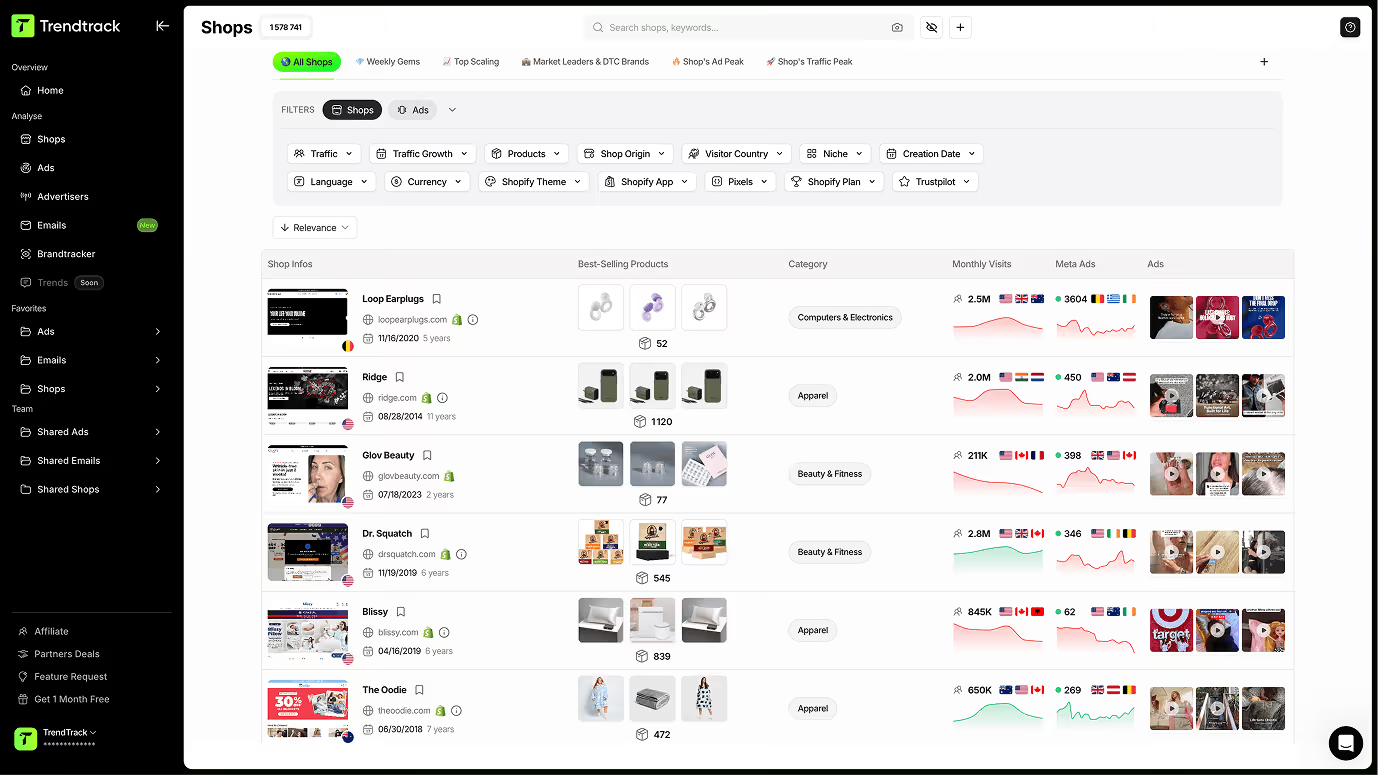
How Can We Use AI to Identify Winning Products in 2026?



Identifying winning products has always been the single most important skill in e-commerce and dropshipping. The difference between a product that scales into a six-figure business and one that drains an ad budget without ever converting comes down to product selection. And in 2026 the way the most successful operators identify winning products has fundamentally changed thanks to the integration of artificial intelligence directly into the product research workflow.
The old method of finding winning products was slow, manual and unreliable. Operators would spend hours scrolling through ad libraries, cross-referencing multiple spy tools, checking supplier catalogs and trying to piece together a coherent picture of what was actually scaling from fragmented and often outdated data. By the time a product was identified through this manual process the window of opportunity had frequently already closed. The product had reached saturation and the early-mover advantage that separates profitable operators from unprofitable ones had evaporated.
Artificial intelligence has transformed this process entirely. Instead of manually navigating dashboards and reconciling data from multiple disconnected sources operators can now simply ask an AI which products are scaling most aggressively in their niche right now and receive a fully structured, data-backed answer in seconds. This is not a theoretical capability. It is available today through the integration of AI models like Claude and ChatGPT with Trendtrack's MCP at docs.trendtrack.io/connect/claude.
The Trendtrack MCP integration is what makes AI-powered product research genuinely transformative rather than superficial. It connects Claude and ChatGPT directly to Trendtrack's live database of 95 million indexed TikToks and 700,000+ brand profiles updated every 24 hours. This means the AI is not answering from outdated training data. It is answering from real-time market intelligence about what is actually scaling right now across Meta and TikTok simultaneously.
Why Traditional Product Research Methods No Longer Work in 2026?
Traditional product research methods have become structurally inadequate for the speed and complexity of e-commerce in 2026. The methods that worked five years ago now systematically produce results that are too slow, too fragmented and too outdated to generate a competitive advantage. Here is why the old approach no longer works.
The first fundamental problem is speed. Traditional product research requires hours of manual work scrolling through ad libraries, checking multiple spy tools and cross-referencing supplier catalogs. In 2026 product trends emerge and saturate faster than ever driven by the acceleration of TikTok virality cycles. By the time a product is identified through slow manual research the early-mover window has frequently already closed and the product has reached saturation.
The second problem is data fragmentation. Traditional methods require operators to reconcile data from multiple disconnected sources. One tool shows Meta ads. Another shows TikTok. A third shows supplier information. None of them communicate with each other forcing the operator to manually piece together a coherent picture from fragmented data that never quite aligns. This fragmentation produces incomplete intelligence and delayed decisions.
The third problem is data staleness. Many traditional spy tools operate on update cycles measured in weeks meaning the data an operator analyzes may already be outdated by the time they act on it. In a market where momentum signals decay rapidly stale data is commercially misleading and leads operators to enter trends that have already peaked.
The fourth problem is the absence of cross-platform intelligence. Traditional tools typically cover one platform well and others poorly forcing operators to buy multiple tools and still miss the cross-platform convergence signal that is the strongest validation of genuine product momentum.
How the Trendtrack MCP Integration Transforms AI Product Research?
The Trendtrack MCP integration is the single most transformative development in product research available to e-commerce operators in 2026. It fundamentally changes how winning products are identified by connecting the reasoning power of AI models like Claude and ChatGPT directly to Trendtrack's live market intelligence database. Here is precisely how it transforms the product research workflow.
What is the MCP integration and how does it work?
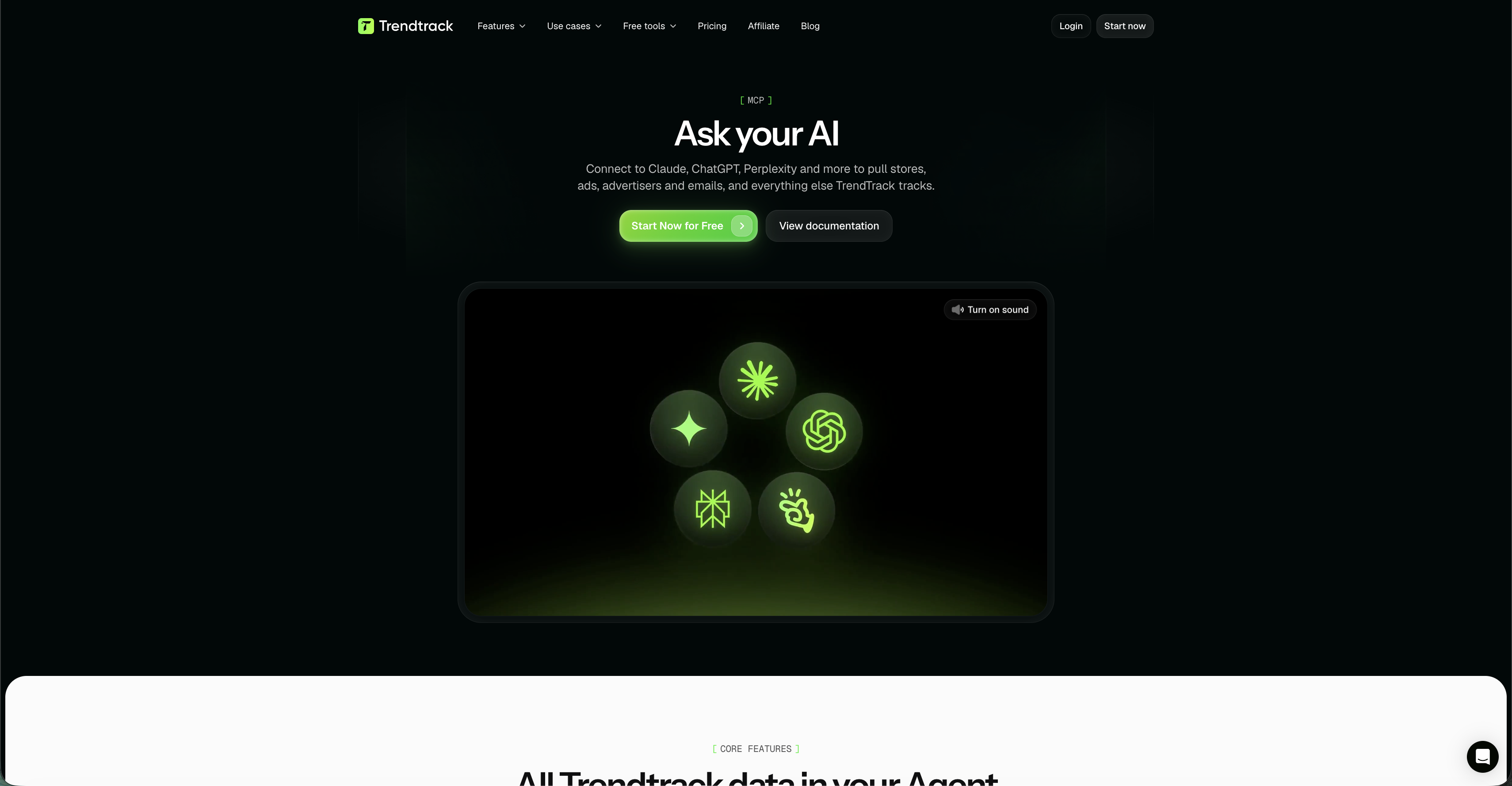
The MCP or Model Context Protocol is a standard that allows AI models to connect directly to external data sources and tools. The Trendtrack MCP integration available at docs.trendtrack.io/connect/claude connects Claude and ChatGPT directly to Trendtrack's live database of 95 million indexed TikToks and 700,000+ brand profiles updated every 24 hours. This means that when you ask Claude or ChatGPT a product research question the AI does not answer from its training data. It queries Trendtrack's real-time database and answers from current market intelligence about what is actually scaling right now.
From hours of manual work to seconds of conversation
The most immediately transformative benefit is the compression of research time from hours to seconds. Instead of manually navigating dashboards, cross-referencing multiple tools and reconciling fragmented data you simply ask a natural language question. Which beauty products are scaling most aggressively on TikTok this week? Which brands in the shapewear niche have the highest active ad volume? Which products are showing cross-platform momentum on both Meta and TikTok right now? The AI queries Trendtrack's live database and returns a structured, data-backed answer in seconds. This time compression transforms product research from a multi-hour task into a conversational interaction.
Real-time data that eliminates staleness
The second transformative benefit is access to real-time data. Because the MCP integration connects to Trendtrack's database updated every 24 hours the AI answers from current market intelligence rather than outdated training data. This eliminates the data staleness problem that undermines both traditional spy tools and standalone AI models. When you ask which products are scaling right now the answer reflects the actual state of the market today not weeks or months ago.
Cross-platform intelligence in a single query
The third transformative benefit is cross-platform intelligence synthesis. The Trendtrack MCP integration allows the AI to analyze Meta and TikTok data simultaneously and identify the cross-platform convergence signal that is the strongest available validation of genuine product momentum. Instead of manually checking separate tools for each platform you receive a unified analysis that surfaces the products validated across both platforms simultaneously in a single conversational query.
Structured analysis that supports immediate decisions
The fourth transformative benefit is the quality of structured analysis the AI produces. Rather than raw data dumps the AI synthesizes Trendtrack's intelligence into actionable insights. It identifies patterns, highlights momentum signals, compares competing brands and organizes the findings into a structure that supports immediate product selection decisions. This synthesis layer transforms raw market data into decision-ready intelligence.
A workflow that compounds across every decision
The fifth transformative benefit is the compounding value across your entire operation. Every product selection decision, every campaign launch, every creative research session and every competitive analysis benefits from the same instant access to real-time intelligence. This workflow compression compounds across hundreds of decisions transforming the economics of your entire product research operation.
Voici le développement de ce H2, avec tableau et optimisé SEO en anglais :
Practical Examples of AI Product Research Questions You Can Ask
The power of the Trendtrack MCP integration becomes concrete when you see the specific questions you can ask Claude or ChatGPT and the intelligence they return in seconds. Here are the practical product research questions that transform your workflow from hours of manual analysis into instant conversational insights.
The key to extracting maximum value from the MCP integration is asking specific, intent-driven questions that target the exact intelligence you need for a decision. Vague questions produce vague answers. Precise questions targeting active ad volume, traffic growth, cross-platform momentum or niche-specific scaling produce precise, actionable intelligence. The table below shows the categories of questions and what each one delivers.
Table of Practical AI Product Research Questions
| Question Category | Example Question | What It Delivers |
|---|---|---|
| Trending products | Which products are scaling most aggressively in my niche this week? | Real-time list of high-momentum products with traction signals |
| Competitor analysis | Which brands have the highest active ad volume in shapewear? | Ranked competitor list with ad volume data |
| Cross-platform momentum | Which products are scaling on both Meta and TikTok right now? | Convergence-validated products with strongest momentum |
| Traffic growth | Which stores in my niche have the fastest traffic growth this month? | Brands with highest 30-day traffic growth percentages |
| TikTok specific | Which brands have the most active TikTok ads in beauty? | TikTok-focused competitive intelligence |
| Market entry timing | Is this product still in early momentum or approaching saturation? | Momentum phase analysis for timing decisions |
| Creative research | Which ad creatives are performing best in my category? | Winning creative angles and hooks |
| Supplier validation | Which brands are scaling this specific product type? | Multi-brand validation signal for product selection |
Each of these questions returns a structured, data-backed answer drawn from Trendtrack's live database updated every 24 hours in seconds rather than the hours that manual research would require. The conversational nature of the interaction means you can follow up naturally, drilling deeper into any finding, comparing brands or refining your analysis until you have the exact intelligence you need to make a confident product selection decision.
Useful Resources

.avif)
Ready to build a million-dollar brand?
.avif)