How is AI impacting e-commerce?



Artificial intelligence is transforming e-commerce more deeply and more rapidly than any other technological revolution since the rise of the smartphone. This is no longer an emerging trend reserved for giants like Amazon or Alibaba, who have been experimenting with sophisticated recommendation algorithms for years. In 2026, AI is an operational reality accessible to thousands of merchants of all sizes who use it daily to automate tasks, personalize the customer experience, optimize ad campaigns, and make better strategic decisions.
The impact of AI on e-commerce is multidimensional and simultaneously touches every aspect of the business. Winning product research is transformed by tools that analyze millions of data points in real time to identify emerging trends before they become obvious to the entire market. Content creation is accelerated by language models that generate product listings, emails, and sales pages in seconds. The customer experience is personalized by recommendation algorithms that adapt offers to the individual behavior of each visitor. And digital advertising is optimized by automated systems that adjust bids and creatives in real time to maximize return on investment.
But AI in e-commerce is not a magic wand. It's a set of tools whose real impact depends directly on how merchants integrate them into their processes and on the quality of the data they rely on. The e-commerce operators who get the best results with AI are those who have understood that the power of these tools multiplies exponentially only when connected to real market data in real time rather than to generic or outdated information.
In this article, we walk you through all the concrete impacts of AI on e-commerce in 2026, the areas where it generates the most added value, and the most effective tools to leverage it in your business.
AI in Product Research and Competitive Intelligence
This is the area where the impact of AI on e-commerce is most immediate and most measurable for the merchants who adopt it. Product research and competitive intelligence are traditionally the most time-consuming activities in an e-commerce operator's daily workflow. And these are precisely the ones AI is most radically transforming in 2026.
Identifying Winning Products Before Saturation
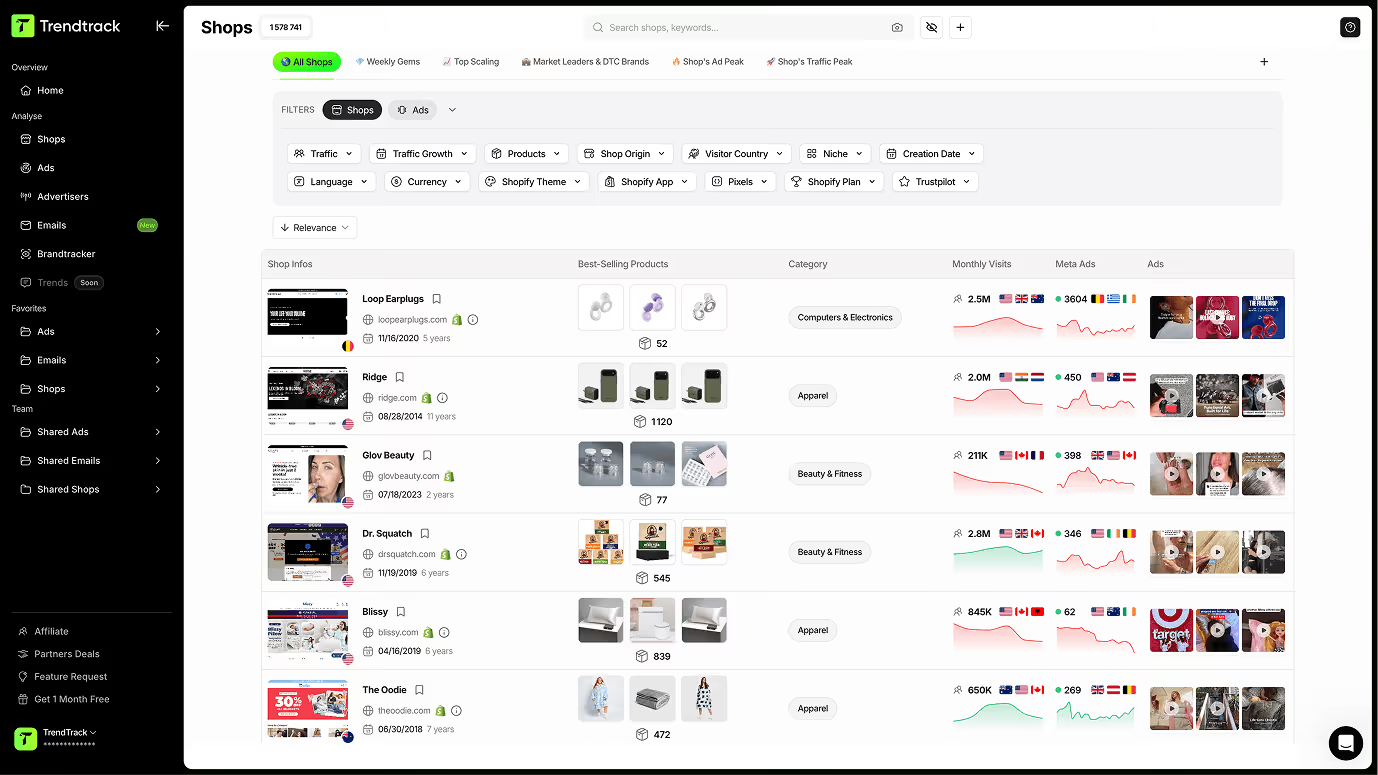
The opportunity window on a winning e-commerce product is now measured in weeks rather than months. Merchants who identify a product in its emergence phase and launch their campaigns in the first few days benefit from acquisition costs far lower than those who enter the market once the trend is already obvious to everyone. AI connected to a real-time e-commerce database like our Trendtrack platform can simultaneously analyze thousands of advertising signals, search volumes, and purchasing behaviors to identify these opportunity windows well before manual methods would detect them. Our MCP connection with Claude allows you to query this database in natural language and receive structured analyses on emerging products in any niche in seconds transforming hours of manual monitoring into a handful of conversational prompts.
Automated Real-Time Competitive Analysis
Manual competitive monitoring is one of the most frustrating tasks in the e-commerce business. Opening Meta ad libraries, noting competitors' creatives, analyzing their marketing angles, tracking their new product launches. These repetitive tasks consume hours of work every week and always produce results that lag behind the reality of the market. AI connected to Trendtrack transforms this process by simultaneously automating the analysis of your competitors' most-distributed creatives, detecting shifts in advertising strategy, tracking newly launched products, and identifying emerging marketing angles in your niche. Simply ask Claude via our MCP connection to analyze a specific competitor's ads over the past thirty days and get a complete report including top-performing creatives, hooks used, and landing pages tested in seconds.
Automatic Data-Driven Creative Brief Generation
One of the most powerful AI use cases in product research is the direct transformation of competitive insights into concrete creative actions. After analyzing the top creatives in your niche through Trendtrack, Claude can automatically generate a complete creative brief for your next video or image ad. This brief is not based on intuition or generic trends. It's grounded in the patterns identified in the creatives that generated the most impressions in your category over the past few weeks. The narrative structure, format, tone, hook, and call to action are all inspired by what's actually working in your market right now. This data-driven approach to ad creation structurally improves campaign ROAS by reducing the creative risk inherent in every launch.
The result of this AI-driven transformation of product research and competitive intelligence is spectacular for the e-commerce operators who embrace it. Before, we spent 70% of our time searching and 30% executing. Now we spend 10% asking the right questions and 90% executing on the identified opportunities. This inversion of the time-to-value ratio is the most concrete and transformative impact of AI on the daily operations of e-commerce businesses in 2026.
AI in Content Creation and Customer Experience Personalization
Content creation and customer experience personalization are two areas where the impact of AI on e-commerce is particularly visible and immediately measurable in commercial performance. In 2026, e-commerce operators who master these tools produce more content, of better quality, and with a level of personalization that is impossible to achieve manually at scale.
Generating Text Content for Product Listings and Emails
Writing product listings, marketing emails, sales pages, and category descriptions is an essential but time-consuming task that takes up a significant portion of e-commerce teams' time. Large language models like Claude, ChatGPT, or Gemini have transformed this reality by making it possible to generate professional-quality content in seconds adapted to your brand's tone, optimized for SEO, and personalized to the targeted audience segment. A store managing a catalog of several hundred SKUs can now generate or improve all of its product listings in a few hours rather than several weeks of editorial work.
AI is particularly effective for marketing email sequences. By analyzing the top ad copies in your niche through tools like Trendtrack and asking Claude to draw inspiration from them to write your welcome emails, abandoned cart recovery sequences, or post-purchase retention flows, you get email sequences based on what's actually performing in your market rather than on generic templates.
Creating UGC Videos With AI
This is one of the most spectacular AI revolutions in e-commerce in 2026. UGC User Generated Content is the highest-performing ad format on TikTok and Meta because it mimics the authenticity of customer testimonials and generates engagement rates far superior to traditional advertising. Until recently, creating UGC required recruiting content creators, shipping them products, waiting for their footage, and managing back-and-forth validation processes that were costly in both time and money.
Tools like Higgsfield are completely changing this equation. Higgsfield is a generative AI platform that allows you to create realistic UGC videos with AI avatars that present your products in a natural and convincing way without a human actor, without filming, and without waiting. In just a few minutes, you can generate multiple UGC video variations with different avatar profiles, custom scripts, and tested hooks. These videos are indistinguishable from real UGC for the vast majority of viewers and can be tested at massive scale to identify the angles and hooks that convert best before investing in more elaborate human productions. For e-commerce operators who want to multiply their volume of tested creatives without blowing up their production budget, Higgsfield fundamentally changes the economics of ad creation.
Personalizing the Customer Experience at Scale
Personalizing the shopping experience is one of the most powerful conversion and retention levers available to e-commerce operators. AI-based recommendation systems analyze the browsing behavior, purchase history, and preferences of each visitor to dynamically display the products, offers, and messages most likely to generate a conversion. This individual personalization at scale is impossible to achieve manually but becomes perfectly accessible through AI tools integrated into leading e-commerce platforms like Shopify, Klaviyo, and specialized solutions like Nosto or Dynamic Yield. Stores that implement AI personalization on their product pages, email marketing, and popups typically see significant improvements in their conversion rate and average order value.
AI in E-Commerce Ad Campaign Optimization
Digital advertising is the area where artificial intelligence has had the earliest and most profound impact on e-commerce. Advertising platforms like Meta Ads, Google Ads, and TikTok Ads have been integrating automatic optimization algorithms for several years managing thousands of variables simultaneously in real time to maximize campaign performance. In 2026, this integration of AI into digital advertising is so advanced that understanding how these algorithms work and how to leverage them effectively has become a fundamental skill for any e-commerce operator who wants to maximize their return on ad spend.
The first impact of AI on e-commerce advertising is real-time automatic bid optimization. Google Ads' smart bidding systems like Target ROAS or Target CPA and Meta Ads' equivalent systems analyze hundreds of signals simultaneously for every ad impression. User browsing history, time of day, device used, geographic location, estimated purchase probability based on past behavior. These algorithms automatically adjust bids at millisecond speed to maximize conversions according to your defined objectives. This real-time optimization capability is structurally impossible to replicate manually and represents a considerable competitive advantage for campaigns that have sufficient conversion data volume to effectively fuel the algorithm.
The second impact is the automatic generation and testing of creatives. Meta Advantage+ and Google Performance Max are AI-driven campaign formats that automatically generate and test combinations of creatives, copy, headlines, and audiences to identify the best-performing combinations based on your objectives. These campaigns require feeding the algorithm a sufficient volume of varied creative assets images, videos, copy, headlines and then letting the AI decide which combinations to serve based on audience profiles. For e-commerce operators who master feeding these systems with enough quality creatives, Performance Max and Advantage+ structurally generate higher ROAS than traditional manual campaigns on accounts with a solid conversion history.
The third impact is the dynamic personalization of ads based on each user's profile. The Dynamic Ads systems available on Meta and Google automatically create personalized ads that display the most relevant products for each user based on their browsing behavior on your store. A visitor who viewed a pair of shoes without buying will automatically see that pair in their subsequent ads with a message tailored to their stage in the purchase funnel. This automatic ad personalization at the individual level is one of the most directly profitable AI applications available to e-commerce operators whose product catalog is large enough.
The fourth impact concerns audience prediction and advanced lookalike modeling. Meta and Google's AI algorithms analyze the behavioral characteristics of your best customers to automatically identify similar audiences within their user base. In 2026, these lookalike models have become extraordinarily precise thanks to years of learning across billions of purchasing behaviors. For e-commerce operators with a qualified and well-segmented customer base, leveraging AI lookalike audiences can multiply the effectiveness of advertising prospecting by targeting user profiles whose purchase probability is far higher than an unqualified cold audience.
The fifth impact is the automation of performance analysis and optimization recommendations. Tools like Madgicx, Revealbot, or the native features of Meta and Google automatically analyze your campaign performance and generate precise optimization recommendations. Increasing budget on ad sets whose ROAS exceeds your target threshold, automatically disabling creatives whose cost per click surpasses a defined limit, redistributing budgets between campaigns based on real-time performance. These automations free media buyers from repetitive optimization tasks and allow them to focus on higher-value strategic decisions.
FAQ: The Impact of AI on E-Commerce
What are the main impacts of AI on e-commerce in 2026?
AI is impacting e-commerce across five simultaneous dimensions in 2026. Product research and competitive intelligence are transformed by tools that analyze millions of data points in real time to identify opportunities before saturation. Content creation is accelerated by language models that generate product listings, emails, and UGC videos in minutes. Customer experience personalization is multiplied by recommendation algorithms that adapt offers to each visitor individually. Ad optimization is automated by systems that adjust bids and creatives in real time. And strategic decision-making is improved by analytics tools that transform massive volumes of data into actionable insights.
Can AI really replace a human media buyer in e-commerce?
Not entirely but it profoundly transforms the role. Meta Advantage+ and Google Performance Max's AI algorithms effectively automate repetitive optimization tasks like bid management, creative testing, and budget distribution. However, defining overall strategy, creating high-quality ad content, understanding market nuances, and making decisions in new or unanticipated situations remain areas where human judgment is indispensable. The media buyer of 2026 spends less time on manual optimization tasks and more time on creative strategy and market opportunity analysis.
How does AI help find winning products in e-commerce?
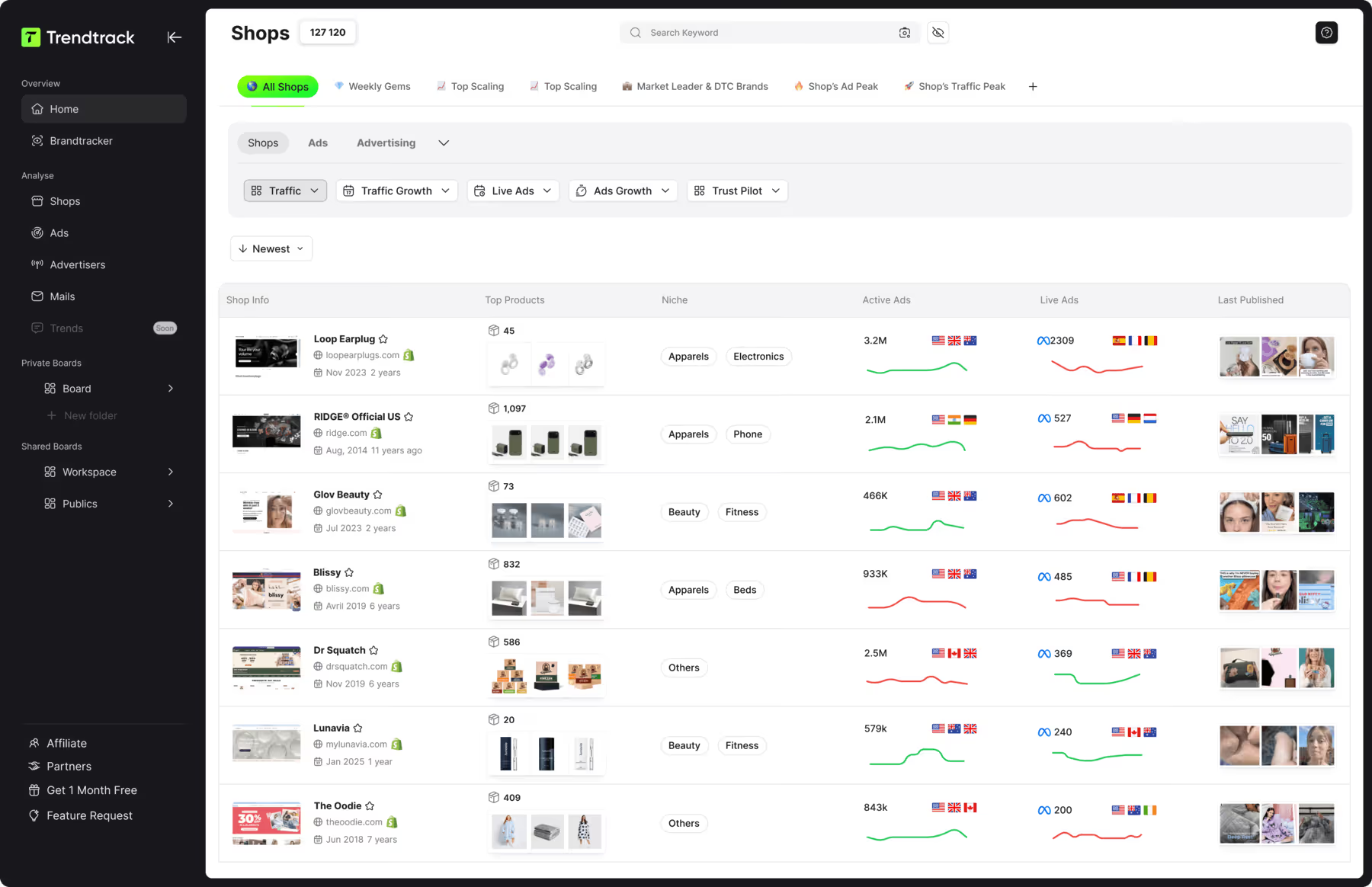
AI connected to real-time e-commerce databases like Trendtrack allows you to identify winning products in a structural and systematic way. Our MCP connection with Claude allows you to query our database in natural language to identify the products whose advertising demand is growing fastest in a given niche, analyze the common characteristics of the best-performing creatives, and detect market opportunities that aren't yet saturated. Our browser extension enriches every browsing session with real-time performance data that immediately signals whether a product you're viewing is in an emergence or decline phase.
Are AI-generated UGC videos as effective as real UGC?
Results observed on advertising platforms in 2026 show that UGC videos generated by AI tools like Higgsfield achieve ad performance comparable to real human UGC across many product types. The key is the quality of the script, the relevance of the hook, and the credibility of the product presentation rather than the absolute authenticity of the avatar used. AI UGC is particularly effective for large-scale creative testing phases because it allows you to quickly test many script and angle variations at low cost before investing in more elaborate human productions to scale the validated angles.
Which AI tools are essential for an e-commerce operator in 2026?
The ecosystem of useful AI tools for e-commerce in 2026 is vast, but a few categories are particularly indispensable. For product research and competitive intelligence, our Trendtrack platform with its extension and MCP connection to Claude is the reference for e-commerce operators who want real-time market data. For UGC video creation, Higgsfield allows you to produce realistic ad content without filming. For text content writing, Claude and ChatGPT are the top-performing models for product listings, emails, and sales pages. For ad optimization, Meta Advantage+ and Google Performance Max are the most accessible native tools. And for customer experience personalization, solutions like Klaviyo AI, Nosto, or Dynamic Yield offer advanced personalization capabilities directly integrable into the leading e-commerce platforms.
Is AI accessible to small e-commerce operators or only to large brands?
AI is perfectly accessible to e-commerce operators of all sizes in 2026. The majority of the most impactful tools are available at reasonable monthly rates that pay for themselves quickly from the first results. No-code platforms and native integrations in e-commerce tools like Shopify or Klaviyo allow merchants without technical skills to access advanced AI features without any development investment. The democratization of AI is precisely what has created the urgency of adoption for smaller operators. Those who don't adopt these tools are no longer competing on equal footing with those who do regardless of store size.
How do you measure the real impact of AI on an e-commerce store's performance?
Measuring the impact of AI on an e-commerce store requires defining precise metrics before and after adopting the tools. For product research, measure the average time between identifying a product and launching it, as well as your launch success rate. For content creation, measure the production time for product listings and emails along with the associated open and conversion rates. For advertising, compare the ROAS of manually managed campaigns versus those optimized by AI. And for competitive intelligence, evaluate your reaction time to competitors' moves before and after automating your benchmark. These before-and-after metrics give you an objective view of the return on investment of each AI tool integrated into your workflow.

.avif)
Ready to build a million-dollar brand?
.avif)