How much does a TikTok Ads campaign cost?


Before committing budget to a new channel every advertiser asks the same question. The answers found online range from "a few euros a day" to "thousands to get started", which helps nobody. So how much does a TikTok Ads campaign actually cost and what should you realistically plan for?
The platform imposes minimum budgets that set the floor. TikTok requires a minimum daily budget at campaign level and another at ad group level, with lifetime budget minimums calculated accordingly. These thresholds mean you cannot test seriously with five euros a day, whatever some guides suggest.
Beyond those minimums your real cost depends on several variables. The cost per click on TikTok typically sits below Meta and Google, often in the range of a few tens of cents depending on your market and audience. The cost per thousand impressions varies with competition, season and targeting. And the metric that actually matters, your cost per acquisition, depends on your conversion rate and your creative far more than on any platform setting.
That last point is where most budget questions are answered incorrectly. Two advertisers spending identical amounts on the same audience can see costs per purchase that differ by a factor of three, purely because one has stronger creatives and a better landing page. On TikTok the video drives most of the result, which means your budget efficiency is largely determined before you ever open Ads Manager.
There is also the learning phase to account for. The algorithm needs enough conversions to identify who buys, generally around fifty, which means a budget too small never exits that phase and delivers unstable results indefinitely.
In practice a realistic first test sits between 30 and 50 euros per day over seven days, or roughly 210 to 350 euros, with the exact figure depending on your product price and margin.
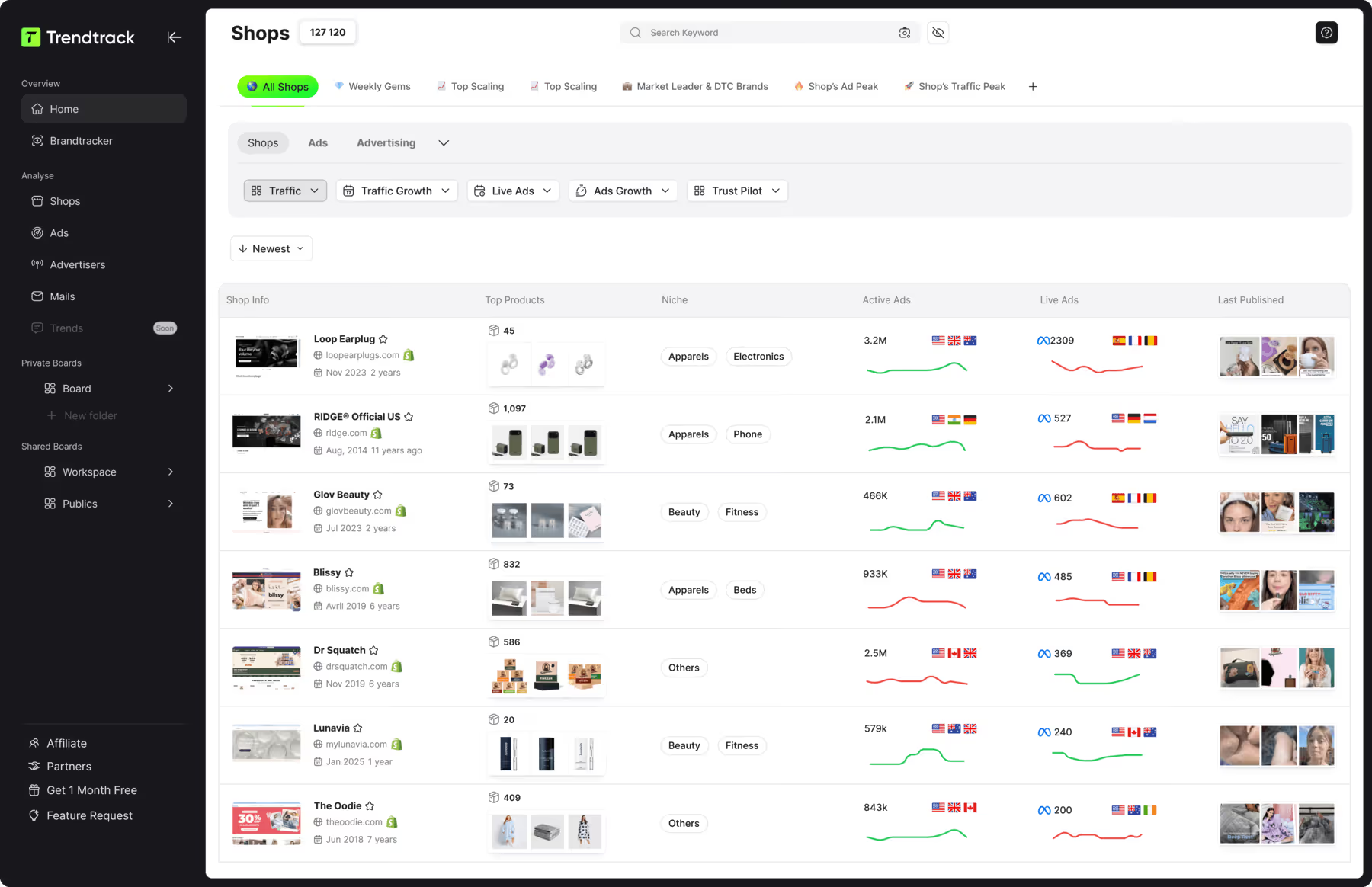
To see which creatives competitors are actually scaling before you spend, Trendtrack available at app.trendtrack.io/en/sign-up indexes 95 million TikToks with 700,000+ brand profiles updated every 24 hours.
In this article we break down exactly what a TikTok Ads campaign costs.
What Are TikTok Ads Minimum Budgets?
TikTok enforces hard budget floors at two levels simultaneously, and falling below either one prevents your campaign from launching. Here are the minimum budgets required in TikTok Ads Manager.
Table: TikTok Ads minimum budgets
| Level | Budget type | Minimum required |
|---|---|---|
| Campaign | Daily budget | $50 |
| Campaign | Lifetime budget | $50 total |
| Ad group | Daily budget | Above $20 |
| Ad group | Lifetime budget | $20 × scheduled days |
| Ad group, 7 days | Lifetime budget | $140 |
| Ad group, 31 days | Lifetime budget | $620 |
| Web conversions, North America and EMEA | Daily budget | $30 recommended floor |
TikTok's official documentation confirms these thresholds: at campaign level both daily and total budgets must exceed 50 USD, while at ad group level daily budgets must exceed 20 USD, with lifetime budgets calculated as the minimum daily budget multiplied by the number of scheduled days. A 31-day delivery schedule therefore requires a minimum ad group budget of 620 USD. TikTok
One detail catches advertisers out. The ad group minimum is strictly above 20 USD, meaning a budget of $20.01 clears the threshold while a flat $20.00 does not. Web conversion campaigns also carry a higher recommended floor in certain markets, with TikTok's Budget and Bidding FAQ stating $30 per day for North America and EMEA brands while APAC brands stay at the $20 floor.
The critical point is that these floors are not recommendations. They let you launch a campaign without giving it enough to actually work, since a $20 per day ad group can run but cannot necessarily learn.
TikTok's learning phase requires roughly 50 conversion events per ad group per week to complete, which means an advertiser with a $25 cost per acquisition needs around $179 per day per ad group, nearly nine times the platform minimum. Underfunded ad groups that never exit learning typically show CPMs 40 to 60% higher than optimized ones.
A common structural mistake compounds this. Splitting a $3,000 monthly budget across ten ad groups gives each one $10 per day, half the platform minimum, so individual ad groups starve even when the campaign level threshold is met. Consolidating into two or three ad groups maximum until your budget exceeds $200 per day avoids this.
What Is the Average CPC and CPM on TikTok Ads?
Two metrics govern how far your budget goes: the cost per thousand impressions, which determines your reach, and the cost per click, which determines your traffic volume. Here is what to expect on TikTok in 2026.
| Metric | Typical range | Comparison |
|---|---|---|
| CPM (cost per 1,000 impressions) | Around $3.50 average | Roughly half of Meta's $6.59 average |
| CPC (cost per click) | Varies by objective and industry | Generally below Meta and Google |
| CPC warning threshold | Above $2.00 | Signals creative or targeting problems |
| Learning phase CPM penalty | 40 to 60% higher | On underfunded ad groups |
The headline figure is TikTok's CPM advantage. According to the Global Ad Cost Index 2026, TikTok's average CPM of $3.50 makes it significantly more affordable than Meta's $6.59 average, giving advertisers nearly twice the reach for the same budget. For brands looking to build awareness or test creative volume this gap is substantial.
Cost per click varies considerably based on your campaign objective and industry. Awareness campaigns naturally produce lower CPCs than conversion campaigns since the algorithm optimizes for different outcomes. Competitive sectors with high customer value push costs upward, while less contested niches stay well below average.
There is a useful diagnostic threshold worth remembering. If your CPC consistently exceeds $2.00, this typically indicates issues with ad creative or overly narrow targeting that need attention. In other words a high CPC on TikTok is rarely a market problem, it is usually a signal that your video fails to hold attention or that you have restricted your audience too tightly.
Several factors move these numbers in either direction. Seasonality matters enormously, with costs rising sharply during Black Friday, the holiday period and other retail peaks as advertiser competition intensifies. Geography creates wide variation since North American and Western European markets cost considerably more than emerging markets. Targeting breadth affects pricing directly, as narrow audiences force the algorithm to compete harder for a smaller pool of users.
The most controllable factor remains creative quality. On TikTok the algorithm rewards content that holds attention with cheaper delivery. A video with a strong hook and high completion rate earns better placement at lower cost, while an ad people scroll past immediately becomes progressively more expensive to serve. This is why two advertisers targeting the same audience can see CPMs differing by a factor of two.
Budget adequacy also influences cost more than most realize. Underfunded ad groups that never exit the learning phase typically show CPMs 40 to 60% higher than optimized ones, which means starving your campaigns actively raises your unit costs rather than saving money.
Ultimately CPC and CPM are diagnostic metrics rather than decision metrics. What determines profitability is your cost per acquisition, which depends on conversion rate as much as on traffic cost.
What Budget Should You Plan for Your First TikTok Campaign?
The honest answer sits well above the platform minimums. TikTok lets you launch at $50 per day at campaign level, but that threshold keeps your ads eligible to run rather than guaranteeing they learn or perform.
For a meaningful first test plan at least $500 in total budget, and ideally between $700 and $1,000 over your first month. That range allows you to launch two or three ad groups above the minimums and generate enough data to judge whether TikTok works for your specific product. Below that you are essentially paying for the learning phase without ever collecting its benefits.
The reason comes down to conversion volume. TikTok's learning phase requires roughly fifty conversion events per ad group per week to complete. If your target cost per acquisition is $25, reaching that volume demands around $179 per day, nearly nine times the ad group floor. Most advertisers cannot commit that immediately, which is why a longer test at a moderate budget often works better than a short burst at the minimum.
Your product price and margin should anchor the calculation. A store selling a $30 item with $12 of margin needs a cost per purchase below $12 to be viable, which is extremely demanding on any paid channel. A store selling at $80 with $45 of margin has far more room to absorb acquisition costs while the algorithm learns.
Two practical rules help. Consolidate into two or three ad groups maximum rather than splitting your budget across many, since underfunded groups starve. And run continuously for at least seven days without pausing, because interrupting delivery resets the learning entirely.
How to Reduce Your TikTok Ads Costs?
Lowering your costs on TikTok has less to do with bidding settings than with the quality of what you put in front of people. Here is how to reduce your TikTok Ads costs.
Improve your hook since a video that holds attention past three seconds earns cheaper delivery from the algorithm
Shoot native rather than polished because ads that look like advertising get scrolled past, which raises your effective cost per result
Keep targeting broad as narrow audiences force the algorithm to compete harder for a smaller pool and push CPMs upward
Fund your ad groups properly since underfunded groups that never exit learning show CPMs 40 to 60% higher than optimized ones
Consolidate your structure into two or three ad groups rather than splitting budget across many that all starve
Let campaigns run without interruption because pausing or editing resets the learning phase and wastes what you already spent
Restrict placements to TikTok rather than including the Pangle partner network, which generally delivers lower quality traffic
Refresh creatives regularly as fatigue sets in within two to three weeks and costs climb as performance decays
Improve your landing page since conversion happens after the click and a better page lowers cost per purchase without touching Ads Manager
Avoid peak seasons for testing as competition during Black Friday and holiday periods raises costs across the board
Among these the creative quality is by far the most impactful. The algorithm rewards content that holds attention with cheaper placement, which means two advertisers on the same audience can see costs differing by a factor of two purely because of their videos.
Budget adequacy comes next and is counterintuitive. Starving your campaigns actively raises your unit costs rather than saving money.
FAQ about TikTok Ads costs
What is the minimum budget to advertise on TikTok?
TikTok enforces two hard floors simultaneously. At campaign level both daily and total budgets must exceed 50 USD, while at ad group level daily budgets must exceed 20 USD. Lifetime budgets at ad group level are calculated as 20 USD multiplied by the number of scheduled days, meaning a 31-day campaign requires at least 620 USD. Note that the ad group threshold is strictly above 20 USD, so a budget of $20.01 clears it while a flat $20.00 does not. Web conversion campaigns in North America and EMEA carry a higher recommended floor of $30 per day.
Is TikTok cheaper than Facebook Ads?
On raw reach, yes. According to the Global Ad Cost Index 2026, TikTok's average CPM of $3.50 sits well below Meta's $6.59 average, giving advertisers nearly twice the impressions for the same spend. That advantage does not automatically translate into cheaper conversions however. Your cost per acquisition depends on your creative quality, your landing page and your conversion rate as much as on traffic cost. TikTok rewards native, attention-holding content, which means brands accustomed to polished Meta creatives often see disappointing results until they adapt their approach.
Why is my TikTok CPC so high?
A consistently high cost per click usually signals one of two problems. The first is creative quality, since a video that fails to hold attention past the first seconds gets penalized by the algorithm with more expensive delivery. The second is overly narrow targeting, which forces the system to compete harder for a smaller audience pool. As a diagnostic threshold, a CPC consistently above $2.00 typically indicates issues with ad creative or targeting that need attention rather than a market pricing problem. Broadening your audience and testing stronger hooks generally resolves it.
How long before TikTok Ads become profitable?
Expect at least seven days before drawing any conclusion, since the learning phase requires roughly fifty conversion events per ad group per week to complete. During that period results are deliberately unstable and your cost per result runs higher than it will once the algorithm stabilizes. Profitability itself depends on your product margin and creative performance. Some advertisers reach a viable cost per acquisition within the first test, others need several creative iterations across a few weeks. Cutting campaigns after twenty-four hours is the most common and most expensive mistake.
Do Spark Ads cost more than regular ads?
Spark Ads use the same auction and bidding system as In-Feed Ads, so there is no separate premium built into the format. In practice they often perform more efficiently because they carry the accumulated likes, comments and shares of the original organic post. That social proof typically improves click-through and conversion rates, which lowers your effective cost per result even at an identical CPM. If you work with creators, Spark Ads are generally the more cost-effective route to scale proven content.
How much should a small business budget monthly for TikTok?
Plan between $700 and $1,000 for your first month if you want a genuinely informative test. This allows you to launch two or three ad groups above the minimums and generate enough data to judge whether the channel works for your product. Budgets below $500 total rarely produce enough conversions for the algorithm to optimize, which means you pay for the learning phase without benefiting from it. Consolidating into fewer, properly funded ad groups always outperforms spreading the same amount across many underfunded ones.
Useful Resources:

.avif)
Ready to build a million-dollar brand?
.avif)