Dropship.io Review: Price; Features ; Comparison



Among product research tools, Dropship.io built its reputation on a specific angle: revenue data pulled from Shopify stores. Rather than surfacing products from marketplaces, it shows you what competing stores are actually selling and roughly how much they make. But does that approach still hold up in 2026?
Dropship.io is a product research and competitor intelligence platform built for Shopify sellers. Its Product Library indexes millions of items with revenue estimates, its Sales Tracker monitors competitor stores, and an Ad Library, weekly Product Drops and a Chrome extension complete the offering.
Pricing runs across three tiers: Basic at 39 dollars monthly or 26 annually, Standard at 59, and Premium at 99, with a 7-day trial.
Two structural points deserve stating upfront. The data is modelled rather than measured, which makes it useful for ranking competitors and unreliable for precise business cases. And the platform is Shopify-centric, which produces real depth there and leaves everything else outside.
Its Ad Library also shows what runs now without preserving history, so you cannot tell a creative profitable for six months from one launched last week.
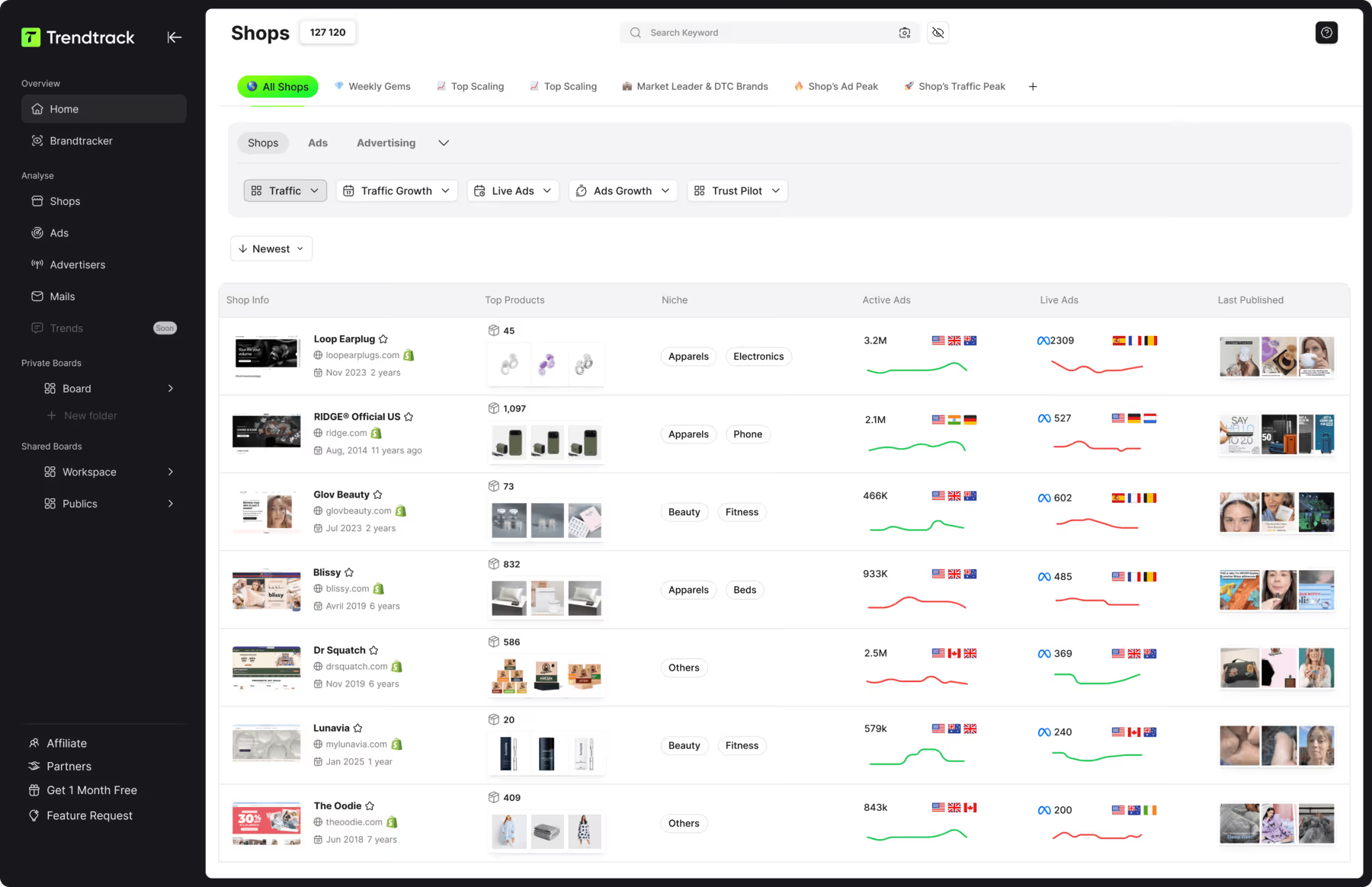
Trendtrack available at app.trendtrack.io/en/sign-up preserves full ad history across Meta, TikTok and Google, with 700,000+ brand profiles refreshed every 24 hours.
In this article we deliver our complete Dropship.io review.
What Is Dropship.io?

Dropship.io is a product research and competitor intelligence platform built specifically for Shopify sellers. Operated by Dropship FZCO, a company registered in Dubai, it has become one of the more recognized tools in the dropshipping category.
Its operating principle sets it apart from most competitors. Where tools like Ecomhunt curate products manually and others crawl AliExpress listings, Dropship.io works from the store side. It indexes millions of products across Shopify stores and models their revenue, which lets you see what is actually selling rather than what might sell.
That orientation produces a different research workflow. You start from a competitor rather than from a product, examining their catalog, their best sellers and their estimated performance, then work backward to identify what you could sell yourself.
The platform organizes around three operational layers.
The discovery layer includes the Product Library, which indexes items with revenue estimates, sales velocity and historical trends, filterable by price, reviews, store age and category. Weekly Product Drops deliver 20 to 40 curated picks depending on your plan.
The monitoring layer covers the Sales Tracker, where you add specific Shopify stores and follow their performance over time, and Competitor Research, which analyzes individual stores on demand.
The execution layer includes one-click Shopify import, pushing products directly into your store, and a Chrome extension that surfaces data while you browse stores and Facebook advertisers.
An Ad Library covering Meta creatives and Magic AI Search complete the toolkit, alongside Dropship University, a training program included across all plans.
Its target audience is clearly defined: Shopify sellers running paid ads, typically spending somewhere between 500 and 5,000 dollars monthly, who need to validate a product before scaling.
One characteristic defines the data and deserves stating plainly. Revenue figures are modelled rather than measured. Dropship.io estimates store performance from signals it can observe externally, which produces useful relative comparisons and unreliable absolute numbers. The platform is reasonably transparent about this, and independent testing rates it 7.8 out of 10 partly on that basis.
A second structural point: the platform is Shopify-only. That focus produces genuine depth where it operates and leaves WooCommerce, Amazon and other platforms entirely outside.
What Features Does Dropship.io Offer?
The platform organizes around discovery, monitoring and execution. Here is what each module delivers.
Product Library
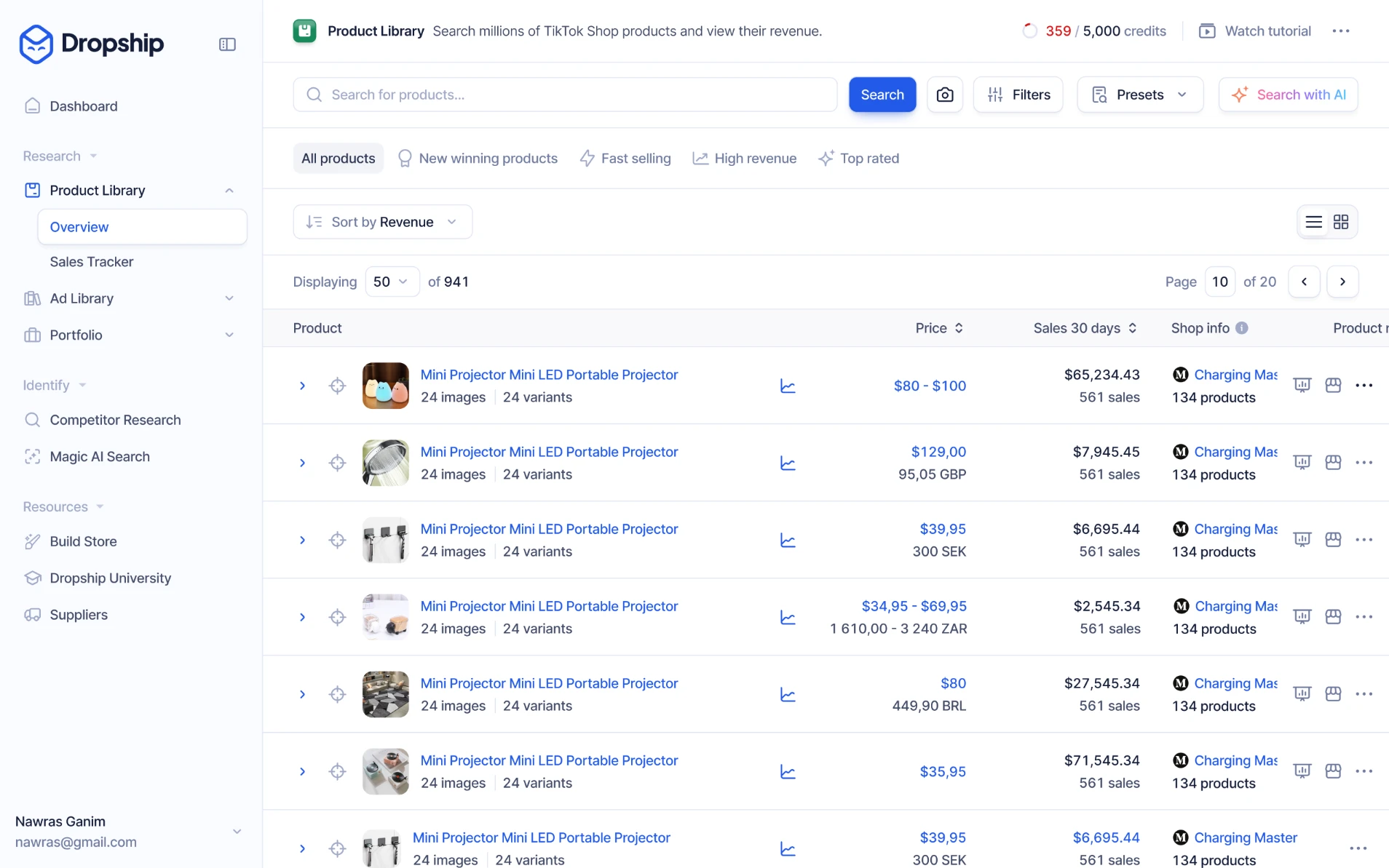
The core module and the starting point the platform recommends. It indexes millions of products pulled from Shopify stores with revenue estimates, sales velocity and historical trends.
Filters cover price, estimated sales, reviews, store age and category, with predefined views like Best Sellers and New Arrivals. Credits range from 10,000 to 50,000 depending on your plan.
Sales Tracker
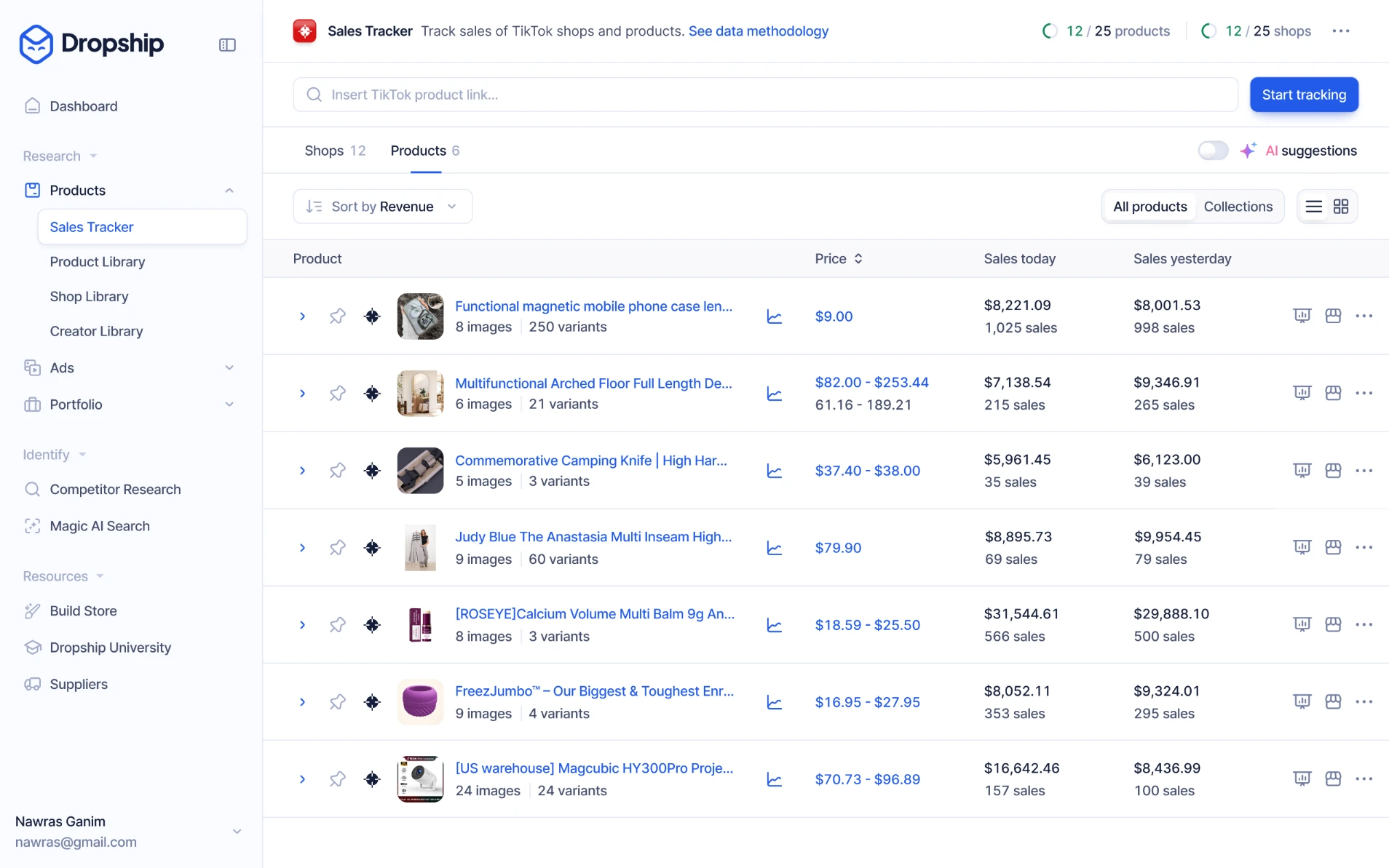
The monitoring layer. You add specific Shopify stores and products, then follow their performance over time rather than reading a single snapshot.
This matters more than it appears. A product selling consistently across several weeks tells you considerably more than one appearing in a single scan. Tracker capacity scales with your plan.
Competitor Research
Analyzes individual Shopify stores on demand, surfacing their estimated revenue, best-selling products and catalog composition.
Basic limits you to 20 searches daily, while Standard and Premium remove the cap entirely.
Ad Library
Covers Meta creatives, letting you browse ads and the products behind them.
One limitation deserves noting: the module shows what is running now without preserving history. You cannot distinguish a creative profitable for six months from one launched last week, which is the clearest profitability signal available from outside.
Product Drops
Weekly curated picks delivered with sourcing links and margin estimates, ranging from 20 to 40 products depending on your tier.
Useful for inspiration, though every subscriber receives the same list, which means saturation arrives quickly on anything promising.
Chrome extension
Surfaces Dropship.io data directly over Shopify stores and Facebook advertisers you visit, with one-click import from product pages.
This is a genuine workflow improvement, removing the back-and-forth between browsing and dashboard.
Shopify integration
Pushes products directly into your store with images, descriptions and pricing prefilled. Import volume ranges from 100 to 500 monthly by plan.
It also works with AutoDS for fulfillment automation.
Dropship University
A training program included across all tiers, covering dropshipping from setup to scaling. Useful for beginners, redundant for experienced operators.
How Much Does Dropship.io Cost?
Three plans structure the offering, all built around a credit system. Here is the monthly breakdown.
Table: Dropship.io pricing
| Feature | Basic | Standard | Premium |
|---|---|---|---|
| Monthly price | $39 | $59 | $99 |
| Product Library credits | 10,000 | 25,000 | 50,000 |
| Shop Library credits | 5,000 | 12,500 | 25,000 |
| TikTok Shops tracked | 10 | 25 | 50 |
| TikTok products tracked | 25 | 50 | 100 |
| Ad Library credits | 10,000 | 25,000 | 50,000 |
| Advertiser Library credits | 5,000 | 12,500 | 25,000 |
| Advertisers tracked | 10 | 25 | 50 |
| Competitor Research | 20 searches daily | Unlimited | Unlimited |
| Creator Library credits | 3,000 | 6,000 | 10,000 |
| Product Drops | 20 per week | 30 per week | 40 per week |
| AI Search credits | 100 | 200 | 400 |
As the table shows, every tier runs on credits rather than unlimited access. That structure matters more than the headline price, since heavy research consumes allowances faster than most users anticipate.
Basic at 39 dollars suits someone testing the research workflow. Its real constraint is the 20 daily competitor searches, which caps you quickly once you start examining stores seriously.
Standard at 59 dollars removes that cap entirely with unlimited competitor research and roughly doubles every credit allowance. For an active Shopify seller running weekly research, this is the plan that makes operational sense.
Premium at 99 dollars doubles again across the board and raises Product Drops to 40 weekly. It justifies itself for operators managing multiple stores or running daily research loops.
Annual billing brings Basic to around 26 dollars monthly, a meaningful discount across all tiers.
Two points deserve attention.
The credit system applies separately to each library, meaning Product, Shop, Ad, Advertiser and Creator allowances deplete independently. Tracking five separate counters is operationally awkward.
And TikTok tracking caps are restrictive at the entry level, with 10 shops and 25 products on Basic.
What Are the Limits of Dropship.io?
Several constraints deserve attention before you subscribe.
Estimated rather than measured data on store revenue and sales figures
Five separate credit counters depleting independently across libraries
Shopify-centric coverage, leaving WooCommerce, Amazon and others outside
No ad history in the Ad Library, showing only what runs now
Restrictive competitor search cap at 20 daily on Basic
Shared Product Drops, delivered identically to every subscriber
Limited TikTok tracking at entry level with 10 shops and 25 products
No refunds once the trial period ends
Trial requires a card, which several reviews flag
Among these, the estimated data is the most structural and the one Dropship.io is reasonably transparent about. Store revenue figures are modelled from externally observable signals rather than measured, which makes them genuinely useful for ranking competitors against each other and unreliable for building a business case on precise numbers.
Treat a competitor showing 50,000 dollars monthly as “performing well relative to others” rather than as a verified figure.
The credit system across five libraries is the most operationally awkward. Product, Shop, Ad, Advertiser and Creator allowances deplete independently, which means tracking five separate counters and discovering mid-research that one has run out while others remain full.
The absence of ad history matters once you move past product selection. The Ad Library shows what is running now, which means you cannot distinguish a creative profitable for six months from one launched last week. Since nobody funds a losing campaign that long, longevity is the clearest profitability signal available from outside, and its absence undermines the module considerably.
The Shopify focus cuts both ways. It produces genuine depth where the platform operates, and leaves you blind to everything else. For a seller running Shopify exclusively, that trade works. For anyone operating across platforms, it does not.
Shared Product Drops create the same saturation problem every curated list faces. Twenty to forty picks delivered simultaneously to every subscriber means hundreds of sellers launching identical products within days.
The no-refund policy deserves flagging too. Once your trial ends, the subscription is non-refundable, which makes the trial period your only genuine evaluation window.
Dropship.io vs Trendtrack
The two platforms serve adjacent needs without doing the same job. Dropship.io researches products through Shopify store data. Trendtrack tracks what the market actually advertises. Here is the comparison.
| Criterion | Trendtrack | Dropship.io |
|---|---|---|
| Ad history | Full history preserved | Live ads only |
| Platforms covered | Meta, TikTok, Google | Meta, TikTok Shop, Shopify |
| Google Ads | Search, Shopping, YouTube, Display | Not covered |
| Data refresh | Every 24 hours | Variable |
| Brand profiles | 700,000+ | Shopify store database |
| TikTok library | 95 million | Shop tracking, capped by plan |
| Credit system | No per-library counters | Five separate counters |
| Competitor monitoring | BrandTracker, continuous | Sales Tracker, capped by plan |
| Store revenue estimates | Shop Analytics | Core strength |
| Shopify import | Not included | One-click, 100 to 500 monthly |
| Chrome extension | Included | Included |
| MCP integration | Claude and ChatGPT | Not available |
| Entry price | $49 per month | $39 per month |
As the table shows, the decisive gap is ad history. Dropship.io shows what is running now. Trendtrack maintains a searchable archive, which lets you distinguish a creative profitable for six months from one launched last week.
That distinction is the clearest profitability signal available from outside, since nobody funds a losing campaign that long.
The second gap is Google Ads coverage. Dropship.io covers Meta and TikTok Shop, leaving Search, Shopping, YouTube and Display entirely invisible. For e-commerce categories where competitors increasingly run Shopping alongside social, that blind spot costs you.
The third concerns operational friction. Dropship.io runs five separate credit counters across its libraries, which deplete independently and force you to manage allowances mid-research.
Two points go to Dropship.io and deserve stating plainly. Its Shopify store revenue estimates are a genuine strength Trendtrack does not replicate in the same depth. And its one-click Shopify import removes a real step in the research-to-launch workflow.
The practical split is therefore clear. If your need is finding products through Shopify store data with direct import to your store, Dropship.io covers that at a slightly lower entry price.
Useful Resources

.avif)
Ready to build a million-dollar brand?
.avif)