Ecomhunt Review 2026: Price; Features


Among product research tools, Ecomhunt is one of the oldest and most recognized. Its proposition has barely changed since launch: a daily list of winning products hand-picked by real people rather than surfaced by an algorithm. But does that model still hold up in 2026?
Ecomhunt is a curated product discovery platform aimed at dropshippers. Each day a team selects products showing commercial traction and publishes them with supplier links, profit margin estimates, Facebook targeting suggestions, AliExpress statistics and ready-made video creatives.
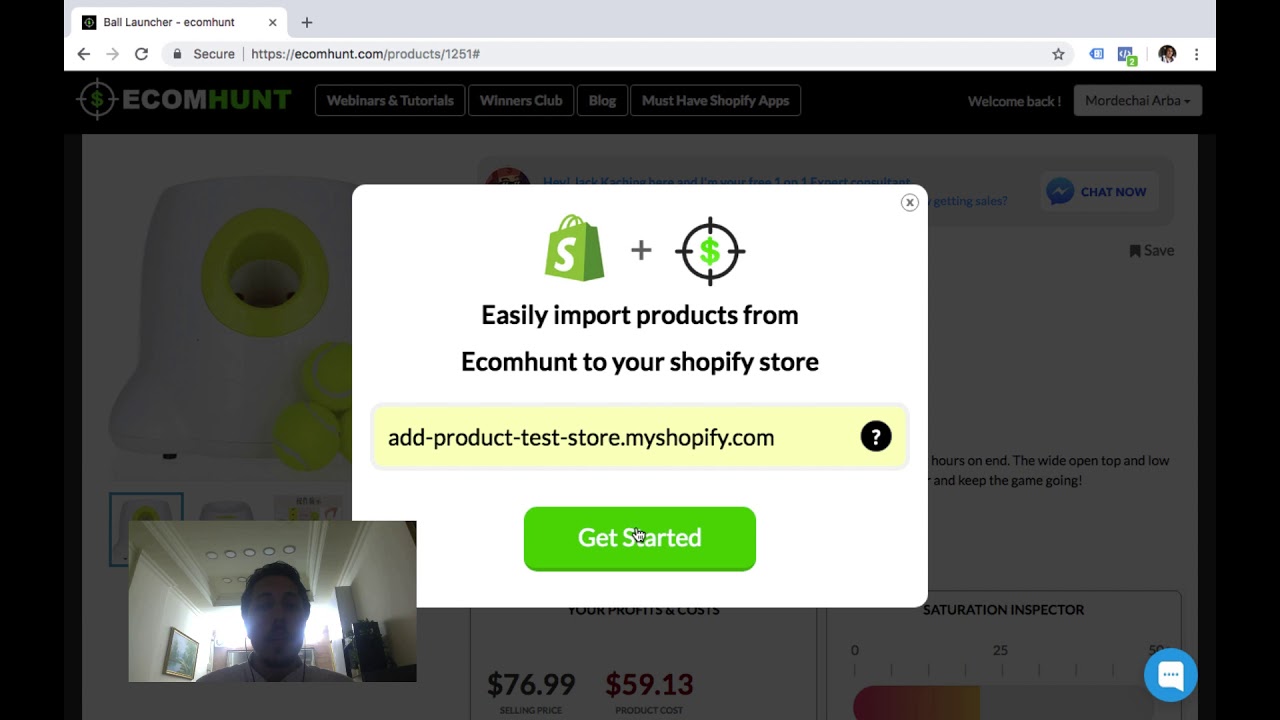
Several tools complete the offering. Adam provides AI-assisted analysis, the Saturation Inspector estimates how crowded a product already is, the Product Tracker monitors competitor stores, and a Shopify one-click import pushes listings directly into your store.
Pricing follows four tiers. Free at zero dollars with limited access, Basic at 29 dollars monthly or 23 annually, Pro at 49 dollars monthly or 39 annually, and Suite at 69 dollars monthly or 49 annually.
The structuring variable across those tiers is product freshness. Lower plans receive products on a delay, and the delay is precisely what determines whether a pick is still exploitable.
That points to the platform’s central weakness. Every subscriber receives the same curated list, which means a genuinely promising product is launched by hundreds of sellers within the same week. The Saturation Inspector exists to address this, which tells you the problem is real.
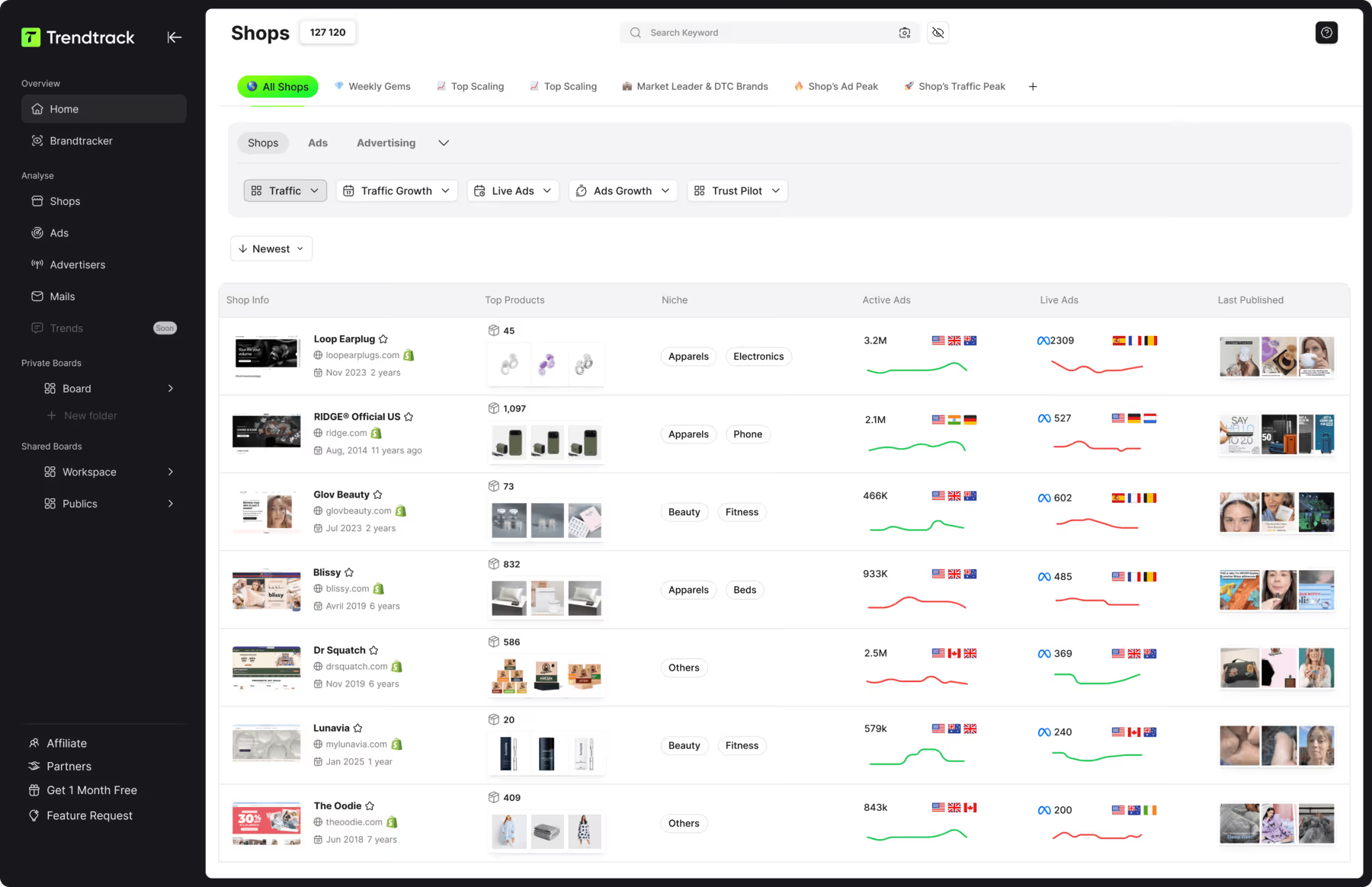
Trendtrack available at app.trendtrack.io/en/sign-up takes a different approach entirely, preserving full ad history across Meta, TikTok and Google, indexing 95 million TikToks and refreshing 700,000+ brand profiles every 24 hours.
In this article we deliver our complete Ecomhunt review for 2026.
What Is Ecomhunt?

Ecomhunt is a product discovery platform built for dropshippers, and one of the longest-running tools in this category. Its operating model has stayed remarkably consistent since launch.
The core principle is human curation rather than algorithmic scraping. Where most competitors crawl marketplaces and surface products matching statistical criteria, Ecomhunt employs a team that manually selects items showing genuine commercial traction, then publishes a limited daily list.
That distinction shapes everything about the product. You receive a few picks per day rather than thousands of filtered results, which removes the decision paralysis beginners face when confronting an unfiltered database.
Each product arrives with substantial context attached. Supplier links to AliExpress, profit margin estimates, Facebook targeting suggestions, AliExpress and eBay statistics, customer reviews, Instagram influencer suggestions and frequently ready-made video creatives you can adapt for your own ads.
This packaging is the platform’s genuine strength. A beginner receives not just a product idea but a near-complete launch kit, which compresses the research phase considerably.
Several tools surround that core. Adam adds AI-assisted product analysis. The Saturation Inspector estimates how crowded a product already is. The Product Tracker monitors competitor stores over time. And a Shopify integration imports listings in one click with images, descriptions and pricing prefilled.
The platform targets beginners and early-stage sellers explicitly, which explains its interface simplicity and its educational components on higher tiers.
One characteristic defines its commercial model: product freshness is the paid variable. Lower plans receive the same picks on a delay, and that delay determines whether a product is still exploitable.
Trendtrack available at app.trendtrack.io/en/sign-up covers ad intelligence with full history across three platforms.
What Features Does Ecomhunt Offer?
The platform organizes around a curated core with several tools built on top. Here is what each delivers.
Daily curated products
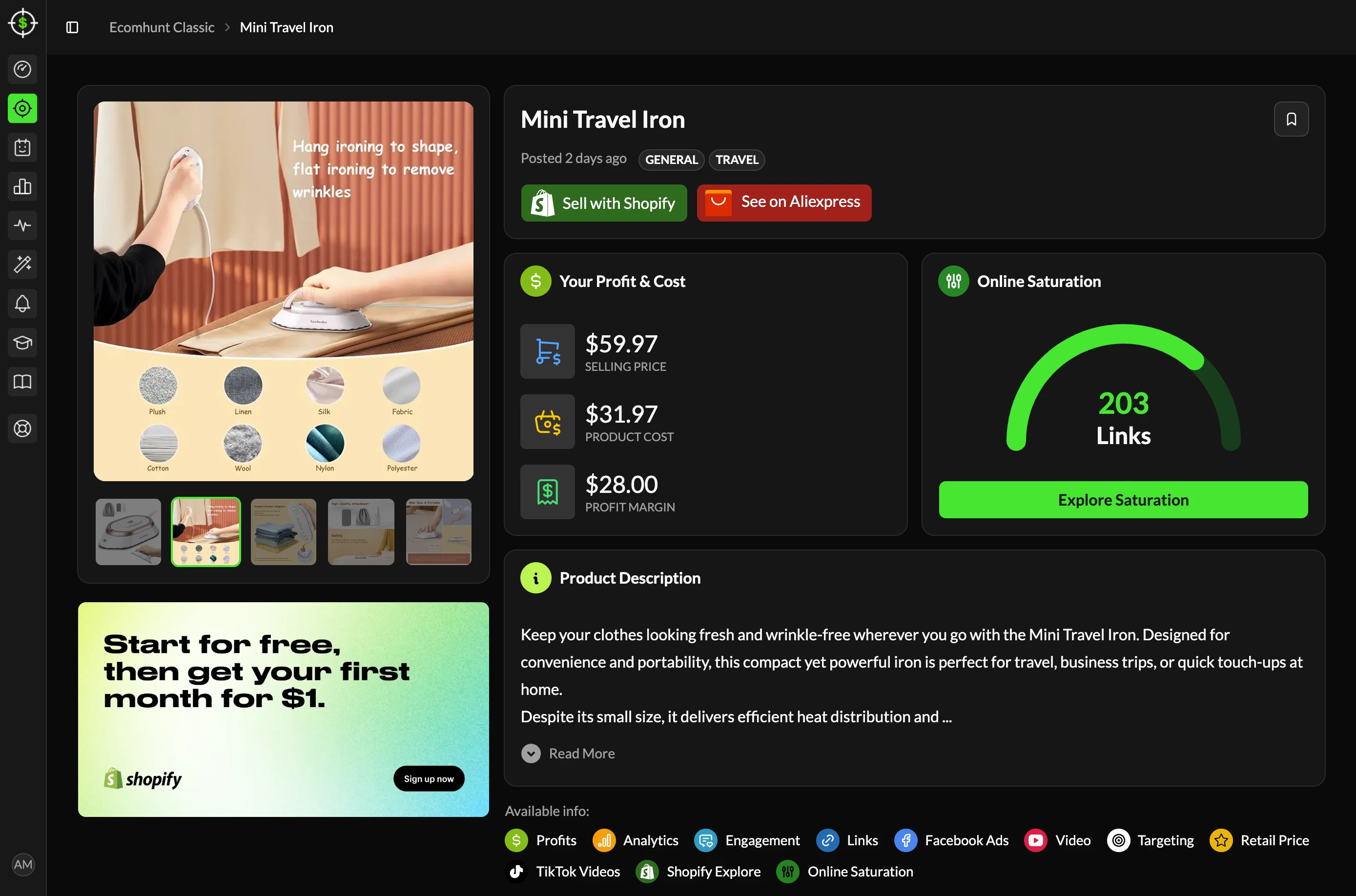
This is the engine and the reason subscribers pay. A team selects a limited number of products each day showing genuine commercial traction, then publishes them with full context attached.
Each listing includes supplier links, profit margin estimates, AliExpress and eBay statistics, customer reviews and engagement data from stores already selling it.
The value for a beginner is real. You receive a near-complete launch kit rather than a raw product idea, which removes the most paralyzing part of starting out.
Ad examples and creatives
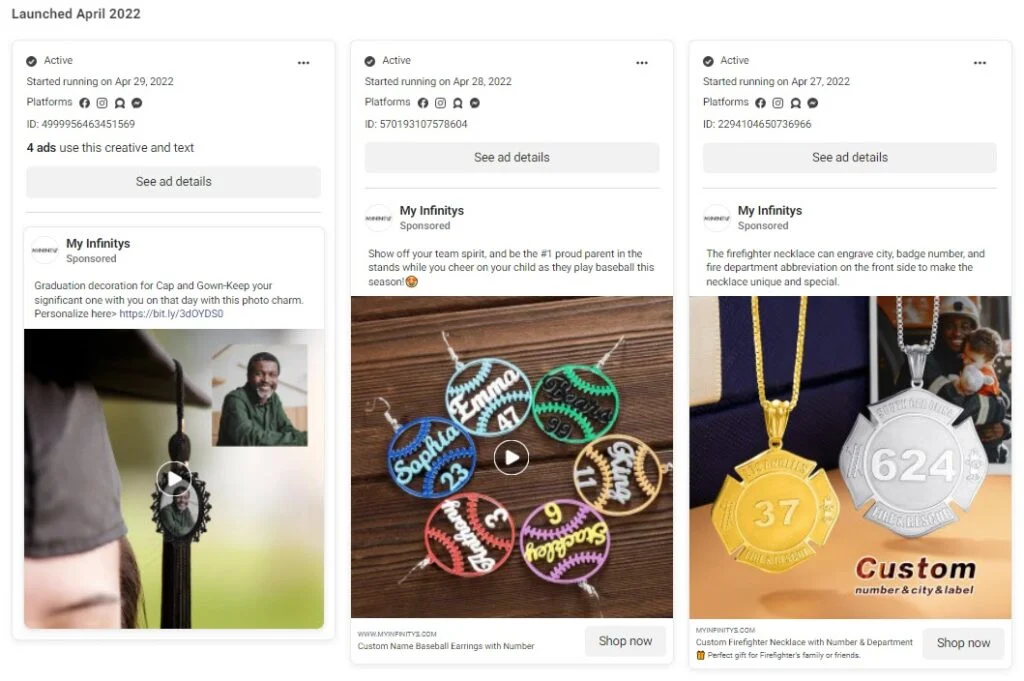
Most products arrive with ready-made video creatives, ad copy suggestions and Facebook targeting recommendations drawn from campaigns already running.
This is where Ecomhunt differentiates most clearly from pure database tools. You can adapt an existing creative rather than producing one from scratch, which compresses your testing timeline considerably.
Instagram influencer suggestions complete the package on some listings.
Saturation Inspector
This tool estimates how crowded a product already is by analyzing how many stores are actively selling it.
Its existence is telling. The platform built it because curated lists reach every subscriber simultaneously, which creates saturation by design. The Inspector helps you identify which picks are already overexploited, though it addresses a symptom rather than the cause.
Product Tracker
Monitors competitor stores over time, showing sales evolution and product additions.
This is genuinely useful for validation. Seeing a product sustain sales across several stores over weeks tells you considerably more than a single snapshot. Tracker sessions are capped by plan, which is one of the main variables between tiers.
Adam

An AI-assisted analysis tool layered over the product database, offering suggestions and summaries.
Useful as a complement rather than a decision-maker. Treat its output as a starting point.
Shopify integration
A one-click import pushes listings directly into your store with images, descriptions and pricing prefilled.
For a beginner this removes genuine friction. It also means hundreds of stores import identical listings with identical copy, which is worth editing before publishing.
Ecomhunt Lucky
A spin-the-wheel feature surfacing random products from the database. Entertainment rather than research, as the platform itself positions it.
Courses and consulting
Higher tiers include educational content, and the top plan adds one-on-one consulting sessions with experienced dropshippers.
This is a meaningful differentiator at the premium level, though it only justifies the cost if you actually use the sessions.
What the feature set does not cover?
One gap deserves naming. Ecomhunt shows you ad examples attached to its curated picks, not a searchable ad library with history. You cannot look up a competitor and see what they have run over months, nor distinguish a creative profitable for six months from one launched last week.
How Much Does Ecomhunt Cost?
Three paid tiers structure the offering, with a free plan underneath. Here is the official pricing in monthly billing.
Table: Ecomhunt pricing
| Plan | Monthly price | Live trending products | Tracker sessions |
|---|---|---|---|
| Free | $0 | Limited | Limited |
| Basic | $29 | 50 | 10 |
| Pro | $49 | 80 | 100 |
| Suite | $69 | 120 | 500 |
As the table shows, the variables between tiers are product access and tracker capacity rather than entirely different feature sets.
Basic at 29 dollars monthly includes two years of the winning products database, specific product data and analytics, 50 live trending products and 10 tracker sessions. It covers discovery without the depth tools.
Pro at 49 dollars monthly is marked as the popular tier and unlocks unlimited access to all Ecomhunt features. It adds a one-on-one ecommerce and dropshipping expert consultant, full access to the Dropshipping Masterclass with 70 video lessons, 80 live trending products and 100 tracker sessions.
That consulting access is the genuine differentiator at this level, and it only justifies the 20 dollar increase if you actually use the sessions.
Suite at 69 dollars monthly, discounted from 89, adds unlimited AliExpress information with extended product analysis, unlimited access to the content library, the 3ET course on landing first sales, 120 live trending products and 500 tracker sessions.
Two commercial details deserve attention.
Yearly billing saves up to 45%, which is substantial. Pro drops to roughly 39 dollars monthly and Suite to around 49 when billed annually. If you intend to use the platform for more than a few months, the annual commitment is the obvious choice.
A 30-day money-back guarantee covers all plans, which removes most of the risk from testing. That matters more than a trial period, since it lets you evaluate the tool with full access rather than a restricted preview.
The free plan deserves a realistic assessment. It exists and costs nothing, but access is limited and products arrive delayed. Treat it as a way to see the interface and data structure rather than as a working tier, since by the time a delayed pick reaches you, the opportunity has usually closed.
That delay mechanism is worth understanding properly, because it is the platform’s core commercial lever. Freshness is what you pay for, and on curated lists freshness determines whether a product is still exploitable.
Comparing to the category, the pricing sits in the normal range. Pro at 49 dollars is competitive given the consulting inclusion, and Basic at 29 undercuts several alternatives.
The question is less whether the price is fair than whether curated lists suit your approach. Every subscriber receives the same picks, which means saturation arrives fast regardless of which tier you pay for.
What Are the Limits of Ecomhunt?
Several constraints deserve attention before subscribing.
Product saturation, since every subscriber receives the same curated list
Delayed access on lower tiers, which erodes the value of a pick
No searchable ad library with history, only examples attached to picks
Coverage limited to Facebook on ad examples, with no Google or TikTok depth
Heavy AliExpress dependency, which limits usefulness if you source elsewhere
Limited daily volume, with only a handful of new products per day
Repeat picks reported by long-term users
PayPal-only billing, which complicates accounting for some businesses
Identical imports, since one-click Shopify import produces the same listings across hundreds of stores
Among these, saturation is the structural weakness and the one worth weighing most carefully. A curated list delivered simultaneously to every subscriber means hundreds of sellers launch the same product within days. Your acquisition costs reflect that crowding, and the market is contested before you finish building your store.
The platform built a Saturation Inspector specifically to address this, which tells you the problem is real and acknowledged. The tool helps you identify overexploited picks, but it treats a symptom rather than the cause.
The delay on lower tiers compounds it. Basic subscribers receive products after Pro and Suite users have already launched, which means the free and entry plans deliver picks whose window has largely closed.
The absence of a searchable ad library matters once you move past product selection. Ecomhunt shows ad examples attached to its own picks, not a database you can query by competitor, keyword or longevity. You cannot look up a brand and see what it has run over months, nor distinguish a creative profitable for six months from one launched last week.
That distinction is the clearest profitability signal available from outside, since nobody funds a losing campaign that long.
Why Is Trendtrack Better Than Ecomhunt?
The two tools serve adjacent needs without doing the same job. Ecomhunt curates products. Trendtrack tracks what the market actually runs. Here is the comparison.
Table: Trendtrack vs Ecomhunt
| Criterion | Trendtrack | Ecomhunt |
|---|---|---|
| Ad history | Full history preserved | Examples only, no archive |
| Platforms | Meta, TikTok, Google | Facebook examples |
| Data refresh | Every 24 hours | Daily curated picks |
| Brand profiles | 700,000+ | Not applicable |
| TikTok library | 95 million | Not covered |
| Competitor monitoring | BrandTracker, continuous | Product Tracker, store-level |
| Searchable ad library | Yes, by brand and keyword | No |
| Product saturation | You find your own angles | Shared list, saturates fast |
| Curated daily picks | Not the focus | Core strength |
| Ready-made creatives | Not included | Included |
| Entry price | $49 per month | $29 per month |
As the table shows, the decisive gap is ad history. Ecomhunt attaches ad examples to its picks. Trendtrack maintains a searchable archive, which lets you distinguish a creative profitable for six months from one launched last week.
That distinction is the clearest profitability signal available from outside, since nobody funds a losing campaign that long.
The second gap is saturation. Ecomhunt delivers the same curated list to every subscriber, which means hundreds of sellers launch identical products within days. Trendtrack gives you the raw market data to find angles nobody else is working.
The third is platform coverage. Ecomhunt focuses on Facebook examples. Trendtrack indexes Meta, TikTok and Google, with 95 million TikToks and 700,000+ brand profiles refreshed every 24 hours.
Two points go to Ecomhunt and deserve stating. Its curated daily picks remove decision paralysis for genuine beginners, and its ready-made creatives compress testing timelines. Trendtrack replicates neither.
The practical split is clear. For finding a first product with a launch kit attached, Ecomhunt works at a lower entry price.
For understanding what competitors actually run and what has proven profitable, Trendtrack available at app.trendtrack.io/en/sign-up operates at a different depth.
Conclusion: Is Ecomhunt Worth It in 2026?
For genuine beginners, yes. For anyone past the first product, less so.
Ecomhunt delivers exactly what it promises, and its longevity in a market where tools appear and vanish counts for something. The human curation model is real rather than marketing language, and the packaging around each pick is its strongest asset.
That packaging matters more than the pick itself. Receiving a product with supplier links, margin estimates, AliExpress statistics, Facebook targeting suggestions and ready-made video creatives gives a beginner a near-complete launch kit. It compresses weeks of research into an afternoon, and nothing in this category does it better.
The Saturation Inspector and Product Tracker add genuine value, and the one-on-one consulting included at Pro level is a real differentiator if you actually use the sessions.
Pricing is fair for the category. Basic at 29 dollars, Pro at 49 and Suite at 69 monthly, with up to 45% off annual billing and a 30-day money-back guarantee that removes most of the risk from testing.
Its limits are structural rather than fixable. Every subscriber receives the same curated list, which means hundreds of sellers launch the same product within days. Your acquisition costs reflect that crowding before you finish building your store. The platform built a Saturation Inspector precisely because this problem is real.
The delay on lower tiers compounds it, since Basic subscribers receive picks after Pro and Suite users have already launched.
And ad examples are not an ad library. You cannot query a competitor, search by keyword or see what has run over months. That means you cannot distinguish a creative profitable for six months from one launched last week, which is the clearest profitability signal available from outside.
So who should subscribe? Beginners launching their first store who want a validated starting point with everything attached.
For competitive intelligence once you are running, Trendtrack available at app.trendtrack.io/en/sign-up preserves full ad history across Meta, TikTok and Google, indexes 95 million TikToks and refreshes 700,000+ brand profiles every 24 hours.
Is Ecomhunt worth it in 2026? To start, yes. To scale, look further.
Useful Resources

.avif)
Ready to build a million-dollar brand?
.avif)