10 Tips for Going Viral on TikTok in 2026



Most advice about going viral on TikTok describes luck as if it were a method. Post consistently, use trending sounds, hook them in three seconds. All true, all useless, because every account already does this. So what actually separates a video that spreads from one that stalls at 400 views?
Start with how distribution works, because the rest follows from it.
TikTok shows your video to a small initial audience and measures what happens. Watch time, completion rate, rewatches, shares. If those signals hold, the pool expands. If they do not, distribution stops and nothing you do afterward recovers it.
That mechanism has one consequence worth internalising. Your first batch of viewers decides everything, which means the opening seconds carry more weight than the rest of the video combined.
Three principles govern the ten tips below.
Retention beats reach. A video held to completion by 2,000 people outperforms one abandoned by 20,000, and the algorithm reads it that way.
Native beats polished. Content matching the platform’s visual language gets watched; content that looks produced gets skipped as an ad.
Patterns beat originality. The formats that work are observable, repeatable and already running. Inventing from scratch is the slowest path available.
That last point is where most creators and brands lose time. Before producing anything, look at what already performs in your category.
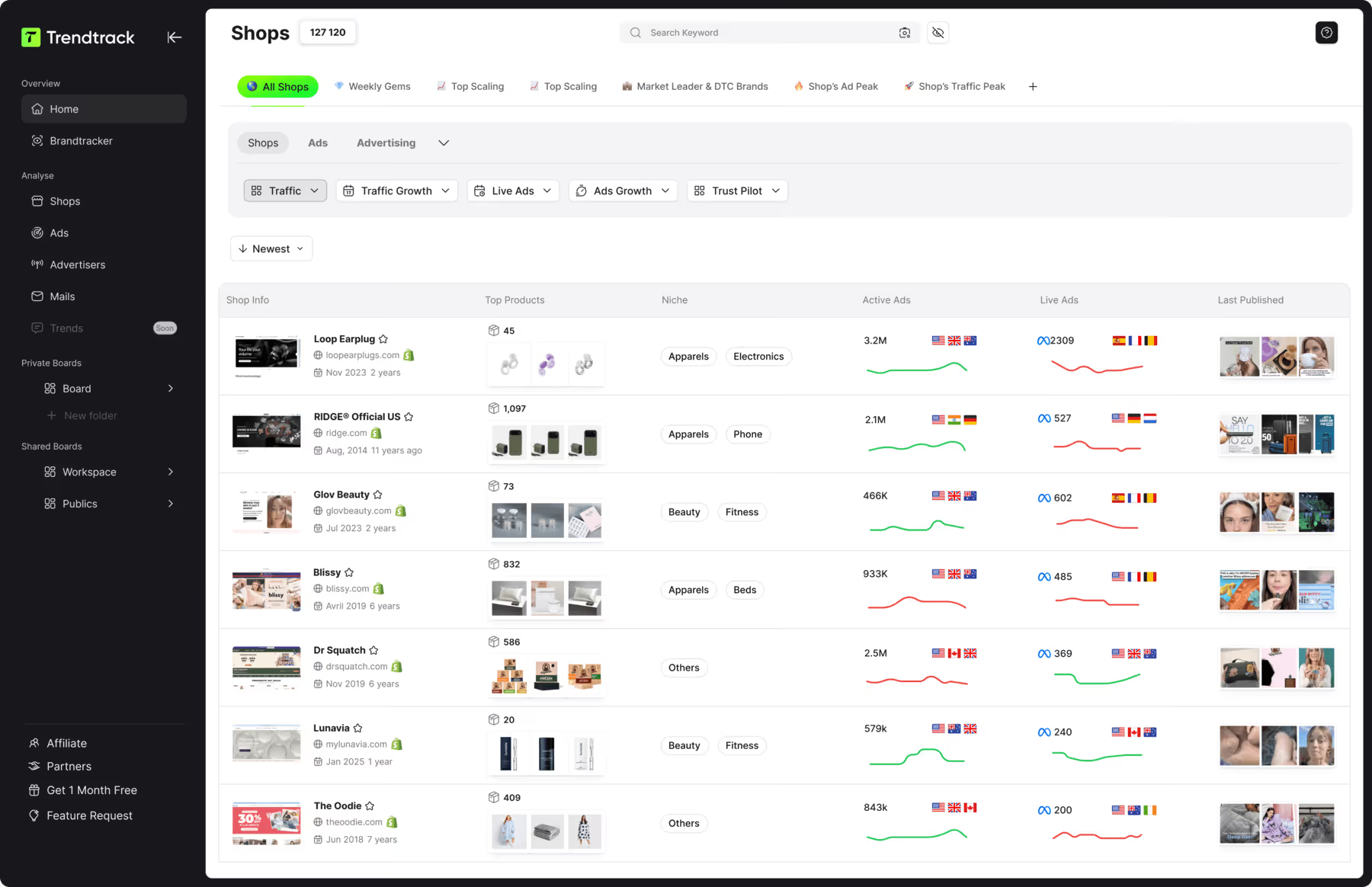
At Trendtrack available at app.trendtrack.io/en/sign-up, we index 95 million TikToks and refresh 700,000+ brand profiles every 24 hours, which shows you which formats sustain rather than which went viral once.
In this article we cover 10 tips for going viral on TikTok.
1. Earn the First Two Seconds
Everything else on this list depends on this one working.
The mechanism is simple. TikTok measures how many viewers stay past the opening moment, and that number determines whether your video reaches anyone beyond its initial test audience. A video abandoned in the first two seconds never gets the chance to be good.
Four openings earn that attention reliably.
Start mid-action. Not an introduction, not a greeting, not your logo. The moment something is already happening. Anything that resembles a preamble reads as a reason to scroll.
Lead with the result. Show the finished thing first, then explain how it happened. Curiosity about the process holds attention better than a promise that the process will eventually be interesting.
State the claim immediately. If your video argues something, argue it in the first line rather than building toward it. The structure you learned for essays works against you here.
Open on a visual anomaly. Something slightly wrong in frame forces the brain to process rather than dismiss. Scrolling is largely automatic, and anything breaking the expected pattern interrupts it.
Three things reliably lose the opening.
Talking head introductions. “Hey guys, so today I wanted to talk about” has lost the viewer before the sentence finishes.
Slow visual builds. A fade-in, an establishing shot, a title card. Each costs you the exact seconds you cannot afford.
Production value signalling advertising. A polished opening on a platform where everything is shot on a phone reads as a commercial, and commercials get skipped.
One practical test: watch your own video with the sound off and stop at two seconds. If nothing has happened, nothing will.
2. Optimize for Completion, Not Views
Views are an outcome. Completion rate is the input that produces them, and treating them as the same metric leads creators to optimise the wrong thing.
The mechanism is direct. TikTok reads completion as the strongest signal that a video deserves further distribution. A fifteen-second video watched to the end by 2,000 people outperforms a ninety-second video abandoned at the halfway point by 20,000.
Three decisions move this number.
Cut the length to the content. The most common mistake is stretching a thirty-second idea to sixty because longer feels more valuable. It is not. Find the shortest version that still delivers the point, then remove another five seconds.
Remove every pause. Breaths, transitions, the moment between finishing a sentence and starting the next. Each is an exit point, and on a platform where the next video is one swipe away, every exit point gets used.
Close the loop you opened. If your hook promised an answer, deliver it. A viewer who reaches the end feeling misled will not watch your next video, and the algorithm eventually learns this from your follower retention.
One metric deserves more attention than completion itself: rewatches.
A video watched twice by the same viewer signals something stronger than one watched once. Short videos with dense information generate this naturally, because a single viewing is not enough to catch everything.
That is why a well-made twelve-second video frequently outperforms a well-made sixty-second one on identical content.
Check your analytics for the exact second viewers leave. The drop-off point tells you what to cut.
3. Study What Already Works in Your Niche
Originality is the slowest path to reach. The formats that work in your category are observable, repeatable and already running, which makes inventing from scratch an expensive way to learn what research would have told you in an hour.
Three things are worth examining, and only one of them is obvious.
The structure, not the subject. How long before the first cut. Where the hook sits. Whether text appears on screen and when. Whether the creator speaks or lets the visual carry it. These are transferable. The topic is not.
The pattern, not the outlier. One video with ten million views tells you nothing, because it may have caught a moment that no longer exists. Three creators independently using the same structure tells you the structure works.
The sustained, not the spike. An account posting daily for eight months has found something repeatable. An account with one viral video and declining numbers afterward found luck.
That last distinction is where most research goes wrong. Browsing a For You page surfaces what is popular right now, which is precisely the content already saturating. By the time a format trends visibly, the window has usually closed.
What you want instead is formats sustaining over time rather than peaking this week.
One practical method: pick five accounts in your category that post consistently, watch twenty of their videos with the sound off, and write down what the first two seconds show. The pattern appears quickly.
At Trendtrack available at app.trendtrack.io/en/sign-up, we index 95 million TikToks, which reveals which formats hold rather than which spiked once.
4. Post Natively, Not Professionally
This is the one tip brands consistently refuse to follow, and it costs them more reach than any other mistake on this list.
The principle is uncomfortable. On TikTok, production value works against you. A video that looks professionally made reads as advertising, and advertising gets skipped before anyone evaluates whether it is interesting.
Four signals mark content as native.
Vertical, shot on a phone. Not reframed from a landscape original, which shows immediately in the composition and the crop.
Imperfect lighting. Natural light in an ordinary room outperforms a lit set, because the lit set announces that someone was paid to be there.
Unpolished delivery. A sentence restarted, a slight hesitation, a visible correction. These read as a person rather than a script, and people hold attention better than scripts do.
No branded opening. A logo in the first frame is the fastest way to lose a viewer.
The resistance to this is understandable and worth naming. Brands spend years building visual standards, and being told to abandon them for a platform feels like degrading the work.
But the comparison is not between your polished video and a sloppy one. It is between your polished video and the content it sits between, all of which was filmed on a phone in someone’s kitchen.
Looking different in that context is not standing out. It is signalling that you do not belong.
Lower the production deliberately. It is the only format on this list where spending less produces better results, and it remains the hardest instruction for marketing teams to accept.
5. Use Sound as a Signal, Not Decoration
Most creators treat audio as background. TikTok treats it as a distribution channel, and the gap between those two views explains why some accounts get discovered and others do not.
The mechanism is structural. Sounds have their own pages, their own feeds and their own audiences. Using one places your video inside a discovery path that exists independently of your account, your followers and your usual reach.
Three approaches work, and they are not equally available.
Catch a sound while it is rising, not while it is peaking. By the time a sound appears constantly on your For You page, thousands of videos already compete inside it. The usable window is earlier, when adoption is climbing but the field is still thin.
Use original audio when your content carries itself. Spoken explanations, demonstrations and anything where the words matter perform better with your own voice than with a trending track fighting it for attention.
Create a sound others can reuse. The highest-leverage outcome available on the platform. A sound adopted by other creators places your name on every video using it, which compounds in a way a single viral video never does.
Two things to avoid.
Trending sounds that contradict your content. An upbeat track under a serious explanation signals that you chose the sound first and the message second. Viewers notice.
Silence by default. A video with no audio at all loses both the discovery path and the viewers who watch with sound on.
One practical note: most viewers watch with sound off initially. Your video must work muted, and the audio should reward turning it on.
6. Write Text That Works Without Sound
A large share of viewers encounter your video muted, at least for the first second. Your on-screen text is what decides whether they turn the sound on or keep scrolling.
Treating it as subtitles wastes it. Treated as a second hook, it does real work.
Three functions text performs well.
It states the premise instantly. A viewer who understands what the video is about within the first frame has a reason to stay. One who has to infer it from visuals alone frequently does not bother.
It creates the gap your video closes. A question or an incomplete statement on screen opens a loop that the content resolves, which holds attention more reliably than any visual.
It carries the content for muted viewers. Someone watching in a meeting or on a train consumes your video entirely through text. If the words alone do not deliver, you lose that audience completely.
Four execution rules matter more than the writing itself.
Keep it short. Six to eight words per screen. Anything longer competes with the video for attention and loses to neither.
Place it high. The bottom of the frame is covered by the caption, the username and the interface. Text placed there is partially hidden on many devices.
Make it readable at a glance. High contrast, no thin fonts, no decorative styling. A viewer scrolling at speed reads shapes rather than letters.
Avoid reproducing your voiceover. Text duplicating exactly what is being said gives the viewer nothing new and splits their attention between two identical channels.
One test: mute your video and watch it. If you cannot follow it, your text is doing too little.
7. Post When Your Audience Is Actually Watching
Timing matters less than most advice claims and more than nothing, which makes it worth getting right without building a strategy around it.
The mechanism is narrower than the folklore suggests. TikTok shows your video to a small initial audience and measures the response. Posting when your specific followers are active means that first test audience is larger and more engaged, which gives the video a better chance of clearing the threshold for wider distribution.
What it does not do is guarantee reach. A video posted at the perfect hour with a weak hook still fails. Timing amplifies content that works and does nothing for content that does not.
Three sources tell you when to post.
Your own analytics. TikTok shows follower activity by hour and by day in the Pro account view. This is the only data specific to your audience, and it beats every generic chart you will find online.
Your content type. Entertainment performs in the evening and at weekends. Professional or educational content frequently performs better in the morning and on weekdays, because the audience context differs.
Your geography. If most of your audience sits in one timezone, optimise for it. If your audience spans several, you are choosing which one to prioritise rather than finding a universal answer.
Two cautions.
Do not sacrifice quality for schedule. Posting a weak video at the optimal hour performs worse than a strong one at a mediocre hour.
Do not chase the universal best time. Published charts describe aggregate behaviour, which is precisely the hour when competition is heaviest.
Test four windows over two weeks, measure, then stop thinking about it.
8. Reply to Comments With Video
This is the most underused feature on the platform and one of the few that gives you content and distribution simultaneously.
The mechanism is worth understanding. A video reply attaches the original comment to the new video and connects it to the post that generated it. That connection pulls viewers from the first video to the second, and it signals to TikTok that an ongoing conversation is happening around your account.
Three reasons it outperforms a standard post.
The topic is pre-validated. Someone asked the question, which means at least one person wanted the answer and usually many more who did not comment. You are no longer guessing what your audience wants.
The hook writes itself. Showing the comment on screen gives you an opening that needs no construction. The viewer reads the question and stays for the answer.
It compounds your existing reach. Viewers who engaged with the first video get surfaced the reply, which means you start with a warmer audience than a cold post receives.
Which comments to choose matters.
Pick questions, not compliments. A comment asking how something works gives you content. A comment saying nice video gives you nothing.
Pick objections. The sceptical comment is frequently the most valuable, because answering it addresses a doubt that many silent viewers share.
Pick the comment with replies under it. Engagement on a comment indicates the question matters to more than one person.
One practical habit: when a video performs, read the comments before producing anything new. Your next three videos are usually sitting there, already validated by the audience that will watch them.
9. Build a Format, Not a Video
Most accounts treat every post as a new creative problem. That approach limits output, produces inconsistent quality and makes success impossible to repeat.
A format is a repeatable structure you fill with different content. Same opening, same pacing, same visual signature, different subject each time.
Three things improve immediately when you work this way.
Production time collapses. You stop deciding how to make the video and start deciding what to put in it. An account working from a format can publish daily; an account inventing each time cannot.
Quality becomes consistent. The structure is already proven, so a weak video is weak on content rather than on execution. That is a far easier problem to diagnose and fix.
Recognition compounds. Viewers identify your videos before reading your name, which converts scrollers into followers faster than any call to action.
Finding your format is a process rather than a decision.
Post varied content for a few weeks and watch which structures retain attention, not which topics got views.
Identify what the best performers share. The opening type, the length, the pacing, whether you appear on camera.
Repeat it deliberately for ten videos before judging whether it works.
Two cautions.
A format is not a template you abandon when bored. Audiences take longer to recognise a pattern than creators take to tire of it. The point where you find it repetitive is usually the point where viewers start noticing it.
Evolve it slowly. Small variations keep it fresh. Reinventing it resets the recognition you built.
10. Publish Enough to Learn Something
Every tip above requires data to apply, and data requires volume. An account posting twice a week spends six months learning what an account posting daily learns in six weeks.
The reasoning is statistical rather than motivational. TikTok distribution varies enormously between videos, which means a single post tells you almost nothing. A video can underperform because the hook failed, or because the test audience happened to be poorly matched. You cannot distinguish those explanations from one data point.
Twenty videos reveal a pattern. Three reveal noise.
Three consequences follow from treating volume as a learning mechanism rather than a growth hack.
Your failures become cheap. When a video is one of thirty, a weak one costs nothing. When it is one of four, you overthink every decision and publish less as a result.
You stop protecting your account. Creators posting rarely develop a fear of damaging their average. That fear produces safe content, and safe content does not travel.
You find your format faster. The process described in the previous section requires a body of work to analyse. Volume is what produces it.
Two things volume does not mean.
Not posting anything to hit a number. A video published to maintain a streak teaches you nothing, because you already know it was not your best attempt.
Not posting without reviewing. Volume without analysis is repetition rather than learning. Check your retention curve on every video, and specifically the second where viewers leave.
A reasonable target for most accounts is one video daily for thirty days, reviewed weekly.
Useful Sources:


Ready to build a million-dollar brand?