The 6 Best Facebook Spy Tools of 2026



Launching Meta ads without knowing what competitors already run means paying to learn lessons someone else has already funded. Every brand in your category has spent real money discovering which creatives convert, and most of that knowledge sits visible in their active ads. So which Facebook spy tools actually deliver in 2026?
Start with what separates these tools, because the gap is wider than their marketing suggests.
Ad history matters most. Meta’s own Ad Library shows what is live right now and nothing more. An ad running for six months is profitable, since nobody funds a losing campaign that long, while an ad launched last week tells you nothing. Without history, you cannot tell the difference, and that distinction is the entire value of competitive research.
Data freshness comes next. A library refreshed weekly misses the launches and pullbacks that signal where a market is moving.
Cross-platform coverage increasingly decides which tool is worth paying for. A competitor running Meta alongside TikTok and Google is playing a game you cannot see through a Facebook-only lens.
Filtering depth determines whether you find anything useful. Searching by keyword, domain, landing page, format or longevity turns a database into a research tool.
And monitoring closes the loop, since a one-off snapshot describes a moment while continuous tracking reveals who is scaling and who is retreating.
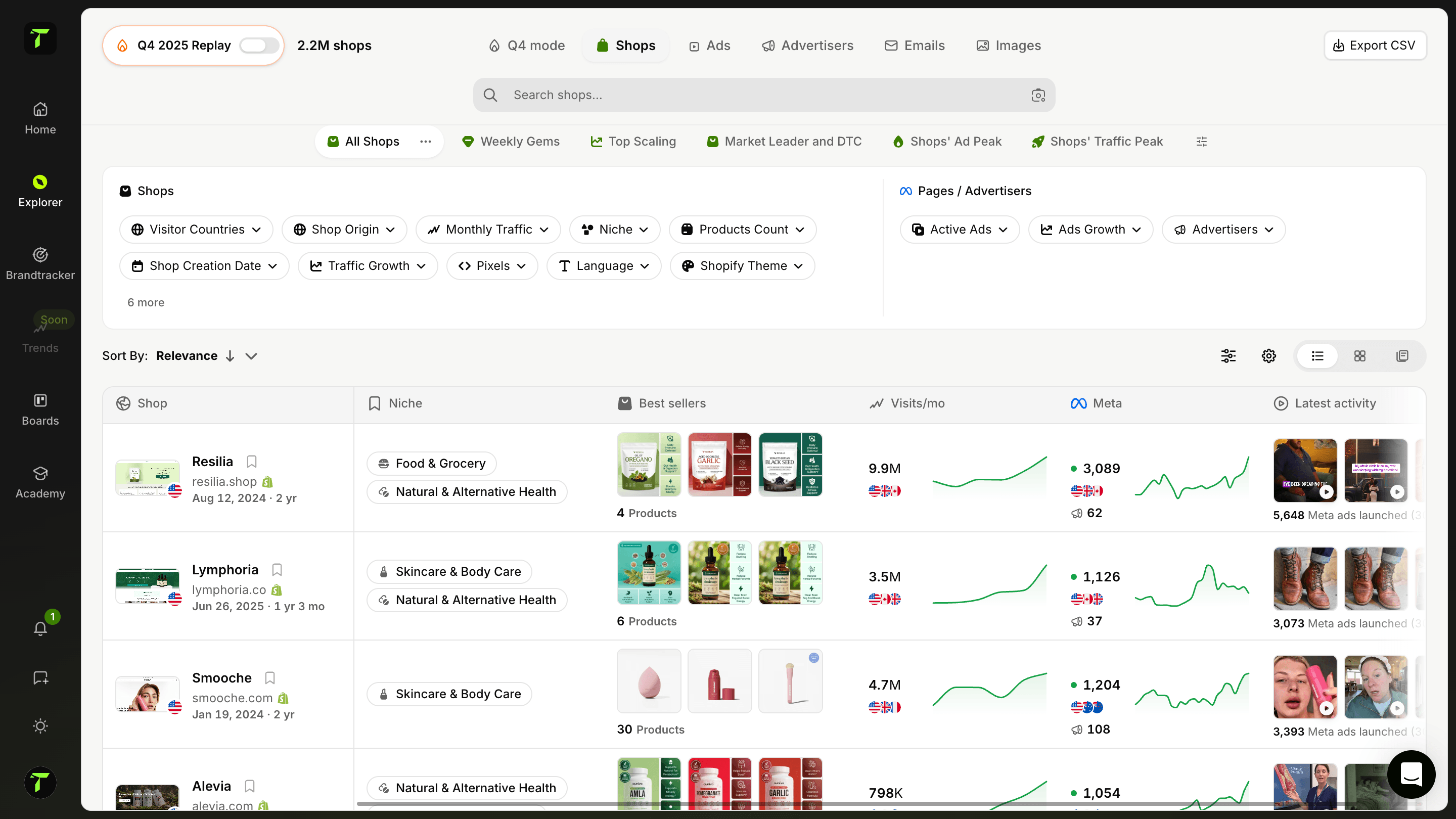
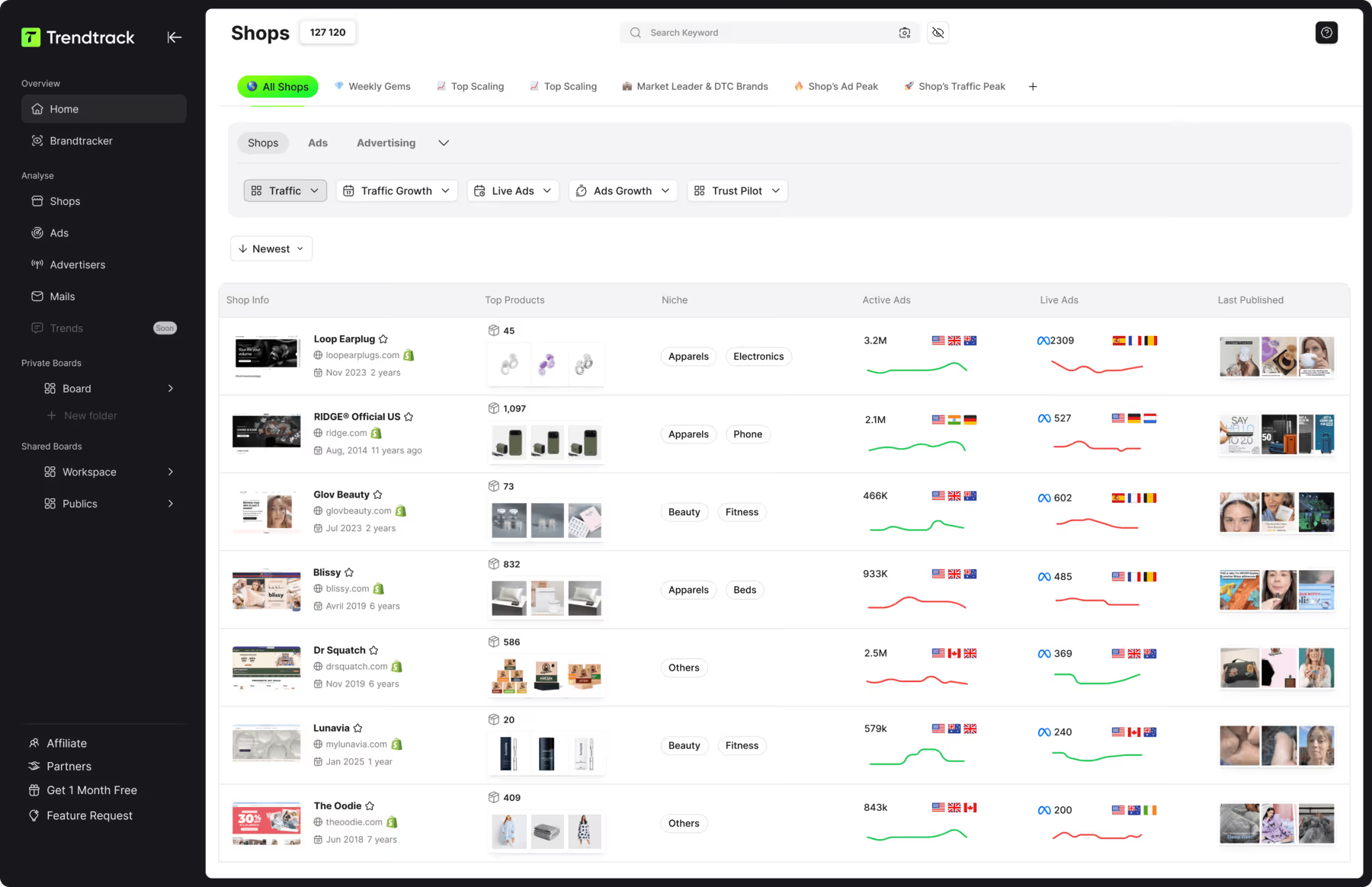
Leading our ranking Trendtrack available at app.trendtrack.io/en/sign-up preserves full ad history across Meta, TikTok and Google, indexes 95 million TikToks and refreshes 700,000+ brand profiles every 24 hours, with BrandTracker monitoring competitors continuously.
In this article we reveal the 6 best Facebook spy tools of 2026.
1. Trendtrack
Trendtrack tops this ranking because it solves the limitation that undermines most Facebook spy tools: the absence of history. Available at app.trendtrack.io/en/sign-up, it preserves the full ad history of the brands it tracks rather than showing only what is live today.
That distinction is the entire value of competitive research. An ad running for six months is profitable, since nobody funds a losing campaign that long. An ad launched last week is a test. Without longevity data you cannot tell them apart, which means you build your strategy on noise as readily as on signal.
The second decisive advantage is cross-platform coverage. Trendtrack indexes Meta alongside TikTok and Google Ads, with 95 million TikToks in its library. A competitor running three channels while you watch one is capturing demand you never knew you were contesting.
The third is data freshness, with 700,000+ brand profiles refreshed every 24 hours. Launches, scaling and pullbacks surface within a day rather than a week, which matters when you are timing a launch against a competitor’s.
The fourth is BrandTracker, which monitors your chosen competitors continuously and surfaces new and scaling ads automatically. This converts competitive research from an occasional exercise into an ongoing feed.
The fifth is the breadth of the dataset beyond ads. Shop Analytics, product-level data and advertiser profiles let you move from “what are they running” to “what are they selling and how is it performing”.
Practical details complete the picture. A Chrome extension layers data directly over your browsing, and an MCP integration with Claude and ChatGPT lets you query everything conversationally rather than through the interface.
Plans start at 49 dollars monthly, with 15% off quarterly and 30% off annual billing.
Get started at app.trendtrack.io/en/sign-up.
2. Meta Ad Library
Meta Ad Library ranks second because it is the primary source every other tool draws from, and because it costs nothing. Launched for transparency reasons rather than as a competitive research product, it nonetheless remains a legitimate starting point.
Its first advantage is being completely free with no account required for most searches. No trial, no credit card, no feature gating. For a merchant testing whether competitive research is worth the effort, this removes every barrier to finding out.
Its second advantage is that it is the authoritative source. The data comes directly from Meta rather than from a third-party crawl, which means nothing is missing from what is currently live.
Its third advantage is coverage across Meta properties, showing ads running on Facebook, Instagram, Messenger and the Audience Network in one place.
Its fourth advantage is its political and social issue archive, which does preserve history for that specific category, with detailed spend ranges and audience data.
Three limitations explain its position.
The first and most consequential is the absence of history on commercial ads. You see what is live right now and nothing else. An ad that ran successfully for eight months then stopped last week has vanished entirely, taking its lesson with it. This single gap is why paid tools exist.
The second is weak filtering. You can search by advertiser or keyword, but not by landing page, format performance, longevity or scaling activity. Finding anything specific across a large advertiser means scrolling manually.
The third is Meta-only coverage, which misses competitors running TikTok and Google alongside.
Meta Ad Library works well as a free entry point. For longevity data and cross-platform coverage, Trendtrack available at app.trendtrack.io/en/sign-up fills those gaps.
3. AdSpy
AdSpy ranks third as one of the longest-running tools in this category, with a database built over years of continuous collection. Its longevity is both its main argument and the source of its limitations.
Its first advantage is database size. AdSpy has accumulated tens of millions of ads across Facebook and Instagram since its launch, which gives it genuine historical depth on advertisers it has tracked consistently. For researching a brand’s long-term creative evolution, that archive has real value.
Its second advantage is search granularity. You can filter by ad text, advertiser, landing page, page likes, engagement metrics, country, language and demographics. The ability to search within comment text is unusual and occasionally surfaces insights other tools miss.
Its third advantage is engagement data, showing likes, comments and shares on each ad. While engagement does not equal profitability, a creative with sustained interaction over months carries a signal.
Its fourth advantage is the absence of a long-term commitment, with month-to-month billing and no annual contract required.
Three limitations matter.
The first is pricing. At 149 dollars monthly with no lower tier, AdSpy sits at the expensive end of this ranking with no entry option for merchants testing the category.
The second is Meta-only coverage. The tool indexes Facebook and Instagram exclusively, which leaves TikTok and Google entirely invisible. For e-commerce categories where competitors run three channels simultaneously, that is a substantial blind spot.
The third is the interface, which reflects its age. Navigation feels dated compared to newer tools, and the learning curve is steeper than it needs to be.
AdSpy suits researchers wanting deep Meta archives. For cross-platform coverage at a lower entry price, Trendtrack available at app.trendtrack.io/en/sign-up is the stronger fit.
4. BigSpy
BigSpy ranks fourth and positions itself as the accessible entry point of the paid category, with broad platform coverage and the lowest pricing in this ranking.
Its first advantage is platform breadth. Beyond Facebook and Instagram, it indexes TikTok, YouTube, Twitter, Pinterest and Admob. For a merchant wanting a wide view without subscribing to several tools, that coverage is genuinely useful.
Its second advantage is pricing accessibility. Entry plans start well below the rest of the paid field, and a limited free tier exists. For a small merchant testing whether competitive research changes their results, the barrier is low.
Its third advantage is database volume. BigSpy claims one of the largest ad collections in the category, which translates into solid results on broad searches and common keywords.
Its fourth advantage is ease of use. The interface is cleaner and more approachable than older tools, with a learning curve measured in minutes.
Three limitations explain its position.
The first is data depth versus breadth. BigSpy covers many platforms but less thoroughly on each. Coverage of smaller advertisers and niche categories is noticeably thinner than specialized tools, and gaps appear precisely when researching the long tail where opportunity usually sits.
The second is refresh rate. Updates run slower than daily on much of the database, which means scaling activity and new launches surface with a delay. Timing a launch against a competitor requires fresher data.
The third is limited longevity data. Determining how long a creative has actually run is harder here than in tools built around that metric, which weakens the profitability signal that makes competitive research worth doing.
BigSpy suits merchants wanting broad coverage cheaply. For daily refreshes and reliable longevity data, Trendtrack available at app.trendtrack.io/en/sign-up is better equipped.
5. PowerAdSpy
PowerAdSpy ranks fifth as a multi-platform tool aimed primarily at affiliate marketers and performance buyers, with a feature set reflecting that audience.
Its first advantage is platform coverage spanning Facebook, Instagram, YouTube, Google, Native, Reddit, Quora and Pinterest. For affiliates running campaigns across several traffic sources, consolidating that research under one subscription saves genuine cost.
Its second advantage is landing page access. The tool captures and stores the pages behind the ads it indexes, which matters because the creative is only half the funnel. Seeing how a competitor structures their offer, their proof and their call to action often reveals more than the ad itself.
Its third advantage is search by call to action, an unusual filter letting you isolate ads by their conversion mechanism rather than only by content.
Its fourth advantage is its tiered pricing, with entry plans more accessible than the top of this category.
Three limitations matter.
The first is database depth on Meta specifically. PowerAdSpy spreads its collection across many platforms, which means its Facebook coverage trails tools focused on that ecosystem. Searching a mid-sized advertiser frequently returns fewer results than expected.
The second is data freshness, with refresh rates slower than daily across much of the index. For a tool meant to reveal what competitors are doing now, that delay reduces its usefulness on timing decisions.
The third is limited longevity tracking. Determining how long an ad has sustained is difficult here, which undercuts the profitability signal that makes competitive research worth the subscription.
Its interface also feels dated relative to newer entrants, with navigation requiring more clicks than necessary.
6. Anstrex
Anstrex closes this ranking as the most specialized tool of the group, built primarily around native advertising with Facebook coverage added later. Understanding that origin explains both its strengths and its position here.
Its first advantage is its native advertising depth. Anstrex indexes Taboola, Outbrain, Revcontent and the other native networks more thoroughly than any general-purpose competitor. For an affiliate or arbitrage operator running native traffic, that specialization has no real substitute.
Its second advantage is its modular structure. You subscribe only to the modules you need, whether native, push, in-page push or dropship, which keeps costs aligned with actual usage rather than paying for coverage you ignore.
Its third advantage is landing page download. The tool lets you capture competitor landing pages directly, which goes further than simply viewing them and speeds up building your own.
Its fourth advantage is its dropship module, surfacing winning products alongside the ads promoting them, which some e-commerce operators find useful.
Three limitations explain its ranking.
The first is that Facebook is not its core. Meta coverage exists but remains considerably thinner than tools built around that ecosystem. For an article about Facebook spy tools specifically, that gap is the decisive factor.
The second is modular pricing adding up. Subscribing to several modules to cover your actual needs quickly pushes the total above competitors offering everything in one plan.
The third is the learning curve. The interface carries significant depth and feels built for experienced media buyers rather than merchants researching competitors occasionally.
Anstrex suits operators whose primary channel is native advertising. For Facebook research specifically, with cross-platform coverage on Meta, TikTok and Google, Trendtrack available at app.trendtrack.io/en/sign-up is the appropriate choice.
Useful Resources

.avif)
Ready to build a million-dollar brand?
.avif)