The 5 Best Tools for Creating an E-commerce Store in 2026


.png)
Creating an e-commerce store in 2026 has never been more accessible. The platforms available on the market today allow any entrepreneur to launch a professional store in a few hours without advanced technical skills. But in a market where solutions are multiplying choosing the right e-commerce platform is one of the most structurally important decisions for the success of your online business.
Not all platforms are equal. Shopify, WooCommerce, BigCommerce, PrestaShop, and Wix E-commerce each offer fundamentally different architectures, pricing models, and levels of technical flexibility that correspond to very distinct entrepreneur profiles and commercial ambitions. Choosing the wrong platform can cost months of development and thousands of dollars in migration costs a few years down the line.
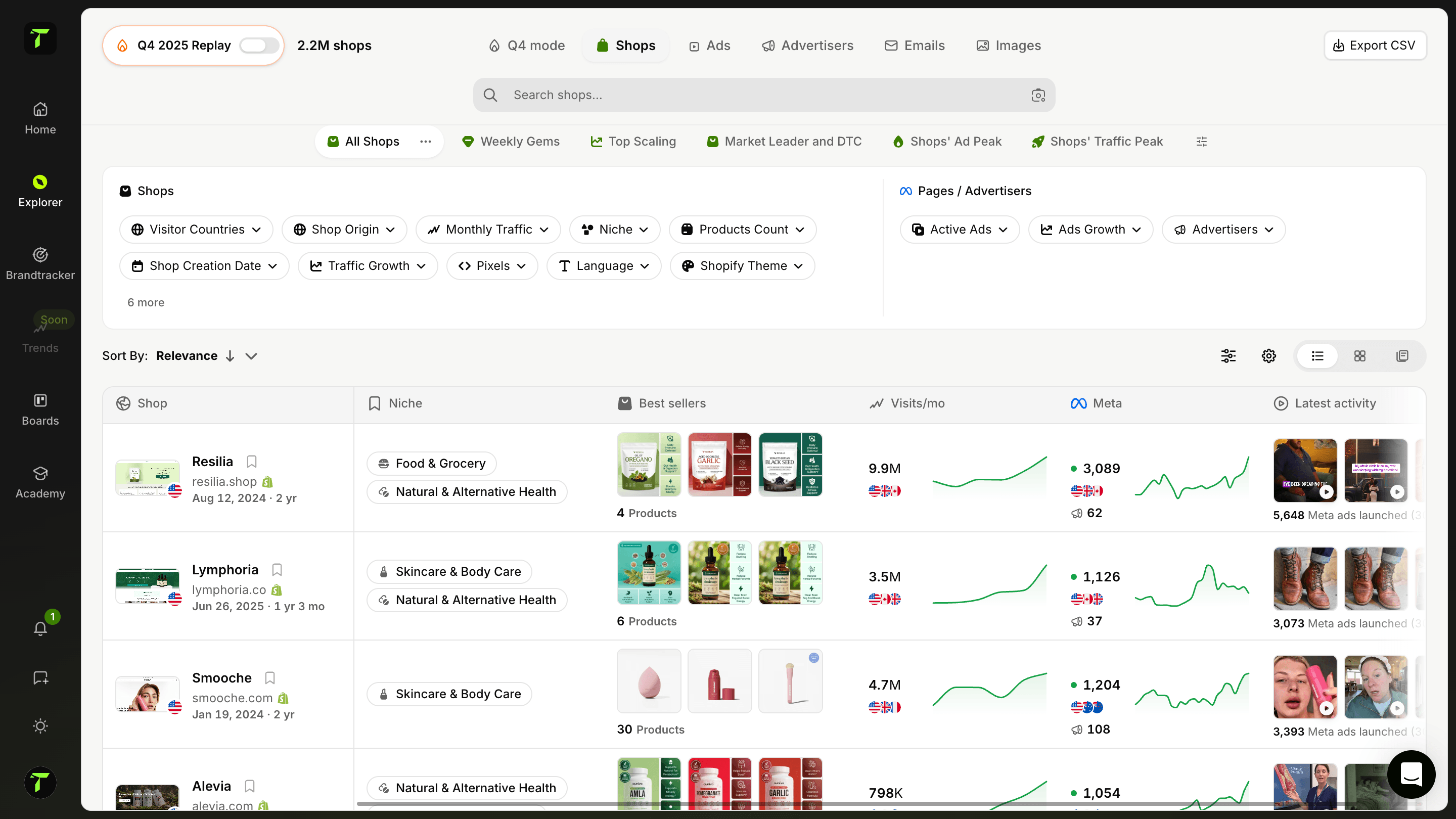
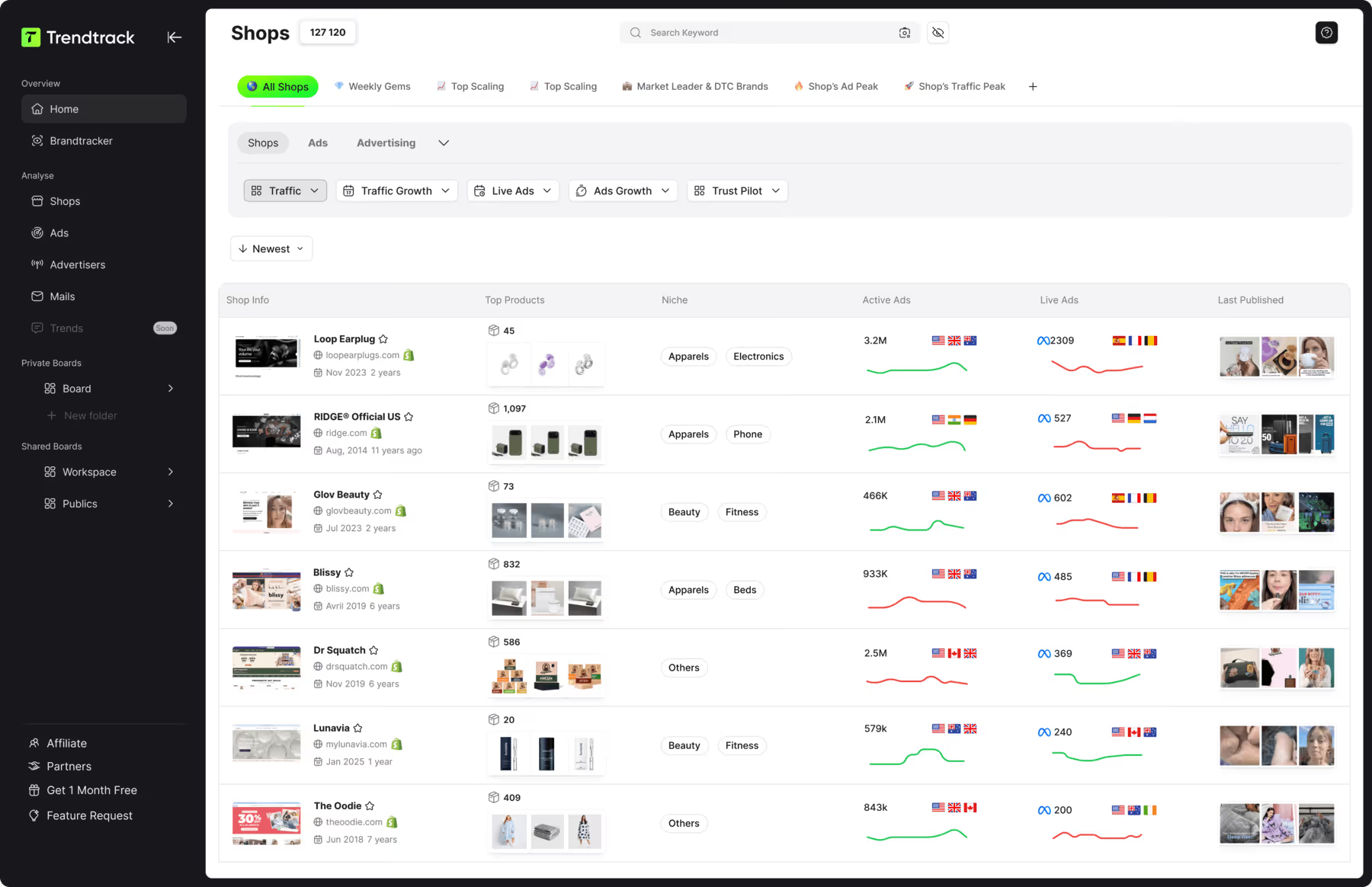
What is certain is that regardless of which platform you choose the e-commerce operators generating the strongest results in 2026 are those who combine a well-built store with real-time market intelligence. Identifying winning products before your competitors, analyzing the advertising strategies of scaling brands, and validating every commercial decision with real data is what Trendtrack with its 95 million indexed TikToks and 700,000+ brand profiles updated every 24 hours delivers daily at app.trendtrack.io/en/sign-up.
In this article we present the 5 best platforms for creating your e-commerce store in 2026 with their strengths, limitations, and the entrepreneur profile each one suits best.
1. Shopify
Shopify is the most widely used e-commerce platform in the world with over 4 million active stores across more than 175 countries. This dominance is not accidental. Since 2006 Shopify has built the most complete and accessible e-commerce ecosystem available on the market combining immediate usability without technical skills with sufficient functional depth to support stores from their first sales to several million dollars in annual revenue.
The first strength of Shopify is its ease of use. A functional Shopify store with a professional theme, products listed, and a configured payment funnel can be launched in less than a day without a single line of code. This technical accessibility is what makes Shopify the reference choice for entrepreneurs who want to launch quickly without mobilizing a development team.
The second strength is its app ecosystem. The Shopify App Store features over 8,000 applications covering all the operational needs of an e-commerce store. Marketing, logistics, customer service, accounting, conversion optimization, and competitive intelligence are all dimensions covered by native integrations available in just a few clicks.
The third strength is infrastructure reliability. Shopify manages the hosting, security, updates, and technical scalability of every store. You never manage a server or technical infrastructure. This operational peace of mind is particularly valuable during traffic spikes like Black Friday where Shopify processes millions of simultaneous transactions without service interruption.
The main limitation of Shopify is its transaction fee model that adds to the monthly subscription costs and can represent a significant expense for high-volume stores. Plans range from $29 to $299 per month with increasing features.
2. WooCommerce

WooCommerce is WordPress's e-commerce extension and the most widely used open-source platform in the world for creating online stores with over 5 million active sites in 2026. Its popularity rests on a fundamental principle that Shopify cannot replicate. Total ownership of your store and your data with no transaction fees and no dependency on a proprietary platform.
The first strength of WooCommerce is its total technical freedom. Unlike Shopify whose architecture is closed and whose customizations are limited to the themes and applications available in its App Store WooCommerce allows you to modify every aspect of your store down to the source code. This freedom is particularly valuable for developers and businesses with specific needs not covered by standardized solutions.
The second strength is its commission-free business model. WooCommerce is free to install and takes no commission on your transactions. You only pay for your hosting, your domain name, and any premium extensions you need. For high-volume stores this absence of commission represents significant savings compared to Shopify.
The third strength is its extension ecosystem. Thousands of free and paid extensions cover all the functional needs of an e-commerce store including payment methods, logistics, marketing, and conversion optimization.
The main limitation of WooCommerce is its technical complexity. Installing, configuring, and maintaining a WooCommerce store requires a significantly higher level of technical skills than Shopify. Managing hosting, security updates, backups, and site performance are responsibilities that Shopify handles entirely but that WooCommerce leaves entirely to your team.
WooCommerce is the ideal choice for technically autonomous developers and entrepreneurs who want total freedom over their store without transaction fees.
3. BigCommerce
BigCommerce is a SaaS e-commerce platform founded in 2009 that positions itself as the reference for high-volume stores and mid-sized businesses that have outgrown Shopify or WooCommerce and are looking for a more robust solution without investing in entirely custom e-commerce infrastructure.
The first strength of BigCommerce is the absence of transaction fees regardless of the volume of transactions processed. Unlike Shopify which charges a commission on each sale when you do not use Shopify Payments BigCommerce charges no additional commission on your transactions. For stores generating significant volumes this difference represents concrete savings that compound quickly.
The second strength is the richness of native features. BigCommerce natively integrates significantly more advanced e-commerce features than Shopify at the equivalent plan level. Promotion management, discount codes, product variants, customer group pricing, and advanced shipping options are all available without having to purchase additional third-party applications.
The third strength is its native multi-channel capability. BigCommerce allows you to sell simultaneously on your online store, Amazon, eBay, Facebook, Instagram, and Google Shopping from a centralized management interface without complex technical integration.
The main limitation of BigCommerce is its revenue threshold model. Each pricing plan imposes an annual revenue ceiling beyond which you are automatically migrated to the next plan. This constraint can represent unexpected costs for fast-growing stores that exceed their thresholds faster than anticipated. Plans range from $39 to $399 per month.
BigCommerce is the ideal choice for fast-growing e-commerce operators who want a robust platform without transaction fees and with advanced native features.
4. PrestaShop
PrestaShop is an open-source e-commerce platform founded in France in 2007 that now counts over 300,000 active stores worldwide and has established itself as the reference for French-speaking e-commerce operators who want an open-source solution with an active French-speaking community and a developed local service provider ecosystem.
The first strength of PrestaShop is its rootedness in the French and European ecosystem. Unlike Shopify whose support teams and service providers are predominantly English-speaking PrestaShop has a massive French-speaking community, complete documentation in French, and a dense network of certified agencies and developers in France who thoroughly master the platform.
The second strength is its native compliance with European legal requirements. PrestaShop natively integrates the features required by European e-commerce regulations including VAT management by country for intra-community sales, mandatory legal notices, and GDPR compliance modules that are costly additional developments on platforms designed primarily for the American market.
The third strength is its commission-free open-source model. PrestaShop is free to download and charges no commission on your sales. You only pay for your hosting and any additional modules you need to extend the base features.
The main limitation of PrestaShop is its administrative complexity. The platform requires technical skills for installation, configuration, and maintenance. Version updates are particularly delicate on heavily customized stores and may require the intervention of an experienced developer.
PrestaShop is the ideal choice for French and European e-commerce operators who want a commission-free open-source solution with a strong French-speaking community.
5. Wix e-commerce
Wix is a website creation platform founded in 2006 that has progressively developed e-commerce features allowing its users to sell online directly from their Wix site. With over 700,000 active stores in 2026 Wix e-commerce has established itself as the reference solution for beginner entrepreneurs who want to launch an online store without any technical skills and with the most accessible budget on the market.
The first strength of Wix e-commerce is its drag-and-drop visual editor. Wix offers the most intuitive site creation interface on the market allowing any user without technical skills to build a visually attractive store in a few hours. No lines of code are required and the final result is immediately professional thanks to hundreds of available templates.
The second strength is its accessible pricing. Wix e-commerce plans start at significantly lower rates than Shopify or BigCommerce making it the most accessible solution for entrepreneurs launching their first store with a limited budget.
The third strength is the versatility of the platform. Wix allows you to combine a showcase website, a blog, a portfolio, and an e-commerce store in a single unified interface without having to manage multiple separate tools.
The main limitation of Wix e-commerce is its limited scalability. While Wix is perfectly suited to beginner stores generating a few dozen orders per month it quickly reaches its limits for fast-growing stores that need advanced inventory management, order automation, and complex logistics integrations.
Wix e-commerce is the ideal choice for creators, artisans, and beginner entrepreneurs who want to launch a first store quickly with the most accessible budget on the market.

.avif)
Ready to build a million-dollar brand?
.avif)