Squarespace vs Shopify: Review 2026



Choosing between Squarespace and Shopify is one of the first decisions any online seller faces and it shapes everything that follows. Pick the wrong platform and you either pay for capabilities you never use or hit hard limits exactly when your store starts to grow. So in the Squarespace vs Shopify comparison which one should you actually choose in 2026? The answer depends on what you are truly building.
Both platforms are excellent but they were designed for fundamentally different purposes. Squarespace is a website builder that later added commerce features. Its templates are genuinely beautiful, its all-in-one simplicity is appealing and it suits portfolios, service businesses and brand sites where visual identity comes first. Shopify was built from the ground up as a commerce engine. Every feature, every integration and every design decision exists to help you sell more which is a completely different starting point.
For anyone serious about e-commerce Shopify is the better choice. Its app ecosystem is vastly larger which means you can extend your store as your needs evolve. Its payment options are far more flexible with Shopify Payments plus over a hundred external gateways where Squarespace limits you to Stripe and PayPal. Its checkout is among the highest converting in the industry, its inventory and multi-channel capabilities are built for scale and it supports you from your first sale to eight figures without ever forcing a migration.
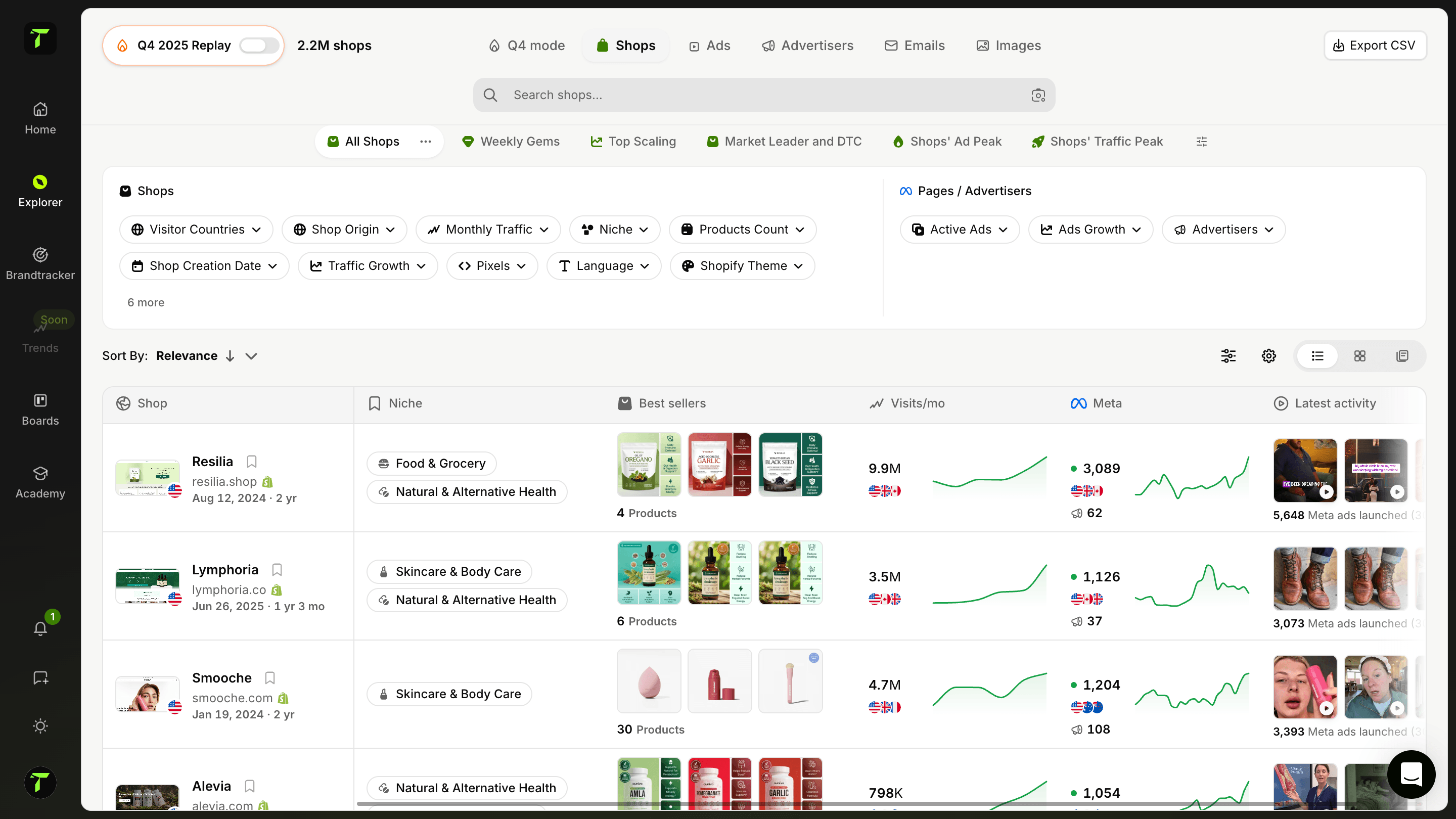
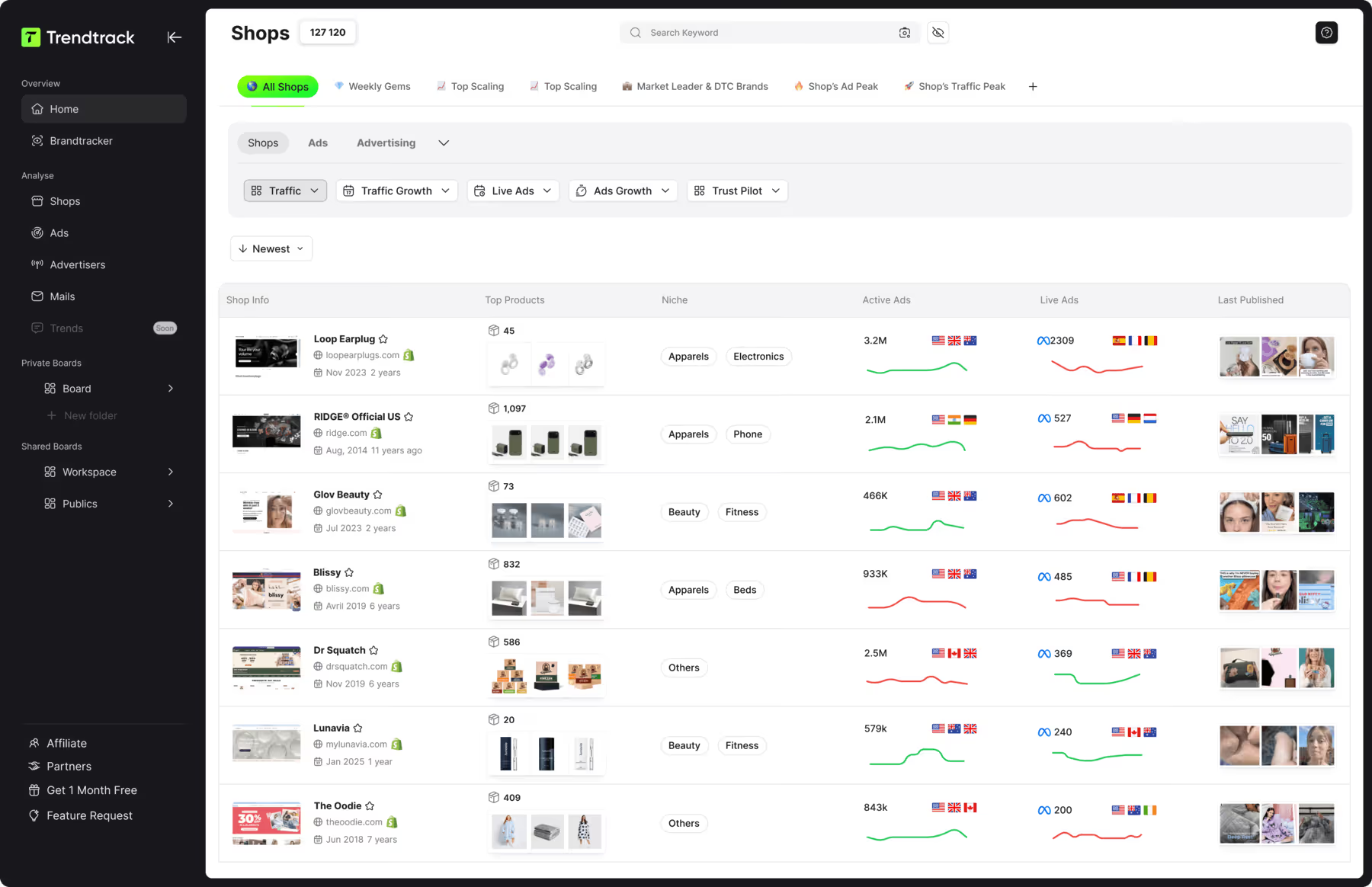
That said no platform tells you what to sell and product choice matters far more than store design. This is where Trendtrack available at app.trendtrack.io/en/sign-up complements your setup with 95 million indexed TikToks and 700,000+ brand profiles updated every 24 hours.
In this article we compare Squarespace and Shopify to help you choose the right platform.
What Is Squarespace?

Squarespace is an all-in-one website builder that lets anyone create a professional website or online store without writing a single line of code. Founded in 2003 it built its reputation on design quality and became a favorite among creatives, service businesses and personal brands. In short Squarespace bundles hosting, design, content management and commerce into one subscription which removes the technical burden of running a website.
The core strength of Squarespace is its design-first approach. Its templates are polished, modern and fully responsive out of the box which means a site looks professional immediately without extensive customization. Its Fluid Engine editor lets you adjust layouts visually while preserving that coherence. For photographers, restaurants, coaches and brand-led businesses this aesthetic advantage is the main reason they choose it.
Squarespace also functions as a genuine all-in-one solution. Hosting, SSL certificates, domain management, blogging, email marketing and appointment scheduling through Acuity are all included within the platform. You never install plugins, manage servers or coordinate multiple providers. For solo founders without technical resources this simplicity saves real time.
On the commerce side Squarespace supports selling physical products, digital downloads, services and subscriptions. Depending on your plan you get inventory management, product variants, discount codes, abandoned cart recovery and customer accounts. Pricing runs from around 12 euros per month for the Basic plan up to 69 euros per month for Advanced when billed annually.
However Squarespace was conceived as a website builder that added commerce afterwards and that origin shows. Its app ecosystem is far smaller than Shopify's, payments are restricted to Stripe and PayPal, lower plans apply transaction fees on top of processing costs and switching templates requires rebuilding much of your content.
Squarespace is therefore an excellent choice for design-led sites with light commerce. For a business whose primary purpose is selling Shopify offers a fundamentally deeper foundation as we will see next.
What Is Shopify?

Shopify is a dedicated e-commerce platform built from the ground up to help businesses sell online. Founded in 2006 it powers millions of stores worldwide from first-time sellers to major international brands. Unlike a website builder that later added commerce features Shopify was designed around one purpose which is selling. Every feature, integration and product decision serves that goal.
The core strength of Shopify is its commerce-first architecture. Inventory management, product variants, multi-currency selling, tax calculation, shipping rules, discount logic and order fulfillment are native capabilities rather than add-ons. As your catalog grows and your operations become more complex the platform absorbs that complexity instead of resisting it. This is precisely where website builders start to break down.
Shopify's second major strength is its app ecosystem. With over eight thousand applications available you can extend your store with upsells, subscriptions, reviews, loyalty programs, advanced analytics, print-on-demand or dropshipping integrations. Whatever specific need your business develops a solution almost certainly exists. This extensibility is what allows a store to evolve for years without ever changing platform.
The third strength is its payment flexibility. Shopify Payments offers native processing with competitive rates and no additional transaction fee. Beyond that the platform supports over a hundred external gateways which gives you real freedom depending on your market and your margins. This matters enormously for international sellers.
Shopify also delivers one of the highest converting checkouts in the industry along with Shop Pay which accelerates purchase for returning customers. Its multi-channel capabilities let you sell simultaneously on your store, on social platforms and on marketplaces from one dashboard.
Pricing starts at a competitive entry-level plan and scales with your needs. Shopify is therefore the reference platform for anyone whose primary activity is selling online which is exactly why we recommend it over Squarespace for e-commerce.
Squarespace vs Shopify: The Full Comparison
Comparing Squarespace and Shopify side by side on the criteria that actually matter for e-commerce makes the verdict clear. Here is the full comparison.
| Criterion | Squarespace | Shopify |
|---|---|---|
| Built for | Websites with light commerce | E-commerce from the ground up |
| App ecosystem | Limited selection | Over 8,000 apps |
| Payment gateways | Stripe and PayPal only | Shopify Payments plus 100+ gateways |
| Transaction fees | Applied on lower plans | None with Shopify Payments |
| Checkout conversion | Standard | Among the highest in the industry |
| Multi-channel selling | Limited | Social, marketplaces and POS |
| Inventory management | Basic | Advanced with multi-location |
| Dropshipping support | Very limited | Native integrations |
| Scalability | Limited as you grow | From first sale to eight figures |
| Template flexibility | Rebuild required to switch | Change themes freely |
| Design quality | Excellent out of the box | Excellent with more customization |
As the table shows Shopify wins decisively on every criterion that determines e-commerce performance. The first decisive advantage is its app ecosystem. With over eight thousand applications you can add upsells, subscriptions, loyalty programs or advanced analytics as your needs evolve. Squarespace's limited selection means you eventually hit a wall you cannot get past.
The second decisive advantage is payment flexibility. Squarespace restricts you to Stripe and PayPal and applies transaction fees on lower plans. Shopify offers native processing with no additional fee plus over a hundred external gateways which directly protects your margins.
The third advantage is the checkout. Shopify's checkout is among the highest converting in the industry and Shop Pay accelerates repeat purchases significantly. On identical traffic this difference alone translates into meaningfully more revenue.
The fourth advantage is scalability. Squarespace works for a small catalog but strains with volume and complexity. Shopify supports you from your very first sale to eight figures without ever forcing a painful migration.
For any serious e-commerce business Shopify is clearly the better choice. Squarespace remains excellent for design-led sites where selling is secondary.
Why Is Shopify the Best Choice for E-Commerce Sellers?
Shopify's advantage over Squarespace is not marginal. It comes from a fundamentally different design philosophy where every capability exists to help you sell more. Here is why Shopify is the best choice for e-commerce sellers.
It was built for selling from day one
The first reason is that Shopify was built for commerce from the ground up. Where Squarespace added a store to a website builder Shopify started as a store. This origin shapes everything from inventory logic to tax handling and shipping rules. When your operation becomes more complex the platform absorbs that complexity instead of resisting it which is exactly where website builders break down.
Its app ecosystem removes every limit
The second reason is its app ecosystem. With over eight thousand applications available you can add upsells, subscriptions, product reviews, loyalty programs, advanced analytics, print-on-demand or dropshipping integrations. Whatever specific need emerges as your business evolves a solution already exists. Squarespace's limited selection means you eventually hit a wall you simply cannot get past without migrating.
Its checkout converts significantly better
The third reason is its checkout. Shopify's checkout is among the highest converting in the industry and Shop Pay accelerates purchases dramatically for returning customers. On identical traffic and identical products this difference alone translates into meaningfully more revenue. Since every visitor costs you money in acquisition a higher conversion rate directly improves your profitability.
Its payment flexibility protects your margins
The fourth reason is payment flexibility. Squarespace restricts you to Stripe and PayPal and applies transaction fees on lower plans on top of card processing. Shopify offers Shopify Payments with no additional transaction fee plus support for over a hundred external gateways. This freedom lets you optimize your rates by market which matters enormously when selling internationally.
It scales without ever forcing a migration
The fifth reason is scalability. Shopify supports you from your very first sale to eight figures and beyond. Whether you manage ten products or ten thousand, one warehouse or several, one market or twenty the platform follows. Migrating a store later is costly, risky and damages your SEO so choosing a platform that grows with you from the start avoids a painful problem.
It enables true multi-channel selling
The sixth reason is multi-channel selling. Shopify lets you sell simultaneously on your store, on Instagram, on TikTok, on Facebook, on marketplaces and in person through its point of sale system with everything synchronized in one dashboard. For modern e-commerce where customers buy across multiple touchpoints this capability is essential and Squarespace simply does not match it.
Its ecosystem and support are unmatched
The seventh reason is its ecosystem and support. Shopify offers 24/7 support, extensive documentation, a massive community and thousands of experts available for hire. When you encounter a problem a solution or a specialist is always within reach.
FAQ: Squarespace vs Shopify
Which is better for e-commerce, Squarespace or Shopify?
Shopify is clearly better for e-commerce. It was built from the ground up as a commerce platform where Squarespace is a website builder that later added selling features. Shopify offers over 8,000 apps against a limited selection, native payment processing with no additional transaction fee plus more than 100 external gateways where Squarespace restricts you to Stripe and PayPal, and one of the highest converting checkouts in the industry. It also handles advanced inventory, multi-channel selling and dropshipping natively. Squarespace remains an excellent choice for portfolios, service businesses and brand sites where selling is secondary. But if your primary activity is selling online Shopify is the stronger foundation.
Is Shopify more expensive than Squarespace?
Shopify's entry-level plans sit slightly above Squarespace but the comparison is misleading if you only look at subscription cost. Squarespace applies transaction fees on its lower plans on top of card processing which means every sale costs you more. Shopify Payments charges no additional transaction fee at all. Once you factor in these fees plus the revenue difference from a higher converting checkout Shopify often works out cheaper in practice for an active store. The real question is not the monthly subscription but the total cost per sale and the revenue each platform actually generates on the same traffic.
Can you do dropshipping with Squarespace?
Dropshipping with Squarespace is technically possible but far from ideal. The platform offers very limited integrations with dropshipping suppliers and lacks the automation tools that make this model viable at scale. Shopify by contrast supports dropshipping natively with numerous dedicated applications that automate product import, order fulfillment and inventory synchronization. For anyone planning to run a dropshipping business Shopify is the obvious choice. Whichever platform you use finding winning products remains the real challenge which is where Trendtrack available at app.trendtrack.io/en/sign-up helps with real-time research across TikTok and Meta.
Is Squarespace better for design than Shopify?
Squarespace has a genuine reputation for design and its templates look excellent straight out of the box with minimal effort. However Shopify's themes have improved enormously and now offer comparable quality with significantly more customization freedom. The decisive difference is flexibility. On Squarespace switching templates requires rebuilding much of your content whereas Shopify lets you change themes freely without losing your work. So while Squarespace may require slightly less effort to look good initially Shopify gives you far more control over your final result and lets your design evolve with your brand.
Can you migrate from Squarespace to Shopify?
Yes migrating from Squarespace to Shopify is entirely possible and many sellers do it once they outgrow their initial platform. Tools and applications exist to transfer products, customers and orders. That said migration always carries costs in time and money and can temporarily affect your SEO if redirects are not handled properly. This is precisely why choosing the right platform from the start matters. If you already know your project is primarily commercial starting directly on Shopify saves you a migration you would otherwise face within a year or two.
Which platform is better for beginners?
Both platforms are accessible to beginners without technical skills. Squarespace is marginally simpler to set up because everything is bundled and there are fewer decisions to make. Shopify requires slightly more configuration but remains very approachable and its onboarding guides you step by step. The key point is that Shopify's small additional learning curve pays off quickly. You gain capabilities you will genuinely need within months and you avoid hitting limits that would force a migration. For a beginner whose goal is to build a real online business Shopify is the better long-term investment.

.avif)
Ready to build a million-dollar brand?
.avif)