Shopify Bundle: Top 6 Best Bundle Apps 2026



Bundling raises average order value more reliably than almost any other tactic, which explains why the Shopify App Store now lists dozens of apps for it. So which bundle app should you install?
Start with the variable that costs merchants the most and appears on no comparison page: how the app charges you.
Several of the most popular options price by bundle revenue generated, not by a flat fee. Fast Bundle starts at $19 per month for up to $1,000 in monthly bundle sales, then rises to $49, $139 and $299 as you cross thresholds.
A store scaling successfully therefore pays progressively more for the same functionality.
Others charge a flat rate regardless of volume. That difference becomes decisive the moment your bundles work.
Three further criteria separate these apps.
Bundle types supported. Fixed bundles, mix-and-match, build-your-own, volume discounts, BOGO and frequently-bought-together are distinct mechanics, and few apps cover all of them.
Inventory handling. If you run a 3PL or need SKU-level stock tracking on bundle components, most apps will not serve you.
What free actually means. Free plans range from genuinely unlimited to capped at 30 lifetime orders.
One point worth knowing before you browse: Shopify’s own native Bundles app sits at 2.9 stars across 568 reviews, which explains why the third-party market is so crowded.
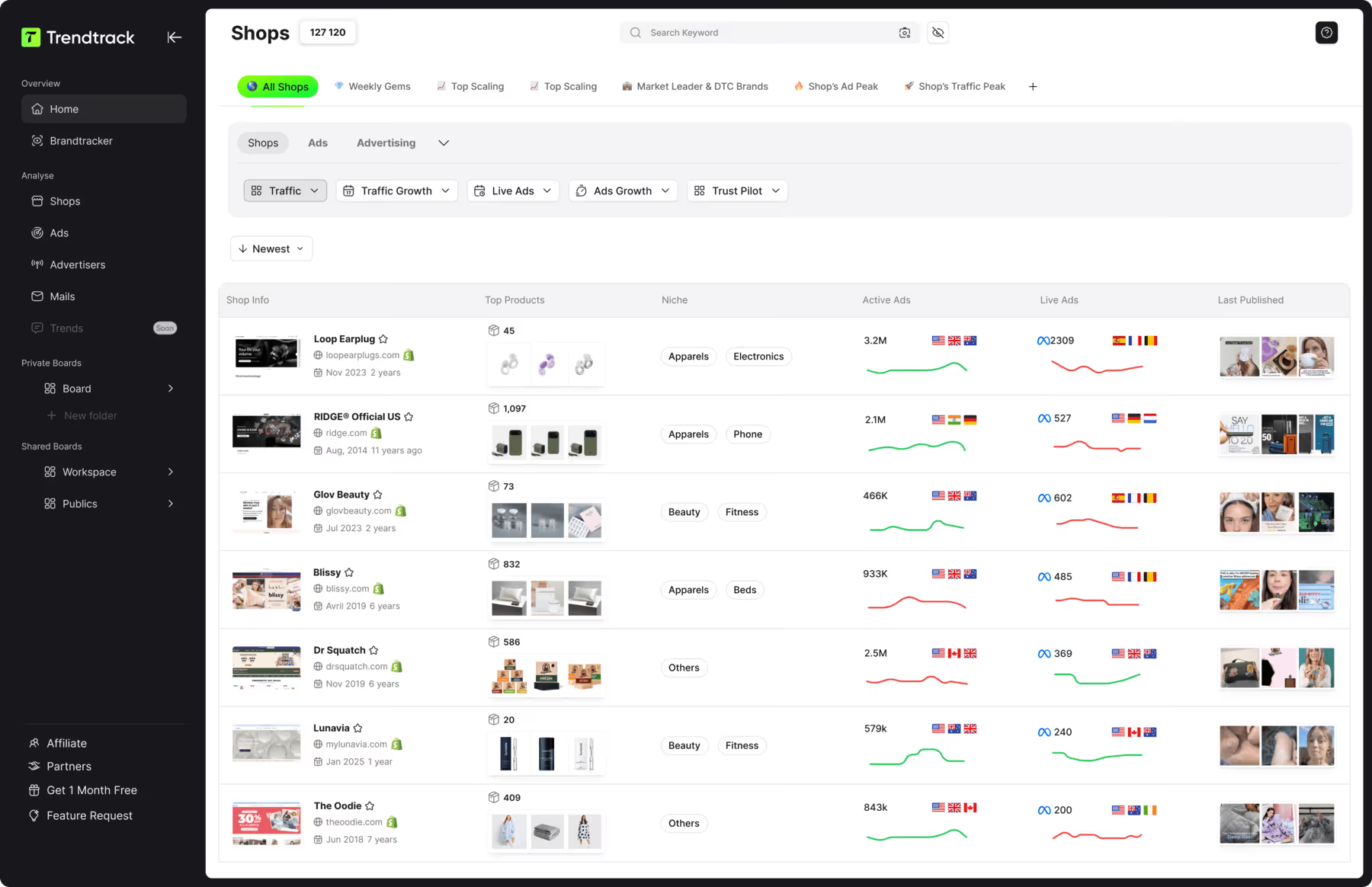
Knowing which products to bundle matters as much as the app you choose. At Trendtrack available at app.trendtrack.io/en/sign-up, we index 95 million TikToks and refresh 700,000+ brand profiles every 24 hours.
In this article we cover the 6 best bundle apps for Shopify.
1. Moon Bundles

Moon Bundles CartDrawer Upsell opens this ranking with the strongest merchant proof in the category: 5.0 stars across 652 reviews, with 655 of its 672 ratings at five stars, plus the Built for Shopify badge.
Its differentiator is scope. Where most apps handle bundles alone, Moon Bundles covers four functions in one: bundles, a cart drawer, post-purchase upsells and free gifts.
That consolidation produces a practical benefit beyond the subscription saving. One script loads instead of four, which matters because every additional app degrades storefront speed.
The feature set is unusually complete. Quantity breaks, mix-and-match, a bundle builder for build-your-own, fixed bundles, smart add-on upsells, volume discounts, BOGO and one-click post-purchase offers.
A/B testing runs across modules, and chat support operates seven days a week.
One detail separates it from almost every competitor: every feature appears on every plan, including the free one.
You are not buying functionality as you scale. You are buying headroom.
Pricing follows generated revenue. Free up to $500, then $19.99 monthly up to $2,000, $39.99 up to $10,000, and $79.99 unlimited. Annual billing saves 20%, with a 7-day trial.
That $79.99 ceiling deserves attention. Several competitors keep climbing past $139 and $299 at higher volumes, while Moon Bundles caps.
Two limitations apply.
The app launched in June 2024, making it younger than the established leaders.
There is no SKU-level breakdown for 3PL fulfilment, so stores with complex inventory needs should look elsewhere.
If you already run a cart drawer app, you are paying for overlap.
2. Rapi Apps
Rapi takes second place with the broadest feature set in this ranking, serving over 10,000 DTC brands according to the company.
The app covers an unusually wide range: an advanced bundle builder, upsells, volume discounts, free gifts, subscription bundles and A/B testing.
That last point deserves attention. Few bundle apps let you test offer variants against each other, and testing is what separates a bundle that works from one you assume works.
Two features stand out for international stores.
Color swatches inside the bundle builder, useful for apparel and any catalog with variants.
Translation-friendly configuration, which matters if you sell across markets and run a multilingual storefront.
A progress bar also ships as standard, pushing customers toward a threshold rather than letting them stop at one item.
Pricing runs on generated revenue across four tiers, with a 14-day free trial.
Starter at $15 covers up to $1,000 in additional monthly revenue. Pro at $29 reaches $5,000 and adds 24/7 chat support. Elite at $59 covers $10,000 with priority support and video calls.
Enterprise at $99 is where the detail matters.
The plan is advertised as unlimited revenue, and it includes the cart drawer, post-purchase upsell and checkout upsell that lower tiers do not. But the small print caps included revenue at $15,000 monthly, then charges $10 per additional $1,000 generated.
Run the arithmetic at scale. A store generating $50,000 in bundle revenue pays $99 plus $350, landing near $449 monthly.
Two limitations follow.
The advanced modules sit behind the top tier, so cart drawer and post-purchase offers require the $99 plan.
The uncapped overage makes costs unpredictable for fast-growing stores.
Rapi suits merchants wanting A/B testing and multilingual support, at moderate volume.
3. Fast Bundle
Fast Bundle holds the widest range of bundle types in this ranking, with 5.0 stars across roughly 3,500 reviews.
Seven formats are supported: fixed bundles, mix-and-match, build-your-own, volume discounts, BOGO, add-ons and frequently-bought-together.
For a store running several offer mechanics simultaneously, consolidating them into one app avoids stacking scripts and subscriptions.
Two features distinguish it technically.
An AI bundle image generator, which produces visuals for your bundle offers automatically. That removes a real bottleneck, since creating a composite image for every bundle normally falls to someone.
A customizable editor giving more control over how offers display on product pages than most competitors allow.
Pricing follows generated bundle revenue, and this is where the app requires careful evaluation.
$19 monthly covers up to $1,000 in bundle sales. $49 reaches $3,000. $139 covers $10,000. Beyond that, plans climb to $299.
A 7-day trial applies, with lower annual pricing available. Free installation exists for development stores, and some merchants report a free tier up to $500.
Run that progression against your own trajectory.
A store generating $10,000 monthly in bundle revenue pays $139. The same store at $50,000 pays $299. Compare that to Moon Bundles capping at $79.99, and the gap compounds every month.
The feature depth may justify it. The point is to calculate before installing, not after.
One historical detail worth knowing: the app was pulled from the App Store on 18 July 2026 and later reinstated. It is live now, but the episode is worth noting when evaluating stability.
Fast Bundle suits stores needing many bundle types and willing to pay for breadth as they scale.
4. Kaching Bundles
Kaching Bundles carries the strongest merchant proof in the entire category: 5.0 stars across 6,282 reviews.
That volume matters more than most ranking criteria. An app maintaining a perfect rating across six thousand merchants has handled every edge case, theme conflict and support scenario the Shopify ecosystem produces.
Nothing else in this comparison approaches that sample size.
Its focus is deliberately narrow. Kaching specialises in quantity breaks and product-page bundles, the mechanic that displays tiered pricing directly on your product page: buy one, buy two and save, buy three and save more.
That format converts well because it meets the customer at the moment of decision, without requiring navigation to a separate bundle page.
A/B testing ships with the app, letting you compare offer structures rather than guessing which tier arrangement works.
Pricing starts at $14.99 monthly, which places it among the more accessible options at entry level.
Two limitations deserve weighing.
No free plan exists for live stores. Development stores can install free, but a working storefront requires a paid subscription from day one. Several competitors offer genuine free tiers up to a revenue threshold.
The scope is narrower than the apps above. No cart drawer, no post-purchase upsells, no build-your-own bundle builder. Kaching does quantity breaks and product-page offers well, and leaves the rest alone.
That narrowness is a feature for some merchants and a dealbreaker for others.
If quantity breaks are your primary mechanic, Kaching is arguably the safest choice in this ranking. If you need multiple bundle formats or a cart drawer, you will be adding apps alongside it.
5. Bundler
Bundler earns its place on one argument that no other app in this ranking matches: a genuinely unlimited free plan.
Rated 4.9 stars across roughly 2,729 reviews, the app offers a free tier with no revenue cap and no order cap.
That distinction matters because “free” means something different everywhere else in this category. Moon Bundles caps at $500 in generated revenue. Pumper at $300. BOGOS at 30 lifetime orders. Kaching offers nothing free for live stores.
Bundler simply lets you run bundles without paying, indefinitely.
The free tier covers fixed bundles, mix-and-match, volume discounts and quantity breaks, which handles the mechanics most stores actually need.
Paid plans start at $8.99 or $9.99 monthly depending on the tier, with a Premium level and an Executive level adding analytics around $12.99.
Those figures make it the cheapest paid option in this comparison by a wide margin, and the pricing is flat rather than tied to generated revenue.
That second point deserves emphasis. A store scaling from $1,000 to $50,000 in bundle revenue pays the same $12.99 it paid at the start, while Fast Bundle would be at $299 and Rapi near $449.
Two limitations apply.
The feature set is narrower than the leaders. No cart drawer, no post-purchase upsells, no build-your-own bundle builder, no AI tooling.
The interface is more functional than polished, which some merchants find dated compared to newer apps.
Bundler suits two profiles particularly well: new stores testing whether bundling works before committing budget, and established stores at volume who want flat pricing rather than revenue-based escalation.
For straightforward bundle mechanics, it is the best value in this ranking.
6. Simple Bundles
Simple Bundles & Kits closes this ranking by solving a problem every other app in the category ignores: inventory.
Rated 4.8 stars across roughly 803 reviews, its differentiator is SKU-level breakdown.
When a customer buys a bundle, Simple Bundles splits the order into its individual components. Your stock updates per product, not per bundle, and your fulfilment partner receives line items it can actually pick.
Every other app in this comparison treats a bundle as a single unit. That works until it does not.
Three situations make this decisive.
You use a 3PL. Your fulfilment provider needs to know which physical items to pack. A bundle SKU means nothing to a warehouse system, and manual workarounds break at volume.
You sell components separately. Without SKU-level tracking, selling a product individually and inside a bundle produces stock figures that drift apart until you discover the gap through an oversell.
You run a WMS or B2B workflow. These systems require real inventory data, not aggregated bundle counts.
Simple Bundles also supports subscription workflows, which compounds the inventory complexity it already handles.
Pricing offers a free plan limited to 3 bundles and 50 orders, with paid tiers from $14 to $24 monthly depending on the source and configuration. Costs scale with your Shopify plan and store orders.
Two limitations frame the fit.
The conversion features are thinner. No cart drawer, no post-purchase upsells, no A/B testing, no AI tooling. This app manages bundles operationally rather than optimising their sale.
The free tier is restrictive compared to Bundler, serving as a trial rather than a usable plan.
Simple Bundles suits merchants whose constraint is fulfilment rather than conversion.


Ready to build a million-dollar brand?