Panoramata Review 2026: Details, Pricing, Limitations



Competitor email intelligence used to mean subscribing to a dozen newsletters with a burner address and hoping you noticed the interesting ones. Panoramata built a business on automating that, and it has become one of the more visible names in European marketing benchmarking.
The product tracks what competing brands actually send and publish. It unlocks a brand’s marketing assets including emails, ads, flows, landing pages and SMS, with access to current and historical strategy, alongside marketing stack detection, website snapshots and ecommerce insights.
For an e-commerce or SaaS marketer rebuilding a lifecycle program, that library answers a question that is otherwise expensive to research: what does a welcome flow look like at a brand three times our size, and how often do they actually send?
Pricing is flat rather than usage-based, which is unusual in this category. The Startup plan starts at $99 per month with six months of history and three users, Professional sits at $149 per month with unlimited data and ten users, and Unlimited reaches $399 per month for twenty users, with an enterprise tier on request. Annual billing includes two months free, and a Panoramata MCP connection to Claude or ChatGPT is included on every plan.
That last point deserves noting, because conversational access to competitive data has moved from novelty to expectation in under two years.
So the real question is not whether Panoramata works. It is what it covers, and what it leaves out.
Three limitations shape that answer, and this review examines each in detail. The depth of its social and short-form video intelligence, which matters enormously now that product discovery happens on TikTok before it happens in an inbox. The absence of competitor store traffic data, which is what separates a brand that looks active from one that is genuinely scaling. And the volume of independent reviews available, which remains thin enough that most buyers are evaluating on a demo rather than on peer feedback.
None of these disqualify the tool. They define who it fits.
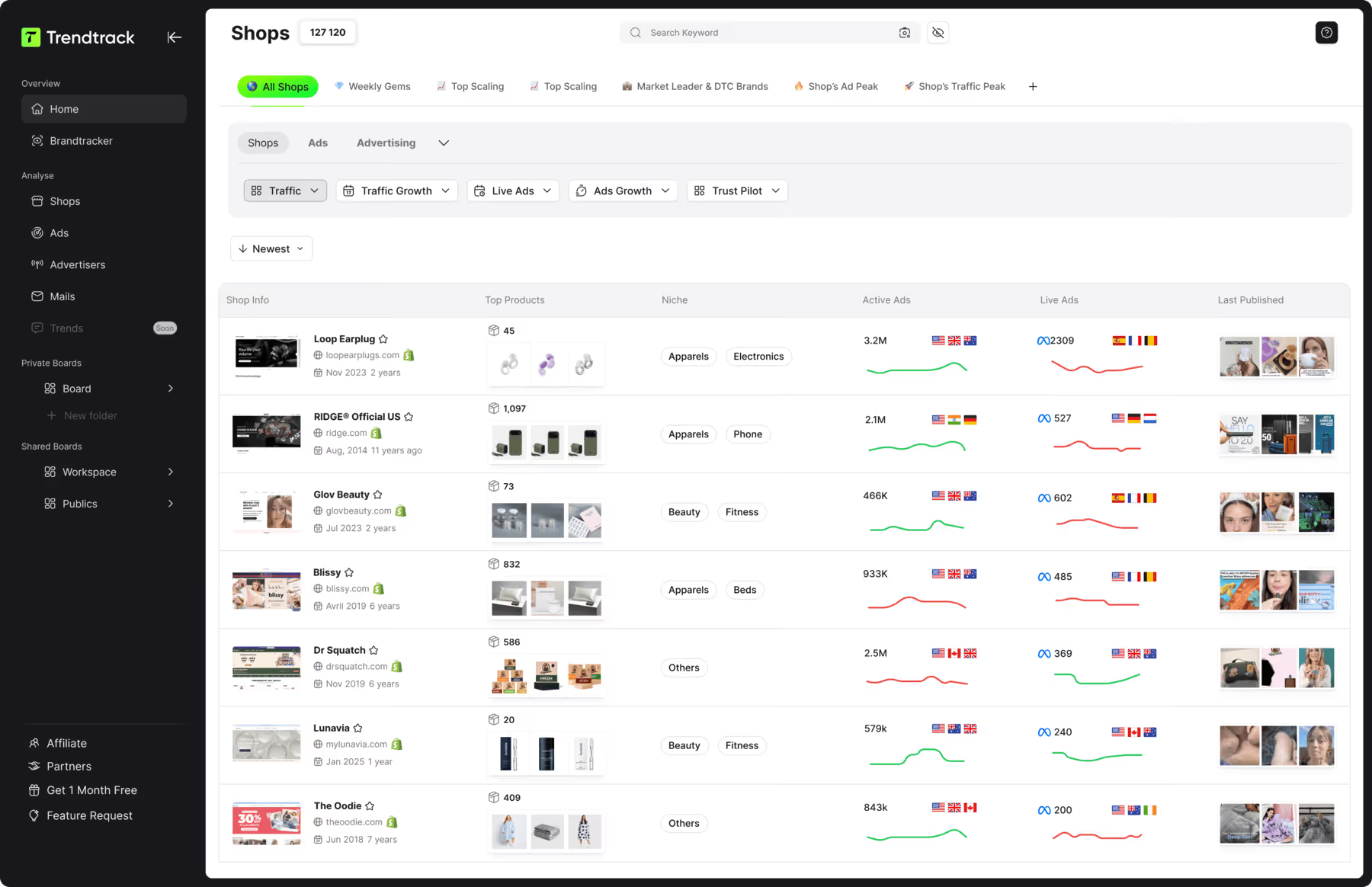
For operators who need email benchmarking alongside real-time TikTok and Meta intelligence, competitor store traffic and product-level discovery in one platform, Trendtrack covers a different scope. Start free at app.trendtrack.io/en/sign-up.
What Is Panoramata?

Panoramata is a competitive marketing intelligence platform built around a simple premise: most of what your competitors do is public, but nobody has time to watch it.
Rather than monitoring a single channel, it indexes a brand’s outbound marketing across several at once. Users access emails, ads, flows, landing pages and SMS for a tracked brand, along with its current and historical marketing strategy. The platform adds marketing stack detection, website snapshots and ecommerce insights on top, which turns a brand page into a reasonably complete picture of how that company goes to market.
The scale claimed is substantial. Panoramata advertises access to 500 million marketing assets through its email and ads libraries, with thousands of brands already tracked across industries.
Two design choices distinguish it from older email-monitoring tools.
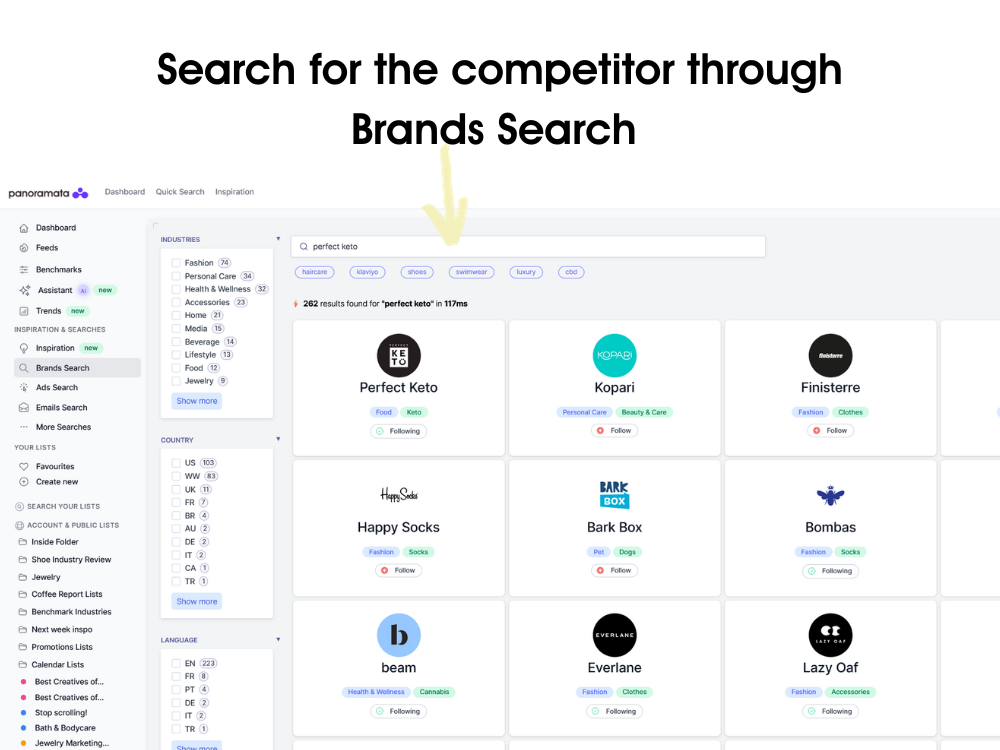
The first is coverage on request. Panoramata can track any competitor, including brands outside its existing database. Tools built on a fixed catalogue leave you stuck when the brand you actually compete with is not in it, which is the most common complaint about this category.
The second is flat pricing across industries. Where legacy platforms pushed competitor email intelligence into custom-priced enterprise plans, Panoramata applies a published rate, which makes it accessible to teams that would never clear an enterprise procurement process.
The working unit is the benchmark report: a real-time dashboard comparing a set of competitors on the metrics you choose, with the number of available dashboards scaling by plan.
An MCP connection to Claude or ChatGPT ships with every plan, so the data can be queried conversationally rather than through the interface alone.
In short, it is a benchmarking tool for marketers who work primarily in email, ads and landing pages.
What Are Panoramata’s Features?
The platform organises its coverage by asset type, with each one tracked continuously once a brand is added.
Email and newsletter tracking

The core of the product. Every email a tracked brand sends is captured and stored alongside its historical marketing activity, which lets you read a campaign calendar rather than a snapshot. Seeing send frequency, seasonal pushes and subject line patterns over months is what makes benchmarking useful, and it is impossible to reconstruct manually. g2
Email flows and sequences
Beyond one-off campaigns, Panoramata captures automated journeys: welcome series, abandoned cart sequences, post-purchase and win-back flows. Flows are included from the entry plan. For a lifecycle marketer, this is the highest-value data in the product, since flows generate the majority of email revenue and are the hardest thing to observe from outside.
Ads library
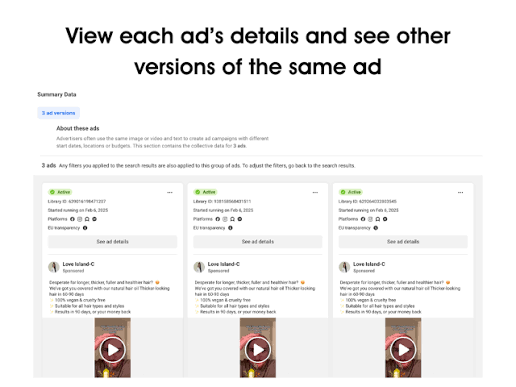
Ad creatives sit alongside emails in the same brand view, which lets you connect what a competitor promotes in the inbox with what they run in paid. The ads and email libraries together are searchable across the platform’s asset base.
SMS tracking
SMS is captured as its own asset type. Coverage here is scarcer across the market than email, so having it in the same timeline is a genuine differentiator for brands running conversational retention.
Landing page tracking and snapshots
Landing pages are tracked with snapshots, meaning you see not only the current version but how it changed. Watching a competitor rewrite a hero section or restructure pricing over time tells you what they learned from testing, without running the tests yourself.
Benchmark reports and real-time dashboards
Benchmark reports are the working unit of the platform, with three included on the entry tier, ten at the next level and fifty higher up. Each one compares a defined set of competitors on live metrics, which is what turns scattered observation into something presentable to a team or a client.
Marketing stack detection
The platform identifies the tools a brand runs. Knowing whether a competitor is on Klaviyo or Braze, and which apps surround it, explains capability gaps that creative analysis alone never surfaces.
Asset search and inspiration
Searches run across the email and ads libraries covering 500 million marketing assets, so research is not limited to brands you have explicitly added. This is the mode most teams use when building a campaign from scratch rather than monitoring a named rival.
Tracking any competitor on request
Brands outside the existing database can be added for tracking, which removes the main structural limitation of catalogue-based tools.
MCP integration with Claude and ChatGPT
An MCP connection is included on every plan, letting you query competitive data conversationally instead of navigating dashboards. It is a meaningful workflow change, and increasingly the baseline expectation rather than a differentiator.
What Is the Price of Panoramata in 2026?
Panoramata runs on flat monthly pricing with three public plans, billed in euros. Paying yearly includes two months free.
| Criteria | Startup | Professional | Advanced |
|---|---|---|---|
| Monthly price | €99 | €149 | €379 |
| Competitors tracked | 20 | Unlimited | Unlimited |
| Historical data | 6 months | Unlimited | Unlimited |
| Included users | 3 | 10 | 20 |
| Dashboards & benchmark reports | 3 | 10 | 20 |
| Library searches | Emails and ads | Emails, ads, SMS, landing pages, flows | Full access |
| MCP + Pano AI credits | 300 | 1,000 | 3,000 |
| Ask AI and AI insights | Not included | Included | Included |
| Summaries, alerts and reports | Not included | Slack, Gmail, PDF | Slack, Gmail, PDF |
| Custom reports builder | Not included | Included | Custom reports and datasets |
| Exports | Not included | Advanced reports, exports, trends, LLM datasets | Bulk export creatives |
| Canvas boards | Not included | Unlimited | Unlimited |
| CRM segments & A/B test detection | Not included | Not included | Included |
| Catalogs SKU tracker | Not included | Not included | Included |
| AI Slack app | Not included | Not included | Included |
| Onboarding & support | Standard | Standard | Whiteglove onboarding, CSM, priority support |
The structure rewards a specific reading: the headline price gaps are small, but the capability gaps are not.
Startup at €99 is a monitoring plan. You track up to 20 competitors, read six months of history and search the email and ads libraries. What you cannot do is automate anything: no alerts, no exports, no custom reports. You log in, you look, you leave. For a solo marketer or a small brand with a defined competitive set, that is often enough.
Professional at €149 is where the product becomes operational. Unlimited competitors and unlimited history remove the two constraints that make benchmarking frustrating, but the decisive additions are elsewhere. Alerts delivered to Slack and Gmail turn passive research into monitoring that reaches you. Exports and LLM datasets let the data leave the platform and enter your own workflows. SMS, landing pages and flows join the searchable libraries.
Fifty euros separates the two plans. In practice, Professional is a different product.
Advanced at €379 targets agencies and multi-market companies. The feature that justifies the jump for most buyers is CRM segments and A/B test detection, which moves you from observing what competitors send to inferring how they segment and what they are testing. The catalogs SKU tracker adds product-level monitoring, and the human layer matters too: whiteglove onboarding, a customer success manager and priority support.
One practical note on the AI credits. They scale from 300 to 3,000 across the plans and cover both MCP queries and in-platform AI features. If conversational access is central to how your team works, model your consumption before committing to Startup, because 300 credits disappear faster than expected once querying becomes a habit.
What Are the Limitations of Panoramata?
No tool covers everything, and Panoramata’s boundaries are mostly consequences of its positioning rather than defects.
No performance data. You see what a brand sends, not how it performed. Open rates, click-through and revenue per campaign remain invisible, so a competitor’s most-repeated email could be their best performer or their least. You are inferring from frequency, never measuring.
Scope stops at outbound marketing. Emails, ads, SMS and landing pages are covered well. Competitor store traffic, product-level sales momentum and organic social activity are not, which leaves a gap between a brand that looks active and one that is genuinely scaling.
The entry plan is observation only. At €99, Startup caps you at 20 competitors and six months of history, with no alerts, no exports and no custom reports. Monitoring that does not reach you tends not to happen.
AI runs on credits. MCP and Pano AI are metered, from 300 credits on Startup to 3,000 on Advanced. Conversational querying consumes them faster than most teams anticipate.
No free trial advertised. The pricing page offers a demo booking and a paid start rather than a self-serve trial, so evaluation requires either a sales call or a commitment.
Thin independent review volume. Public ratings are positive but rest on a handful of reviews across G2 and the comparison directories, which makes peer validation difficult before buying.
Advanced features sit behind a steep tier. CRM segment and A/B test detection, arguably the most strategically useful capabilities in the product, only appear at €379 per month.
None of this makes Panoramata a weak tool. It makes it a specialist one, strongest for teams whose competitive questions are primarily about email and creative.
For operators who also need store traffic, product discovery and real-time TikTok and Meta intelligence, Trendtrack covers that second half. Start free at app.trendtrack.io/en/sign-up.
Panoramata vs Trendtrack
The two platforms are often compared, but they answer different questions. Here is where each one actually sits.
| Criteria | Panoramata | Trendtrack |
|---|---|---|
| Core question answered | What are competitors sending? | What is working in the market right now? |
| Email campaigns | Full archive with history | Email tracking on monitored shops |
| Automated flows & SMS | Covered in depth | Not the focus |
| Landing pages | Tracked with snapshots over time | Landing page library |
| Meta ads | Covered | Covered |
| TikTok intelligence | Limited | 95 million TikToks indexed |
| Brand profiles refresh | Continuous tracking | 700,000+ profiles updated every 24 hours |
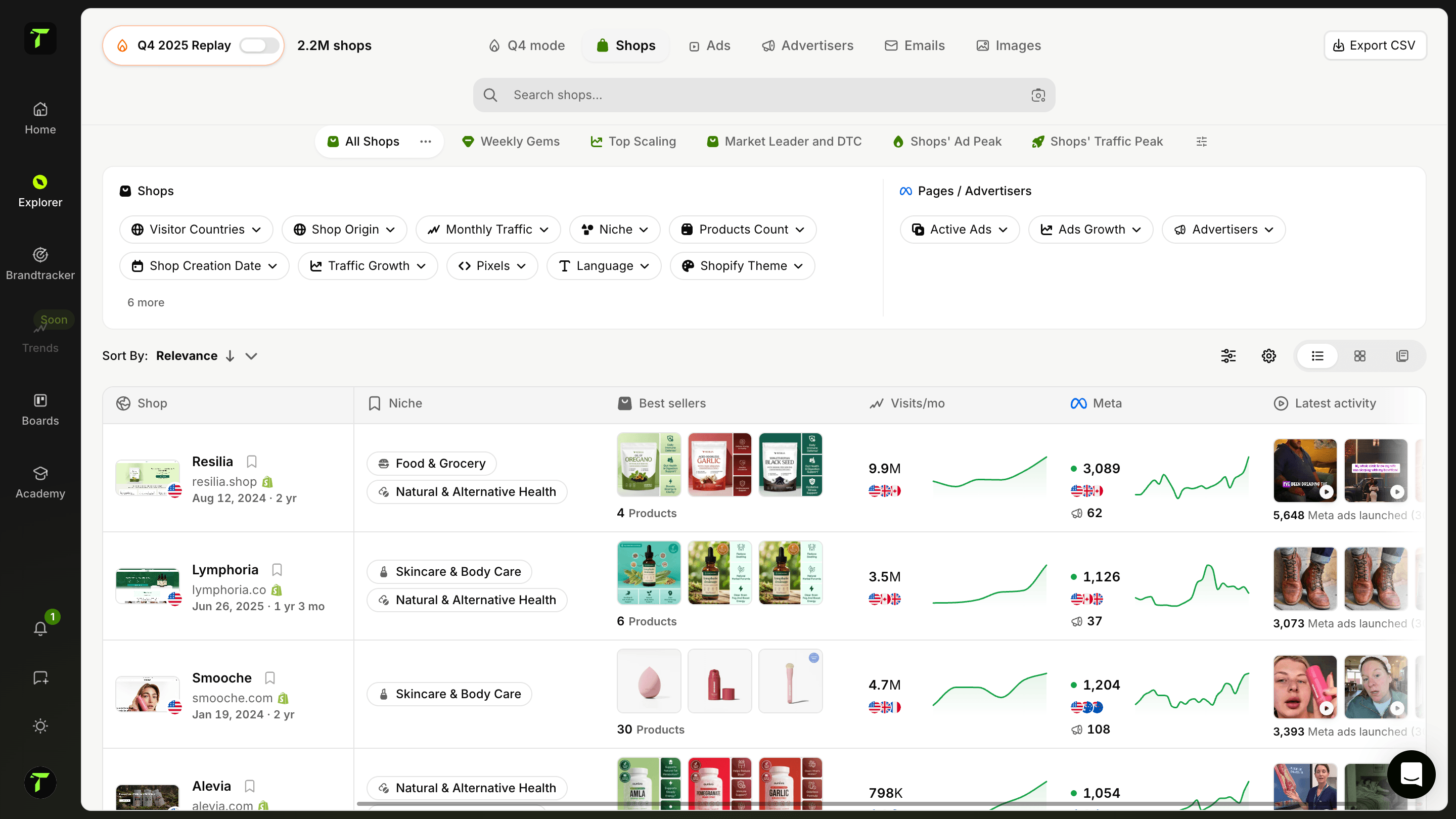
| Competitor store traffic | Not available | Traffic estimates, growth and sources |
| Product-level discovery | Not available | Winning products, best sellers, new launches |
| Chrome extension | Not available | Yes, data surfaces as you browse |
| Continuous brand monitoring | Benchmark reports and alerts | BrandTracker |
| MCP with Claude and ChatGPT | Included on all plans | Included |
| Entry point | €99 per month | Free account available |
| Best suited to | CRM and lifecycle marketers | E-commerce operators and media buyers |
Two lines in that table carry the decision.
Store traffic is the one Panoramata does not attempt. Creative volume tells you a brand is active; traffic tells you whether that activity converts into commercial traction. Without it, you are reading effort rather than results.
Product-level data is the second. Most e-commerce decisions come down to what to sell next, and that question lives upstream of any email calendar.
The arbitration is simple. If your week revolves around email flows and creative benchmarking, Panoramata is the specialist and does it well.
If your week revolves around finding products, reading momentum and deciding where ad spend goes, Trendtrack is the platform you open every day.
Start free at app.trendtrack.io/en/sign-up.
Panoramata Review: Our Final Verdict
Panoramata is a genuinely good tool held back by nothing other than the scope it chose.
What it does, it does better than most. The email archive is deep, the flows and SMS coverage is rare at this price point, and landing page snapshots over time reveal competitor testing that no other channel exposes. For a lifecycle marketer rebuilding a welcome series or benchmarking send frequency against a category, it removes weeks of manual work.
The pricing structure is honest too. Flat rates published openly, from €99 to €379 per month, with two months free on annual billing. No custom quotes, no enterprise gatekeeping on the core features.
Three things should shape your decision.
The entry plan observes, it does not operate. At €99 you get 20 competitors and six months of history, without alerts, exports or custom reports. Most teams discover within a month that €149 is the real starting point.
You see activity, never performance. The platform shows what competitors send, not what worked. That inference gap is structural, and no amount of data volume closes it.
The scope stops before commerce. Store traffic, product momentum and TikTok-driven discovery sit outside the product, which matters because that is where demand now forms before it reaches an inbox.
So, is it worth it? Yes, for CRM and lifecycle teams whose competitive questions genuinely live in email and creative. It is the specialist, and specialists earn their place.
For e-commerce operators and media buyers whose weekly decisions are about products, spend allocation and market momentum, the answer is different. That workflow needs real-time TikTok and Meta intelligence, competitor store traffic and product-level discovery in one place.
That is what Trendtrack was built for, and it is the tool you end up opening every morning rather than once a quarter.


Ready to build a million-dollar brand?