Black Friday E-commerce 2026: How to Prepare Your Online Store in Advance?


Black Friday falls on November 27, 2026, followed by Cyber Monday on November 30. That leaves roughly two months to get ready, and how you use them will largely determine whether this period becomes your best week of the year or an expensive disappointment. So how do you prepare your online store for Black Friday 2026?
The first thing to understand is that Black Friday is won well before the day itself. Stores that perform have already locked their inventory, tested their site performance under load, built their email list, prepared their creatives and mapped what competitors are doing. Those improvising in the final week compete for expensive advertising against brands that warmed their audience for weeks.
Two structural realities shape this period. The first is advertising cost. CPMs rise sharply across Meta, TikTok and Google as every advertiser bids simultaneously, which means acquisition becomes considerably more expensive precisely when you need volume. Building owned traffic through email and organic content beforehand is what protects your margin.
The second is operational strain. A surge in orders exposes every weakness in your setup: a server that buckles, a supplier who cannot restock, a customer service inbox that overflows, a shipping partner missing deadlines. A record sales day followed by three weeks of complaints and refunds is not a win.
The preparation itself breaks into clear phases. Two months out you audit your site performance, secure your inventory and confirm supplier lead times. One month out you build your offers, prepare your creatives and grow your email list. Two weeks out you test everything end to end and warm your audience. The final week you execute rather than improvise.
This guide covers each phase in detail: what to audit, how to structure your offers, what to prepare on the technical side, how to plan your acquisition, how to handle logistics and customer service, and what to measure afterwards.
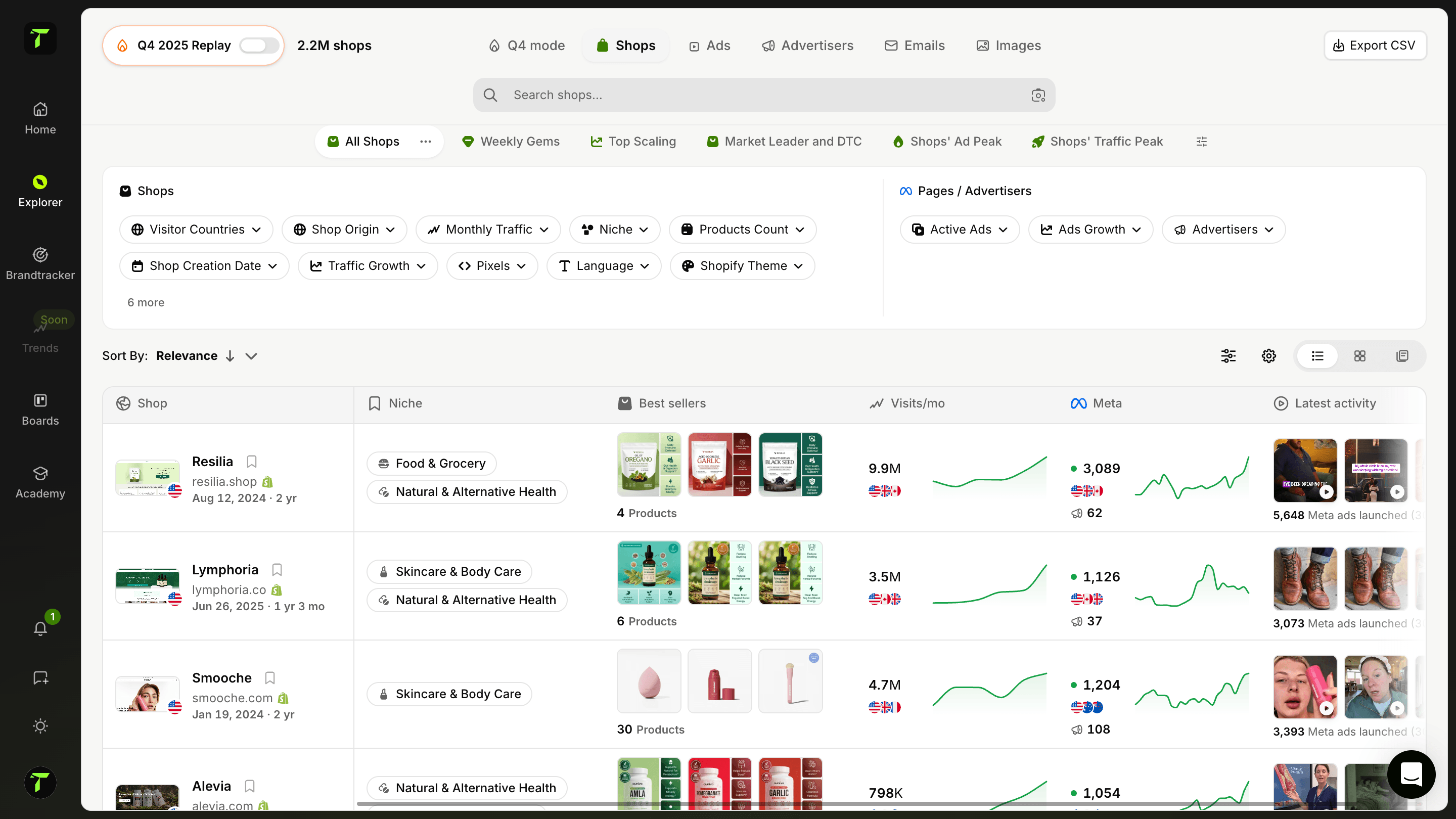
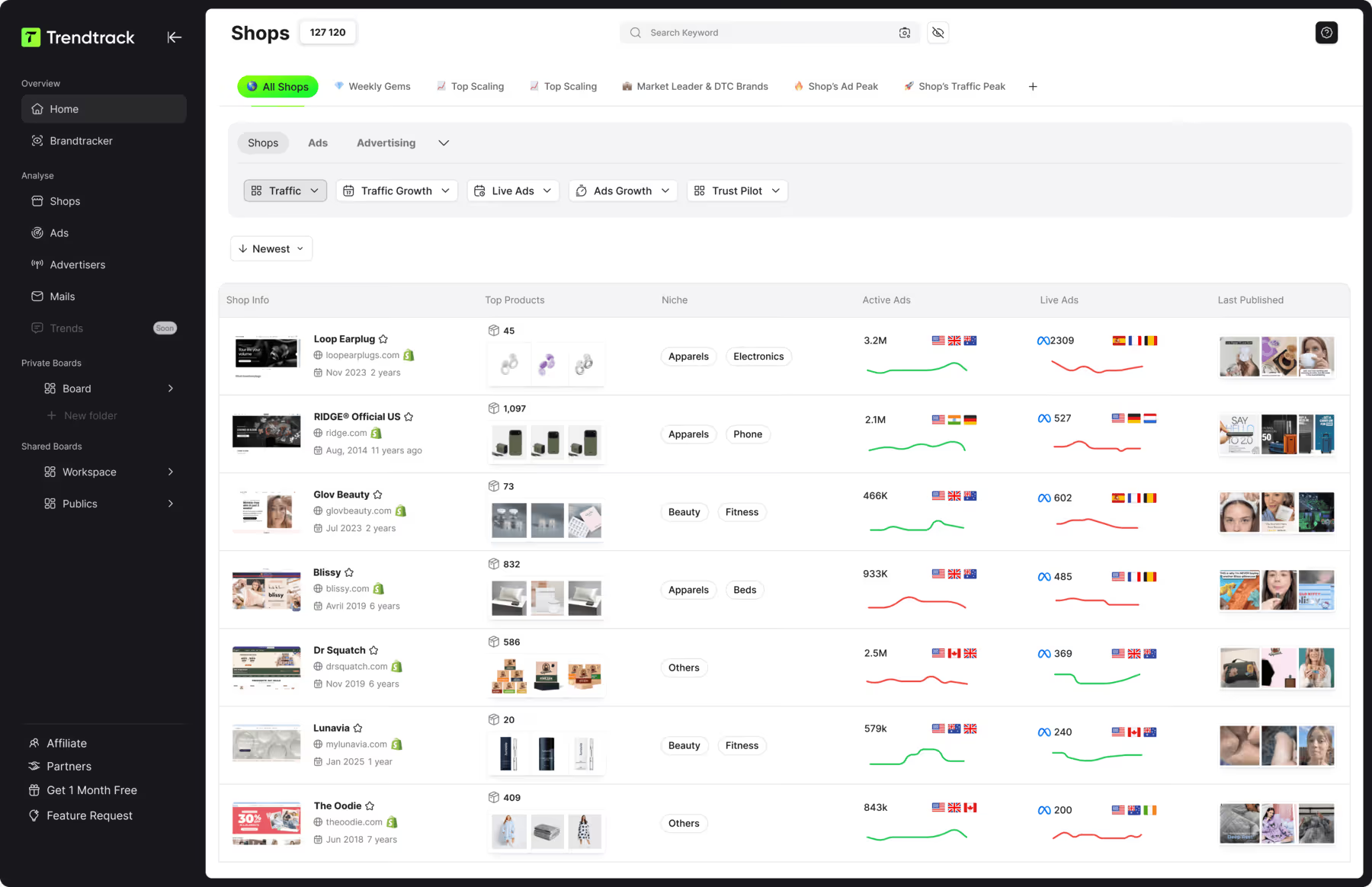
One preparation step is routinely skipped: knowing what your competitors are actually running. Trendtrack available at app.trendtrack.io/en/sign-up reveals their full ad library, top performing creatives, scaled formats and landing pages across Meta, TikTok and Google, backed by 95 million indexed TikToks and 700,000+ brand profiles updated every 24 hours.
In this complete guide we explain how to prepare your online store for Black Friday 2026.
When Exactly Is Black Friday 2026?
Black Friday 2026 falls on Friday, November 27. The date moves every year because it is always the day after Thanksgiving, which is set as the fourth Thursday of November in the United States. In 2026 Thanksgiving lands on November 26.
Table: key dates for Black Friday 2026
| Event | Date |
|---|---|
| Thanksgiving | Thursday, November 26, 2026 |
| Black Friday | Friday, November 27, 2026 |
| Small Business Saturday | Saturday, November 28, 2026 |
| Cyber Monday | Monday, November 30, 2026 |
| Black Friday week | November 23 to 30, 2026 |
In practice the commercial period extends far beyond a single day. Most stores now run a Black Friday week starting around November 23, and many begin teasing offers in early November. Some brands stretch the operation across the entire month.
This extension changes your planning. Concentrating everything on a single day means competing at peak advertising costs, while a longer sequence lets you warm your audience earlier and spread your logistics load.
Cyber Monday on November 30 closes the period and traditionally performs well for digital products and services.
Starting your preparation now gives you roughly two months.
E-commerce: What Should You Prepare Two Months Before Black Friday?
Two months out is when the decisions that actually matter get made. Everything you postpone now becomes either expensive or impossible in November. Here is what to prepare at this stage.
Secure your inventory and supplier lead times
This is the single most consequential decision at this point. Selling out on day one looks like success and costs you the rest of the week, while overstocking ties up capital you may not recover until spring.
Start by identifying your likely best sellers using last year's data if you have it, or your current top performers if this is your first Black Friday. Contact your suppliers now to confirm production and shipping lead times, since a factory in Asia quoting thirty days in September may quote sixty in October as every brand places its orders simultaneously. Build in a buffer for customs and transit delays.
If you operate on dropshipping, confirm your supplier can absorb a volume spike without extending delivery times, since a product arriving in January after a November order destroys your reviews and triggers refunds.
Audit your site performance
Black Friday traffic can multiply your normal volume several times over, and a site that handles two hundred visitors comfortably can collapse at two thousand. A crash during your peak hour costs more than the entire preparation.
Measure your current loading speed on PageSpeed Insights, particularly on mobile where most traffic arrives. Compress your images to WebP, remove apps you no longer use since each one adds scripts, and verify your hosting can scale. If you run on a shared hosting plan, this is the moment to move up rather than during the rush.
Test your checkout flow end to end on both desktop and mobile, including payment, confirmation emails and shipping calculation.
Define your offer strategy
Deciding your discounts two months ahead lets you build everything else around them rather than improvising. Calculate your real margin per product after discount, shipping and payment fees, then confirm the offer remains viable at scale.
Decide whether you run a sitewide discount, deals on selected products, bundles, tiered discounts based on cart value or a combination. Bundles and tiered offers protect margin better than flat sitewide cuts because they raise average order value rather than simply reducing it.
Start building your email list
This is the most underrated preparation step and the one with the highest return. Advertising costs rise sharply in November as every brand bids at once, which means the traffic you own becomes disproportionately valuable.
Install a capture form with a genuine incentive, run modest ad campaigns toward a waiting list rather than toward direct sales, and segment your existing contacts by purchase history. A list of five thousand engaged subscribers in November is worth more than an equivalent advertising budget.
Study what competitors did last year
This is where most stores skip a step. Understanding which offers, creatives and angles your competitors ran previously tells you what works in your category before you commit budget.
Trendtrack available at app.trendtrack.io/en/sign-up preserves full ad history across Meta, TikTok and Google, showing their top performing creatives, the formats they scaled and the landing pages they used.
Plan your logistics and customer service
Confirm your shipping partner can absorb the volume and check their cutoff dates for delivery before Christmas. Anticipate your customer service load, prepare answer templates for the most frequent questions and decide now whether you need temporary help.
What to Prepare One Month Before Black Friday?
One month out the strategic decisions are behind you. This phase is about building the assets you will actually deploy and testing them while advertising is still affordable. Here is what to prepare at this stage.
Produce and test your creatives now
This is the most time-sensitive task and the one stores consistently underestimate. Producing ad creatives in November means testing them at peak CPM, which is the worst possible moment to discover that an angle does not work.
Create several genuinely different concepts rather than variations of the same idea: a product demonstration, a testimonial, a problem-solution format, an offer-led creative. Run them now at modest budget with a standard conversion objective. The goal is not immediate profitability but identifying which hooks hold attention in your category, so that in November you scale proven assets instead of testing blind.
Prepare your Black Friday versions in parallel, adding the offer overlay and urgency elements to the creatives that performed. Have them ready and approved well before launch, since ad review times lengthen as volume rises.
Build your landing pages and collections
Do not send Black Friday traffic to your homepage. Create a dedicated collection page grouping your offers, with clear pricing, visible discounts and filters if your catalogue justifies them.
Publish this page early with a waiting list or a teaser. It accumulates SEO signals before the period, lets you capture emails from early visitors and gives you a link to use across every channel. Prepare your banners, your countdown elements and your product page badges now so that switching them live takes minutes rather than hours.
Grow and segment your email list aggressively
This is the phase where list building pays off most. Advertising costs are still reasonable, which means acquiring an email now costs a fraction of what a sale will cost in November.
Run campaigns toward a Black Friday waiting list with early access as the incentive. Early access works better than a discount promise because it creates exclusivity without committing you on price. Segment your existing base by purchase history, engagement level and product category so that your November sequence speaks differently to a repeat customer and to someone who never bought.
Prepare your full email and SMS sequence
Write everything now rather than during the week itself. A complete sequence typically includes a teaser around two weeks out, an early access message for your list, a launch email, one or two reminders during the period, a last hours message and a Cyber Monday follow-up.
Load them into your platform, set the triggers and test the rendering on mobile. During Black Friday week you want to be monitoring performance, not writing copy.
Stress test your operations
Simulate a volume spike on your site if your hosting allows it, and confirm your payment provider can handle the increase without triggering a risk review. A sudden jump from your normal volume is exactly the pattern that flags aggregator accounts, so warn your provider in advance.
Verify your inventory synchronization across channels and set up low stock alerts so you can pause ads on products about to sell out rather than paying for traffic you cannot serve.
Monitor competitor activity continuously
Competitors start revealing their positioning during this window. Watching which creatives they launch and which offers they tease tells you where the pressure will come from.
What to Do During Black Friday Week Itself?
By this point everything should already be built. This week is about execution and monitoring, not creation. Here is what to do during Black Friday week.
Launch your teaser and early access
Activate your offers on schedule
Scale your winning creatives
Monitor stock levels hourly
Watch your key metrics continuously
Keep customer service responsive
Push your last hours urgency
Extend into Cyber Monday
The first step is to launch your teaser and early access a few days before, rewarding your email list with a head start. This spreads your order volume, reduces operational strain on the day itself and makes your subscribers feel their loyalty matters.
The second step is to activate your offers on schedule with banners, badges and collection pages switching live automatically rather than manually at midnight.
The third step is to scale your winning creatives rather than launching new ones. Increase budget on assets that already proved themselves in October, since testing at peak CPM is expensive and slow.
The fourth step is to monitor stock hourly. Pause ads on products about to sell out rather than paying for traffic you cannot serve, and redirect that budget toward items still available.
The fifth step is to watch your key metrics continuously, focusing on cost per purchase, conversion rate and site speed. A slowdown under load costs more than any advertising adjustment.
The sixth step is to keep customer service responsive since pre-purchase questions convert directly into sales during this window.
The seventh step is to push last hours urgency through email and SMS, which typically generates one of the strongest spikes of the entire period.
The eighth step is to extend into Cyber Monday on November 30 with a distinct angle rather than simply repeating your Friday offer.
What Mistakes Should You Avoid on Black Friday?
Some errors are recoverable and others cost you the entire period. Here are the mistakes to avoid on Black Friday.
Preparing at the last minute, which forces you to test creatives and offers at peak advertising costs
Discounting without calculating your real margin after shipping, payment fees and the higher cost per acquisition
Testing new creatives during the week instead of scaling assets already validated in October
Ignoring your site performance and discovering under load that your hosting cannot absorb the traffic
Running out of stock without pausing ads, which means paying for clicks on products you cannot ship
Neglecting your email list and depending entirely on paid acquisition when CPMs are at their highest
Sending traffic to your homepage rather than to a dedicated collection page built for the offer
Promising delivery dates you cannot meet, which generates complaints, refunds and negative reviews
Underestimating customer service volume and leaving pre-purchase questions unanswered during your peak window
Failing to warn your payment provider before a volume spike, which can trigger a risk review and freeze your payouts
Stopping everything on Friday instead of extending through the weekend and into Cyber Monday
Among these the last minute preparation is the root cause of most others. A store that starts in mid-November inherits every problem simultaneously, at the worst possible moment.
Discounting without margin calculation is the most expensive individually. A record revenue week that loses money on every order is a worse outcome than a quieter week that stays profitable.
The payment provider warning is the most overlooked. A sudden jump in volume is exactly the pattern that flags aggregator accounts, and a freeze during Black Friday blocks the revenue you just spent weeks generating.
FAQ Black Friday E-commerce 2026
When should you start preparing for Black Friday?
Two months ahead is the realistic minimum, meaning late September for a November 27 Black Friday. This timeline exists because the decisions that matter most cannot be compressed. Supplier lead times lengthen as every brand places orders simultaneously, creative testing needs weeks of data to identify what works, and email list building only pays off if started while acquisition costs are still reasonable. Stores beginning in mid-November inherit every problem at once, at the moment when advertising is most expensive and suppliers least available. Larger operations often start planning as early as August.
What discount should you offer on Black Friday?
There is no universal figure since it depends entirely on your margin structure. Start by calculating your real margin per product after shipping, payment fees and the higher cost per acquisition typical of this period, then work backwards to a discount that stays viable at volume. Consider that flat sitewide discounts erode margin fastest, while bundles, tiered offers based on cart value and free shipping thresholds protect profitability better by raising average order value. A 20% discount that keeps you profitable beats a 50% discount that generates record revenue and loses money on every order.
How much does advertising cost during Black Friday?
Expect CPMs to rise sharply across Meta, TikTok and Google as every advertiser bids simultaneously during the same window. The increase varies by market and category but it is consistent enough to plan around. This is precisely why preparation matters: creatives tested in October at normal cost can be scaled in November, whereas testing during the period itself burns budget at peak rates while producing the same amount of learning. Building owned traffic through email and organic content beforehand is the most effective protection for your margin.
Should you extend Black Friday beyond Friday?
Most stores now do, and for good operational reasons. Extending into a full week spreads your order volume, reduces strain on your logistics and customer service, and lets you capture buyers who compare offers before committing. It also lowers your exposure to a single day of peak advertising costs. Cyber Monday on November 30 closes the period and traditionally performs well for digital products. The key is to give each phase a distinct angle rather than simply repeating the same offer, which trains your audience to wait rather than buy.
How do you avoid running out of stock?
Start by identifying your likely best sellers using last year's data or your current top performers, then order with a buffer accounting for customs and transit delays. During the period itself, set low stock alerts and pause ads on products about to sell out rather than continuing to pay for traffic you cannot serve. Redirect that budget toward items still available. If you operate on dropshipping, confirm in advance that your supplier can absorb a volume spike without extending delivery times, since late deliveries generate refunds and negative reviews that outlast the sales.
How do you know what competitors will offer?
You cannot know their exact offers in advance, but you can see what they are building toward and what worked for them previously. Competitors typically start revealing their positioning through creatives and teasers several weeks out, and their historical campaigns show which angles and formats they scaled in past years. Trendtrack available at app.trendtrack.io/en/sign-up preserves full ad history across Meta, TikTok and Google, showing their top performing creatives, the formats they push and the landing pages they use, with brand profiles updated every 24 hours.

.avif)
Ready to build a million-dollar brand?
.avif)