Adheart Review 2026: Price; Features; Comparison



Among Meta-focused ad intelligence tools, AdHeart has built its position on a single argument: database depth at a fraction of what competitors charge. The platform claims over 1 billion creatives, 2.5 billion media files and 57 million app creatives, covering 250+ geographies from 69 dollars monthly. But what does it actually deliver?
AdHeart is an ad intelligence database built for media buyers researching competitor campaigns. It serves advertisers, media buyers, affiliate marketers, dropshippers and user acquisition teams researching campaigns across Meta platforms, Audience Network and mobile apps.
Its positioning is deliberately narrow, and that narrowness is both its strength and its ceiling.
Three capabilities define the tool.
Its creative volume first. The database ranks among the largest available for Meta specifically, which matters when you research niche offers or unusual geographies.
Its geographic coverage next, with particular depth on CIS and Eastern European markets, a region most Western tools handle poorly.
Its Audience Network and mobile app coverage finally, surfacing in-app placements that rarely appear elsewhere.
Two limitations matter before you commit.
The platform is Meta-first, which means no TikTok organic data, no Google Shopping and no cross-platform view of what a brand actually runs.
It also provides no business data. You see creatives, never the traffic, revenue estimates or best sellers behind them, which leaves you optimizing toward products you cannot evaluate.
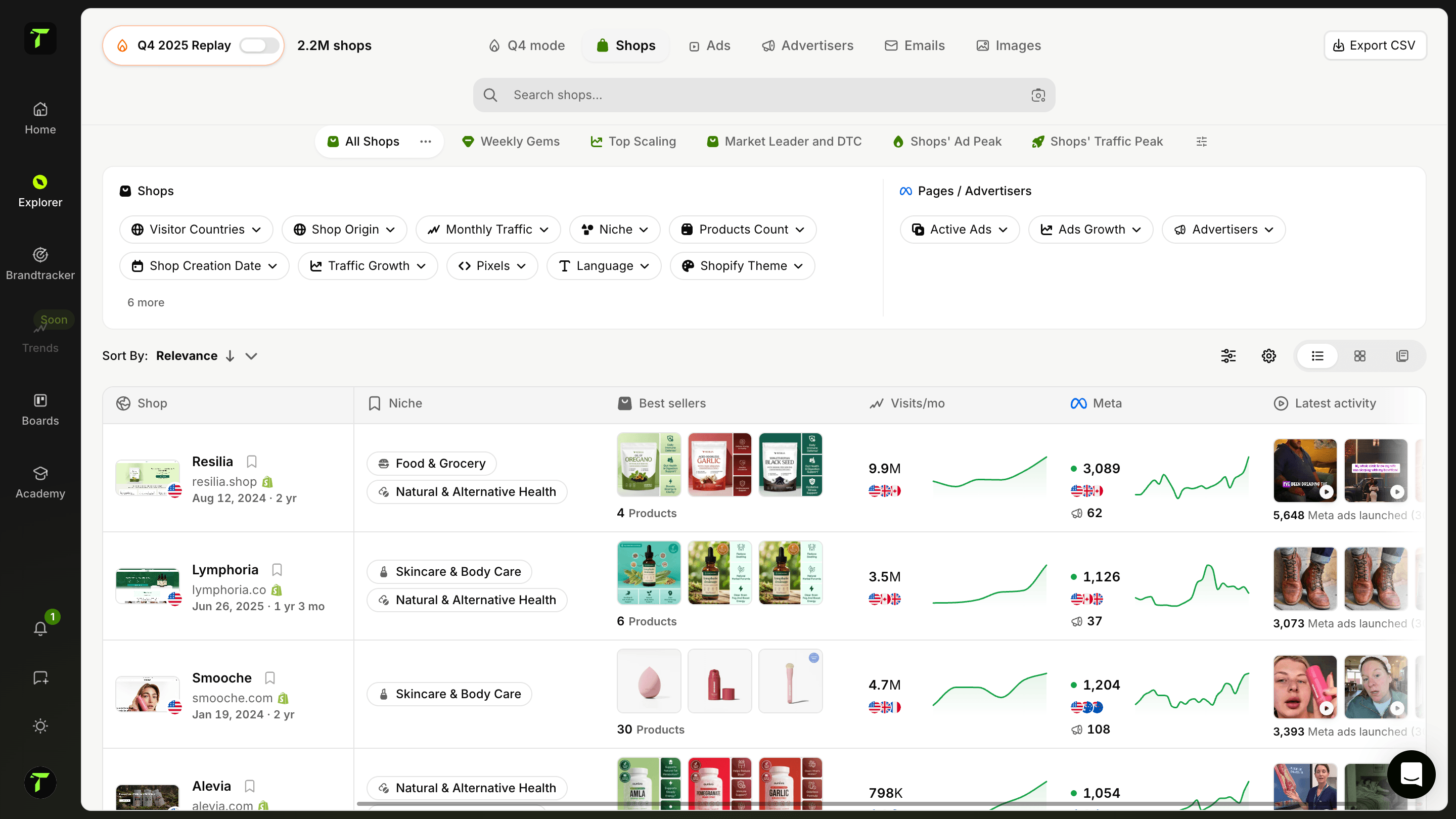
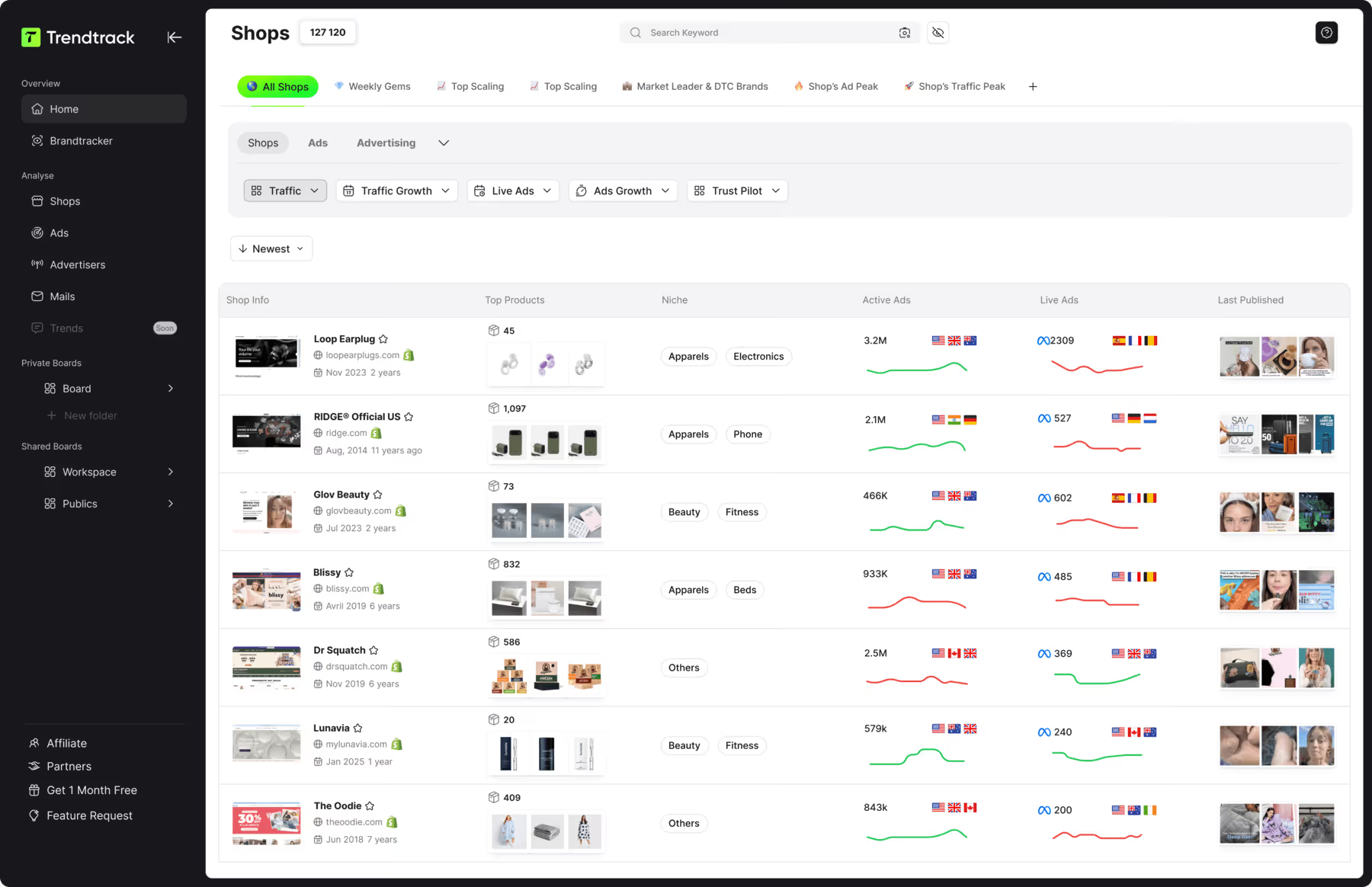
At Trendtrack available at app.trendtrack.io/en/sign-up, we preserve full ad history across Meta, TikTok and Google, index 95 million TikToks and refresh 700,000+ brand profiles every 24 hours.
In this article we share our complete AdHeart review.
What Is AdHeart?
AdHeart is an ad intelligence platform built around a single function: letting media buyers search competitor creatives on Meta with filters the official Ad Library does not offer.
Its origin explains its character. The tool emerged from the affiliate and media buying world rather than from e-commerce, which shows in what it prioritizes and in the markets it covers best.
Its core value is database scale. The platform indexes over a billion creatives alongside billions of downloadable media files, which places it among the largest Meta-specific archives available at any price.
That volume matters practically. When you research an unusual offer, a niche vertical or a market most tools ignore, the difference between a large index and a small one determines whether you find anything at all.
Its geographic coverage spans 250+ regions, with particular depth on CIS and Eastern European markets. Western tools handle these poorly, and for anyone buying traffic in those geographies, AdHeart frequently surfaces what competitors simply cannot see.
Three modules structure the platform.
Facebook and Instagram ads form the main database, searchable by text, advertiser, country, language and creative format.
Audience Network ads cover placements outside Meta’s own apps, a category that rarely appears in competing tools.
Mobile app ads address user acquisition teams specifically, with tens of millions of app creatives indexed.
Its target audience follows from this: affiliate marketers, media buyers and user acquisition specialists rather than merchants researching products to sell.
Two characteristics deserve stating upfront.
The tool is Meta-first, which means no TikTok organic data and no Google Shopping visibility. Their current marketing mentions TikTok, so verify current scope before assuming coverage.
The tool provides creatives, not context. You see what competitors run, never the traffic, revenue or product performance behind it.
Pricing starts around 69 dollars monthly, with a two-week money-back window rather than a free trial.
What Are AdHeart’s Main Features?
The platform organizes around four modules plus a set of search capabilities. Here is what each actually delivers.
Facebook and Instagram ad search

This is the core module and the reason most users subscribe. The database holds over a billion creatives, searchable across multiple dimensions.
You filter by advertiser, country, language, creative format, date range and text contained in the ad copy. That last capability matters more than it sounds: searching for a specific phrase or offer angle surfaces competitors you did not know existed.
The index depth becomes decisive on niche verticals. Where smaller tools return a handful of results, AdHeart frequently returns enough to identify patterns rather than isolated examples.
Audience Network ad spy
This module covers placements outside Meta’s own apps, meaning ads served on third-party properties through Meta’s network.
Few competing tools index this category, which makes it a genuine differentiator. For media buyers running placement-specific campaigns, seeing what performs on Audience Network separately from feed placements changes creative decisions.
Mobile app ad intelligence
With tens of millions of app creatives indexed, this module targets user acquisition teams specifically.
You research how competing apps acquire installs, which creative angles they test and which markets they push. This is a distinct discipline from e-commerce advertising, and the tool treats it as such rather than as an afterthought.
Landing page access
Beyond the creative itself, AdHeart surfaces the destination pages behind indexed ads.
This matters because the creative earns the click and the page converts it. Studying offer structure, pricing presentation and proof elements on a competitor’s page teaches considerably more than the ad alone.
Media file downloads
The platform allows downloading indexed creatives, with billions of media files available.
For teams building swipe files or briefing editors, having the actual asset rather than a screenshot streamlines production meaningfully.
Geographic filtering
Coverage spans 250+ regions, with notable depth on CIS and Eastern European markets.
If you buy traffic in those geographies, this is likely the strongest argument for the tool. Western platforms index them thinly, which leaves genuine competitive blind spots.
Competitor tracking
You can follow specific advertisers and monitor their creative output over time rather than searching repeatedly.
What the feature set does not cover
Two gaps deserve stating plainly, since they determine whether the tool fits your work.
No cross-platform view. The platform is Meta-first, which means no TikTok organic data and no Google Shopping. You see one channel of a competitor’s strategy and assume the rest.
No business data. Creatives arrive without traffic estimates, revenue projections or product performance. You learn what a brand advertises, never whether it sells.
What Is AdHeart’s Pricing?
Three plans make up the offering, all with a two-week money-back guarantee. Here is the breakdown.
Table: AdHeart pricing
| Criterion | Start | Pro | Team |
|---|---|---|---|
| Monthly price | $69 | $89, down from $99 | Custom |
| Unique searches monthly | 3,000 | 9,000 | Custom |
| Access to Meta platforms | All | All | All |
| Geographies covered | 250+ | 250+ | 250+ |
| Competitor ad tracking | Included | Included | Included |
| One-click niche access | Included | Included | Included |
| Creative uniquifier | Included | Included | Included |
| AI tools | No | Included | Included |
| Mobile app analytics | Included | Included | Included |
| Beta feature access | No | Included | Included |
| Multiple seats | No | No | Included |
| Custom data requests | No | No | Included |
| Onboarding call | No | No | Included |
| Money-back window | 2 weeks | 2 weeks | 2 weeks |
As the table shows, the search quota is the main variable separating the first two plans. Start allows 3,000 unique searches monthly, Pro triples that to 9,000.
That distinction matters more than it appears. On an ad intelligence tool, searches are the currency: every query counts against your allowance, and research-heavy workflows burn through a quota faster than most buyers anticipate.
The Start plan at 69 dollars covers a complete scope for an individual operator. All Meta platforms, 250+ geographies, competitor tracking and mobile app analytics are already included.
The Pro plan at 89 dollars, discounted from 99, adds AI tools alongside the higher quota and beta feature access. The 20 dollar gap is modest given the tripled allowance.
The Team plan targets agencies, with multiple seats, custom data requests and an onboarding call.
Two points deserve attention. The two-week money-back guarantee replaces a free trial, meaning you pay first and request a refund if the tool does not fit.
And the creative uniquifier is included from entry level, a feature that modifies creatives to avoid duplicate detection.
What Are AdHeart’s Limitations?
Several constraints deserve stating before you commit.
Search quotas that deplete faster than expected on research-heavy work
No Google Shopping coverage, leaving a channel entirely invisible
No business data, meaning no traffic, revenue or best-seller visibility
No free trial, only a two-week money-back window
Limited third-party reviews, with no G2 or Capterra presence
A creative-first approach that shows what runs, not what sells
An interface oriented toward affiliates rather than merchants
Among these, the absence of business data is the most consequential for anyone selling products rather than buying traffic for offers.
You see a competitor’s creatives in detail. You cannot see their monthly visits, their estimated revenue, which products actually carry the store or whether the brand is scaling or declining.
That gap changes the nature of your research. A beautifully produced ad campaign tells you nothing about whether the underlying business works, and modeling your catalogue on a competitor who generates minimal revenue is a real risk when your tools only show creatives.
The search quota deserves practical attention. Start allows 3,000 unique searches monthly, which sounds generous until you begin a serious research session. Every filter combination, every advertiser lookup and every keyword variation counts, and operators researching multiple niches report hitting ceilings well before month end.
The absence of Google Shopping leaves a structural blind spot for e-commerce. A brand running Meta, TikTok and Google simultaneously signals validated unit economics. Seeing two of those three channels means drawing conclusions from partial information.
The lack of a free trial is a commercial friction rather than a product flaw, but it matters. Paying first and requesting a refund afterward creates a barrier that competitors offering genuine trials do not impose.
The limited review presence deserves mentioning honestly. AdHeart has no G2 or Capterra listing, which restricts the independent perspective available. The product is real and operating, but the external validation has not caught up.
AdHeart vs Trendtrack
Both tools serve competitive research, but they answer different questions. AdHeart shows you creatives. Trendtrack shows you businesses. Here is the comparison.
Table: AdHeart vs Trendtrack
| Criterion | Trendtrack | AdHeart |
|---|---|---|
| Meta coverage | Full ad history | 1B+ creatives |
| TikTok coverage | 95M TikToks indexed | Included |
| Google Shopping | Included | No |
| Store traffic data | Monthly visits | No |
| Revenue estimates | Included | No |
| Best seller identification | Included | No |
| Theme and app detection | Included | No |
| Brand profiles refreshed | 700,000+ every 24h | Competitor tracking |
| Scaling velocity alerts | BrandTracker | Manual monitoring |
| Chrome extension | Included | No |
| Search quotas | No | 3,000 to 9,000 monthly |
| Mobile app ads | No | Included |
| CIS market depth | Standard | Strong |
| Entry price | See pricing | $69 monthly |
As the table shows, the decisive gap is business context.
AdHeart tells you what a competitor advertises. It cannot tell you how much traffic their store receives, what revenue they generate, which products actually carry the catalogue or whether the brand is scaling or declining.
That distinction matters practically. A polished ad campaign reveals nothing about whether the underlying business works, and building your catalogue around a competitor generating minimal revenue is a real risk when your tools only show creatives.
The second gap is Google Shopping. A brand running Meta, TikTok and Google simultaneously signals validated unit economics and serious operation. Seeing two of three channels means drawing conclusions from partial information.
The third gap concerns scaling signals. Our BrandTracker monitors competitor ad counts continuously, surfacing a brand moving from 40 to 300 active ads before saturation hits. AdHeart offers competitor tracking, but reading acceleration requires manual comparison over time.
The fourth is quotas. AdHeart caps searches at 3,000 or 9,000 monthly depending on plan, which forces rationing precisely when deep research matters most.
Two points go to AdHeart and deserve stating plainly. Its mobile app ad intelligence has no equivalent on our side, and its CIS and Eastern European depth exceeds what most Western tools index.
If you research offers and creatives, AdHeart does that job. If you research products and businesses, Trendtrack available at app.trendtrack.io/en/sign-up operates at a different scope.


Ready to build a million-dollar brand?