How can you find trending products on META in 2026?



Meta is in 2026 one of the richest advertising platforms in trend signals for e-commerce operators who know where to look. Hundreds of thousands of ads running every day on Facebook and Instagram from e-commerce sellers around the world constitute an unmatched goldmine of information about emerging products, exploding niches, and converting creatives. When a product is the subject of intensive ad campaigns on Meta, it's a strong signal that sellers are investing real money in its commercial demand. And identifying those signals before your competitors is one of the most powerful competitive advantages available in e-commerce.
But finding trending products on Meta manually is a time-consuming and often frustrating exercise. Scrolling through the Meta ad library for hours, filtering by category, country, and date, analyzing the most active creatives, and attempting to extract actionable patterns without a dedicated tool. This manual monitoring work takes time, produces incomplete results, and always positions you behind the trends that better-equipped e-commerce operators have already identified several days ahead of you.
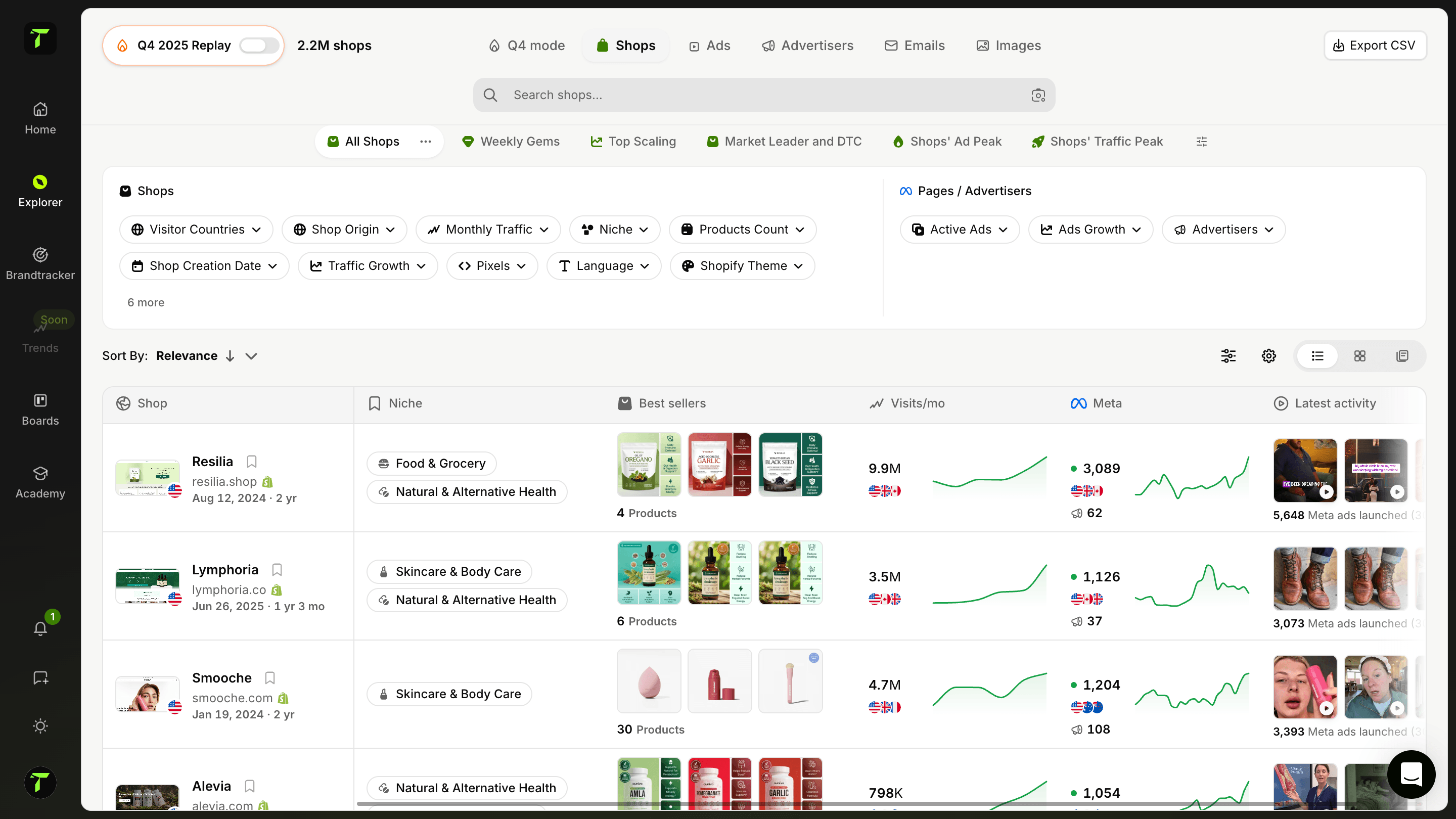
This is precisely the problem we built Trendtrack Adspy tool to solve. Our ad intelligence platform connects directly to Meta's advertising ecosystem. Our database indexes in real time the best-performing ads on Meta with their associated impression data and trend signals. And thanks to our MCP connection with Claude and ChatGPT, you can query this database in natural language to identify trending products on Meta in seconds rather than hours of manual monitoring.
In this article, we walk you through all the available methods for finding trending products on Meta in 2026 from free manual approaches all the way to the most advanced tools that radically transform the quality and speed of your ad intelligence.
Why Is Meta the Best Platform for Finding Trending Products?
Among all the platforms available for identifying trending products in e-commerce, Meta holds a particularly favorable position for several structural reasons that make it the richest and most actionable source of advertising data available in 2026.
The first reason is the exceptional volume of e-commerce ads running on Meta. With more than three billion monthly active users across Facebook and Instagram combined, Meta is by far the most widely used advertising platform by e-commerce operators worldwide. Millions of e-commerce ads are running simultaneously across both platforms, covering virtually every niche, geographic market, and price segment imaginable. This massive volume of active ads constitutes a remarkably precise barometer of the real commercial demand for every product category at any given moment.
The second reason is the transparency offered by the Meta ad library. Unlike other advertising platforms that provide no access to their advertisers' ads, Meta has offered a public ad library since 2018 that gives access to all active ads across its platforms. This transparency is a regulatory decision but it creates an extraordinary competitive intelligence opportunity for e-commerce operators who know how to exploit it. The Meta ad library is technically accessible to everyone, but its manual exploitation remains laborious without the right analysis tools.
The third reason is the direct correlation between advertising intensity and commercial demand. On Meta, ads are funded by real budgets that e-commerce operators invest based on their performance data. A product that is the subject of numerous active ads over several weeks on Meta is a product on which sellers are maintaining continuous advertising investment because it is generating profitable sales. This correlation between advertising intensity and real commercial demand makes Meta a far more reliable trend indicator than Google search data or organic social media trends.
The fourth reason is the speed at which trends emerge on Meta. New product trends appear on Meta before spreading to other channels because this is where e-commerce operators test their new offerings with initial advertising budgets. Identifying these emerging trends on Meta in their first days of appearance, before the competition spots them, is the most valuable competitive advantage that our Trendtrack platform delivers through our real-time monitoring of Meta advertising signals.
How to Use the Meta Ad Library to Find Trending Products?
The Meta ad library is the most accessible free tool for starting to identify trending products on Meta. While its manual use is time-consuming and limited compared to specialized tools, mastering it is an essential baseline skill for any e-commerce operator who wants to develop their market intelligence on Meta.
Accessing the Meta Ad Library
The Meta ad library is freely accessible at facebook.com/ads/library without requiring an active ad account. Once on the platform, select your target country from the location dropdown menu to filter ads running in your priority geographic market. Then choose the All Ads category rather than the political ads category to access all commercial ads available in the library. This initial configuration step is often overlooked by users who don't think to filter by country which dilutes results with ads irrelevant to their target market.
Searching by Niche Keywords
The most direct method for identifying trending products in your niche is keyword search. Enter the terms that describe your product category in the library's search bar. Terms like fitness, skincare, home, or kitchen give you access to all active ads on these themes in the selected country. Then filter results by broadcast start date, prioritizing ads launched in the past thirty days to identify new emerging trends rather than already well-established ads. A recent ad that has generated a significant number of interactions in a short time is a strong signal of a product in its emergence phase.
Analyzing the Most Active Ads
The next step is to analyze in depth the ads that catch your attention. For each interesting ad, click See Details to access the available information including the ad launch date, the platforms it's running on, and in some cases estimated target audience. An ad that has been running for several weeks without being deactivated is a sign that the advertiser is getting sufficiently positive results to maintain their investment. This is the most reliable indicator of a product's commercial performance available in the ad library.
Identifying the Most Active Advertisers in Your Niche
The Meta ad library also allows you to search directly by advertiser name. Once you've identified an active competitor store in your niche, search its name in the library to access all of its active ads. This complete view of a competitor's campaigns gives you a precise picture of their flagship products, marketing angles, and most recent creatives. This direct competitive monitoring technique is particularly effective for identifying new products launched by the most dynamic players in your market.
The Limits of the Meta Library and Why Trendtrack Goes Further
The Meta ad library is a valuable tool, but its limitations are real for intensive professional use. The absence of precise performance data such as impression volumes and ad spend estimates makes it difficult to objectively evaluate a product's potential. This is precisely the data that our Trendtrack platform adds to every Meta ad you view through our browser extension, instantly displaying the performance indicators that transform your manual monitoring into actionable market intelligence.
How to Use Trendtrack to Research Trending Products on Meta Step by Step?
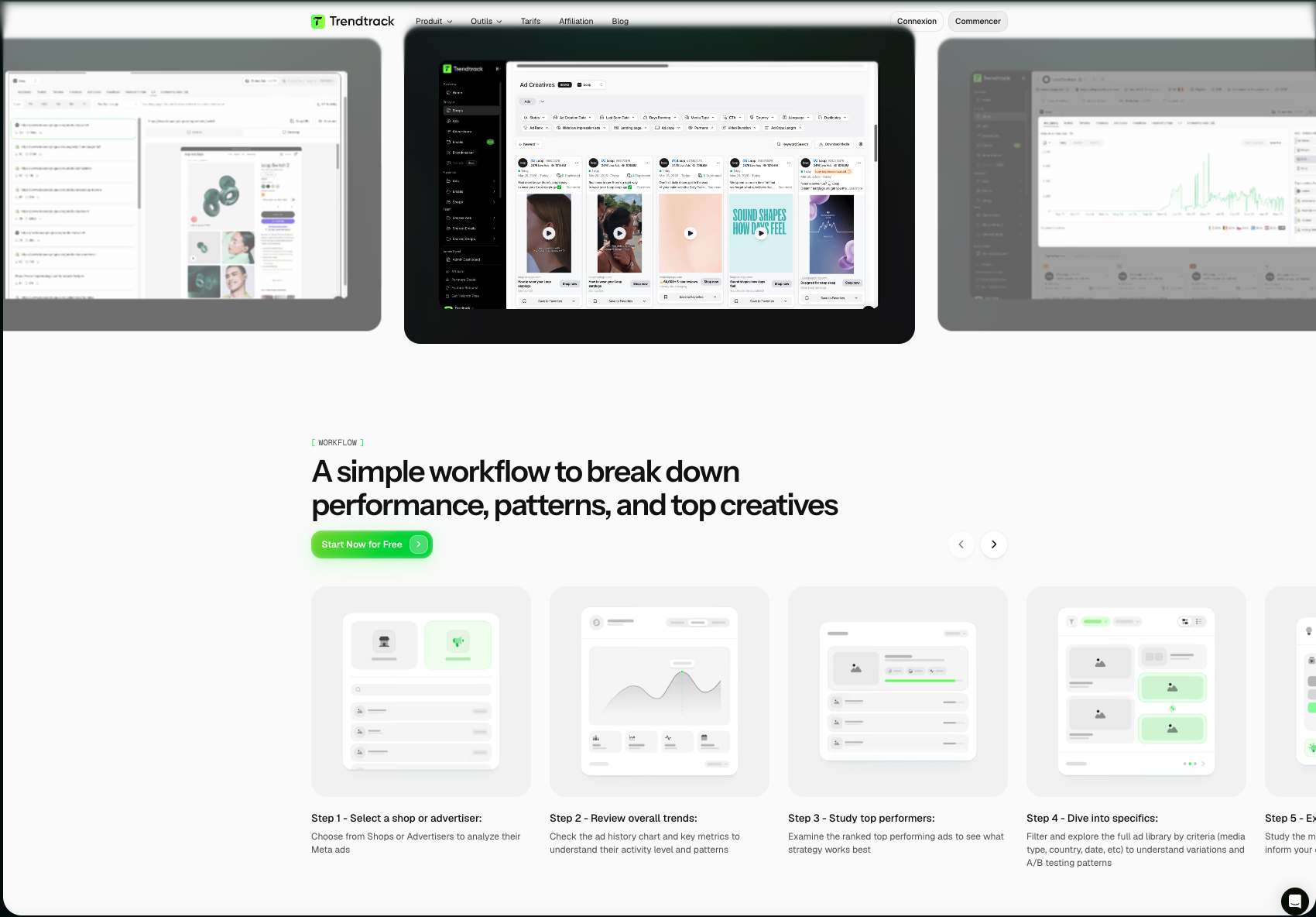
Our Trendtrack platform offers a structured, progressive workflow that allows you to analyze Meta advertising trends with unmatched precision and speed. Here is how to use our features in the right order to maximize the quality of your product research.
Step 1: Explore the Most Active Stores in Your Niche
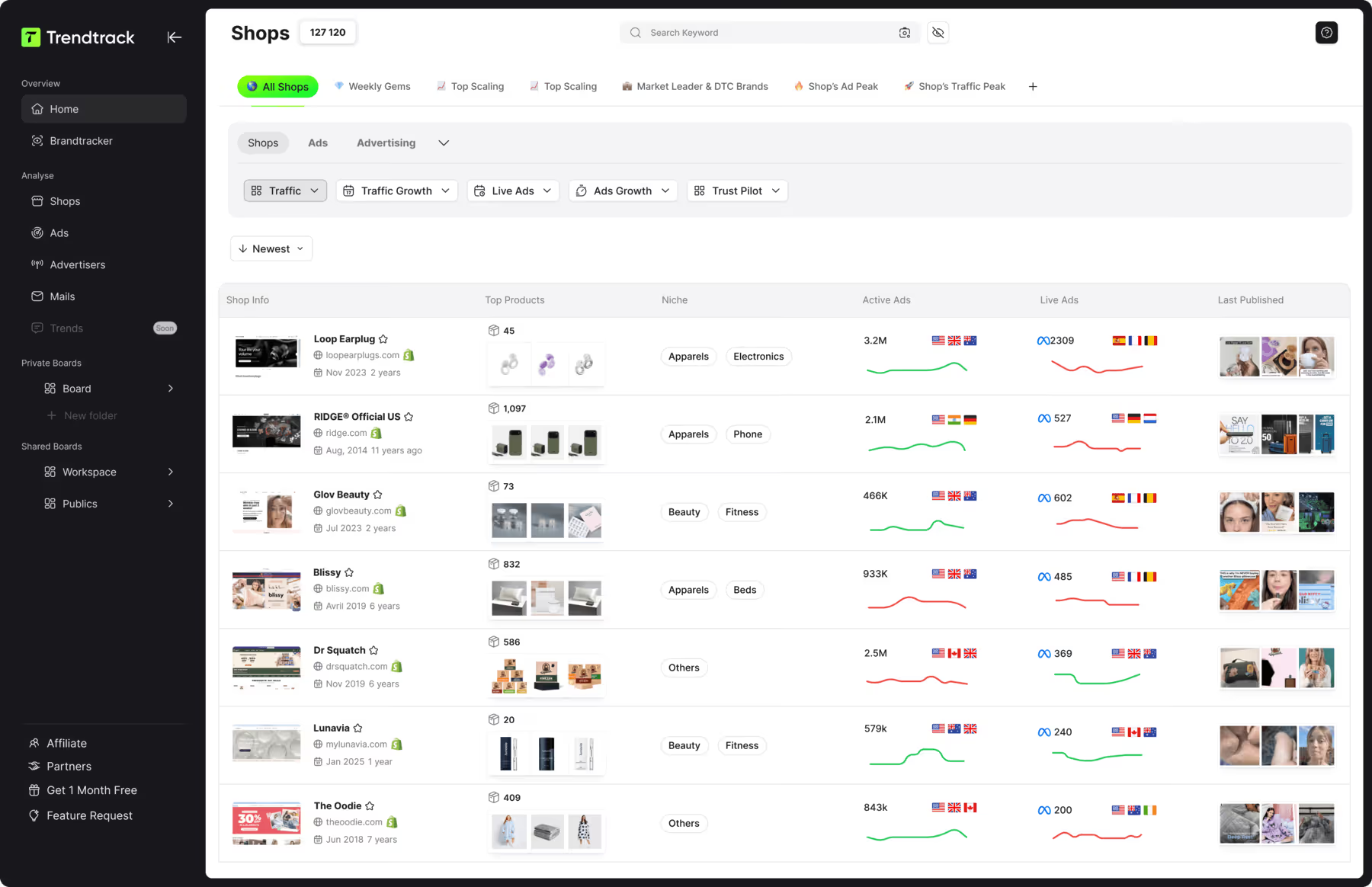
The first step is to use our Shops module to identify the most active e-commerce stores in your niche on Meta. Our database references thousands of stores ranked by advertising activity level, sector, and geographic area. Filter by niche and country to get a list of the stores investing the most in Meta advertising in your target market. These active stores are your most reliable indicators of products generating real sales because nobody invests heavily in advertising on a product that doesn't convert.
Step 2: Analyze Your Competitors' Meta Strategy with Meta Ads Library
Once your target stores are identified, access our Meta Ads Library module from the Shop Analytics section. This is our most powerful feature for competitive analysis on Meta. For each selected store, you access a dedicated tab presenting a complete view of its Meta advertising strategy the complete history of its ads, the best-performing ads ranked by spend and reach, the media mix used between videos and images, the landing pages tested, and the recurring patterns in its best campaigns. This in-depth analysis allows you to precisely understand what is working for your competitors and extract insights directly applicable to your own strategy.
Step 3: Identify the Best-Performing Ads with Ads Library
Next, use our Ads Library module to explore the best-performing ads in your niche independently of specific stores. Our database ranks ads by performance level with estimated spend and reach data that allows you to objectively evaluate the potential of each identified product. Filter by niche, ad format, launch date, and country to precisely target the most relevant ads for your research. Ads ranked as top performing with a recent broadcast history and high reach volume are your best indicators of trending products on Meta.
Step 4: Analyze the Copy and Transcripts of the Best Ads
Our Copy and Transcript feature gives you direct access to the text of the best-performing video and image ads in your niche. This copy analysis reveals the most effective sales arguments, the ad hooks that capture attention, and the narrative structures that convert best in your category. These insights are directly usable to improve your own ads or to generate via Claude connected to our MCP creative briefs based on the best copy in your market.
Step 5: Monitor Continuously with the Brandtracker
The final step is to configure our Brandtracker to continuously monitor the stores and products you've identified as most relevant. Add your priority competitors to your watchlist and automatically receive alerts when they launch new ads, test new products, or modify their marketing angles. This continuous monitoring transforms your Meta intelligence from a one-time activity into a permanent information flow that allows you to react in hours rather than weeks to your competitors' moves.
To start your trending product research on Meta with Trendtrack, visit app.trendtrack.io/en/sign-up and create your account for free.
FAQ: Meta Product Research in 2026
How do you find trending products on Meta for free?
The most accessible free method is the direct use of the Meta ad library available at facebook.com/ads/library. Search for keywords related to your niche, filter by country and recent launch date, and analyze ads that have been running for several weeks without being deactivated. An ad that has been running for a long time is a sign that the advertiser is getting positive results and therefore that the featured product is generating sales. This method is accessible but time-consuming and does not provide the precise performance data needed to objectively evaluate a product's potential.
What is the difference between the Meta ad library and Trendtrack?
The Meta ad library is a free native tool that gives you access to active ads without precise performance data. You can see the ads but not their impression volumes, growth trend, or competitive saturation level. Our Trendtrack platform adds this layer of real-time performance data on every Meta ad through our browser extension and database. The difference is comparable to navigating blind versus navigating with a precise map. Trendtrack immediately tells you whether an ad represents an emerging opportunity or an already saturated trend without any additional analysis effort on your part.
How do you know if a trending product on Meta is already too saturated?
A product is generally considered too saturated on Meta when several signals converge simultaneously. A high volume of active ads on this product with very similar messages that all look alike. A long existing broadcast duration for current ads, indicating that established players are firmly in place. Rising CPMs and CPCs due to intense competition on the same audiences. And a strong presence of established players with significant ad budgets that make competition difficult for new entrants. Our Trendtrack platform allows you to precisely evaluate this saturation level by simultaneously analyzing these signals in our real-time database.
How often should you monitor Meta trends to stay competitive?
In 2026, daily monitoring is ideal for staying competitive in dynamic e-commerce markets. Trends can emerge and saturate within weeks on Meta, and an e-commerce operator who monitors weekly systematically misses the best opportunity windows. Our automated daily radar connected to Claude via our MCP solves precisely this problem by delivering every morning a briefing of new Meta advertising trends without consuming any of your monitoring time.
Can Trendtrack be used to monitor TikTok trends in addition to Meta?
Yes. Our Trendtrack platform is not limited to Meta. We also index the best-performing ads on TikTok Ads, allowing you to simultaneously monitor both of the most important advertising platforms for e-commerce in 2026 from a single tool. This multi-platform coverage is particularly valuable for e-commerce operators who want to identify trends emerging on TikTok before they spread to Meta, and for those looking to validate a trend by verifying its simultaneous presence on both platforms.
How do you connect Trendtrack to Claude to automate Meta trend research?
The connection between Trendtrack and Claude is made in three clicks via our MCP server with no technical skills required. Open Claude from the desktop app or web, go to settings in the Connectors section, click Add custom connector, and paste the URL of our MCP server available at docs.trendtrack.io/connect/claude. Once connected, Claude has direct access to our real-time Meta advertising database and can analyze your market's trends in response to your natural language questions. For ChatGPT users, the same connection is available via docs.trendtrack.io/connect/chatgpt.
Useful Resources

.avif)
Ready to build a million-dollar brand?
.avif)