How can you find a winning product in e-commerce in 2026?



Every successful e-commerce store starts with the same thing: the right product.
Not a trending product. Not a random product from a supplier catalog. Not the product your competitor is selling. The right product the one that solves a real problem, targets a motivated audience, and generates healthy margins even when advertising costs are rising.
In 2026, finding a winning product is both easier and harder than ever before.
Easier, because the tools available today from AI-powered research platforms to real-time competitive intelligence give any entrepreneur access to market data that used to require an entire team to collect. Harder, because the barrier to entry has dropped so dramatically that competition moves faster, trends saturate quicker, and generic products struggle to convert against established brands.
The e-commerce operators who consistently find winning products are not the ones who get lucky. They are the ones who follow a structured research process one that combines market demand analysis, margin validation, competitive intelligence, and supplier qualification before a single dollar is spent on advertising.
In this guide, we break down exactly how to find a winning product in e-commerce in 2026. From identifying high-demand niches and validating real buyer intent to analyzing competitors and leveraging platforms like Trendtrack to spot opportunities before the market becomes saturated.
Whether you're launching your first store or scaling an existing one, this is the framework that separates products that die in testing from ones that scale profitably.
Because in e-commerce, product selection is not luck.
It's a skill. And skills can be learned.
What Is a Winning Product in E-Commerce?
The concept of a winning product is one of the most widely used and most misunderstood in the e-commerce world. Many beginner entrepreneurs equate a winning product with a viral product that explodes in sales over a few weeks thanks to a well-executed TikTok creative. This view is too narrow and often leads to opportunistic product choices that generate a brief sales spike before collapsing just as quickly as they emerged.
A winning product in e-commerce is one that simultaneously combines four fundamental characteristics that make it a sustainable and profitable commercial opportunity.
The first characteristic is real, measurable demand. A winning product addresses an existing, identifiable, and quantifiable need in your target market. That demand can be an emerging trend you identify before your competitors, or an established need you enter with a superior offer. In either case, the demand must be broad enough to generate profitable sales volume and durable enough to justify the investment in developing your offer.
The second characteristic is sufficient gross margin. A winning product must generate a minimum gross margin of 40 to 50% to absorb advertising acquisition costs, logistics fees, returns, and fixed store expenses while still producing a positive net profit. A product that sells well but doesn't generate enough margin is not a winning product. It's a revenue generator with no real profitability.
The third characteristic is an accessible level of competition. A winning product is not necessarily a product with no competition. It's a product on which you can build a differentiated position that allows you to capture a profitable market share without getting caught in a destructive price war with players who have far greater resources than you do.
The fourth characteristic is scalability. A winning product can be sold in growing volumes without supply, logistics, or quality constraints becoming insurmountable obstacles as your store grows. This ability to scale is what distinguishes a sustainable commercial opportunity from a limited niche that quickly hits a ceiling.
These four characteristics combined define what a winning product in e-commerce truly means in 2026. And identifying all of them simultaneously on a single product requires analytical tools and a structured methodology which we break down in detail throughout the rest of this article.
How to Find Winning Products Effectively in 2026
Product research has radically evolved in 2026. The manual methods that involved scrolling through ad libraries for hours, monitoring trends on AliExpress, or copying Amazon bestsellers have become structurally insufficient in a market where the speed of opportunity identification is a decisive competitive advantage. The e-commerce operators who find the best products today use tools that combine real-time data and artificial intelligence to identify emerging opportunities before everyone else has spotted them.
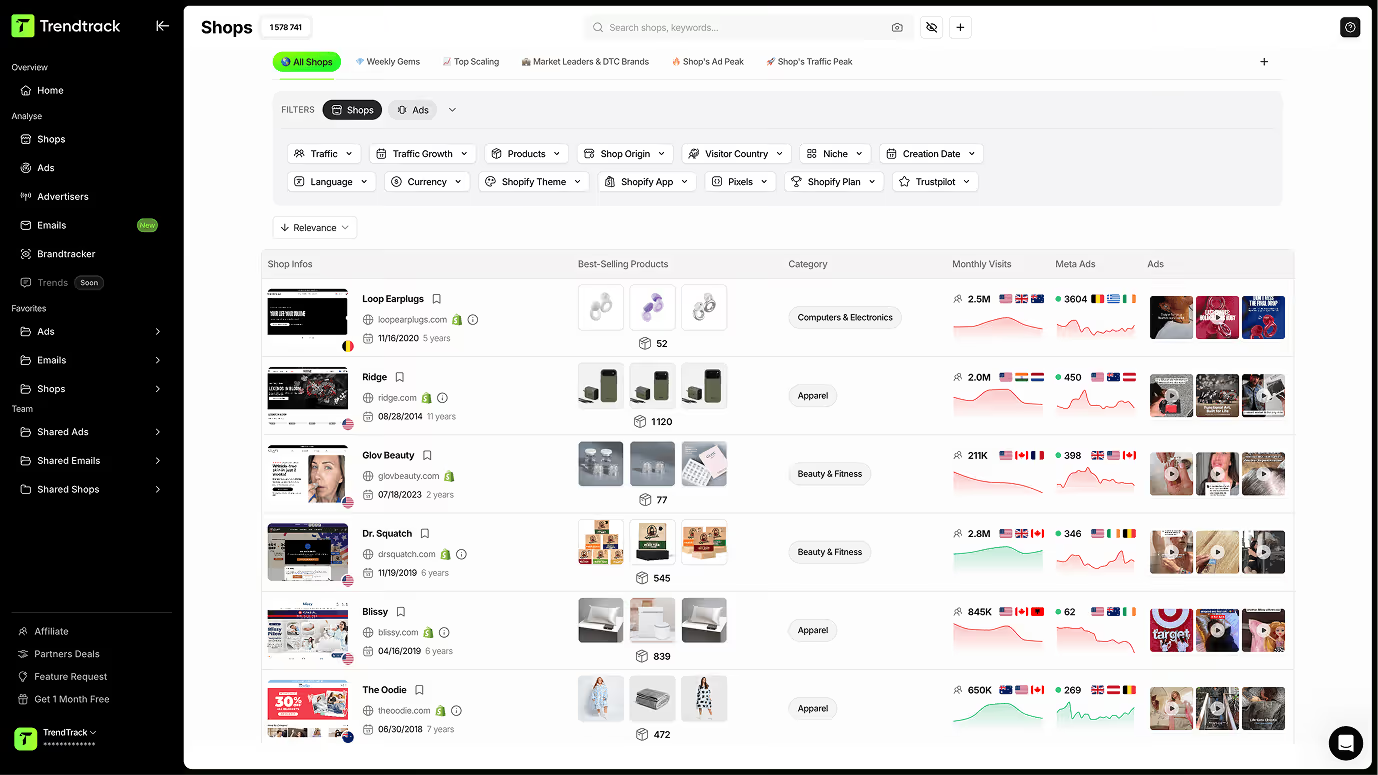
The most effective method available in 2026 for finding winning products is built around our Trendtrack platform and its two complementary entry points the browser extension on one side, and the MCP connection with Claude or ChatGPT on the other. These two tools combined cover the entire product research workflow, from passive daily monitoring all the way to deep on-demand analysis.
The Trendtrack Extension for Passive, Continuous Product Monitoring
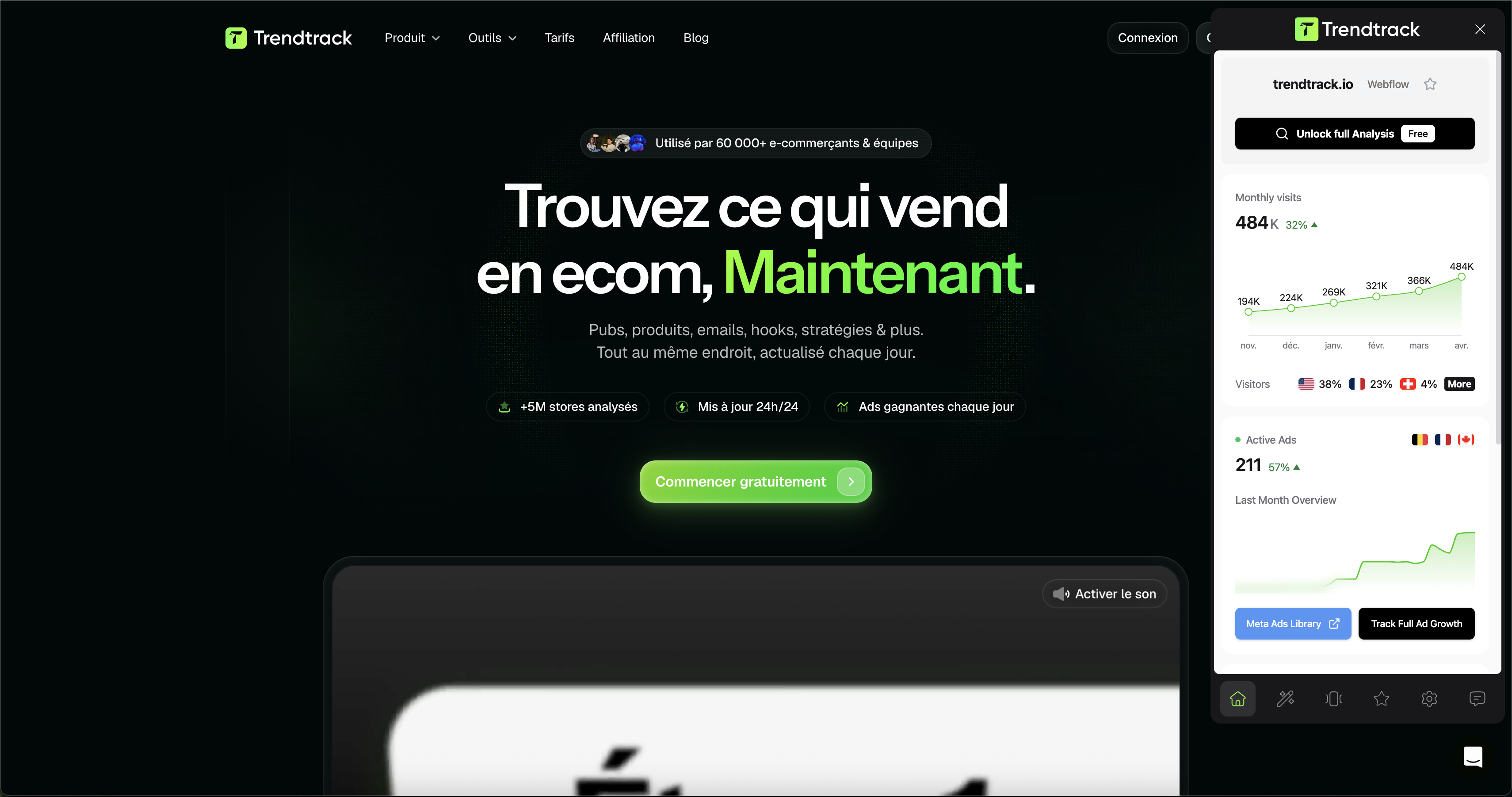
The Trendtrack extension is the most immediately accessible monitoring tool for e-commerce operators looking for winning products during their daily browsing. It installs directly in your browser and follows you everywhere on the web. When you browse social media, marketplaces, or competitor e-commerce sites, the extension analyzes in real time the products and ads you're viewing and instantly displays the associated performance data. Impression volume, growth trend, competitive saturation level, estimated ad performance. This information appears directly in your browser without leaving the page you're on or opening a separate tool.
The extension is particularly powerful when browsing Meta or TikTok ad libraries. Rather than scrolling endlessly hoping to stumble across something interesting, every ad you view is immediately enriched by our performance data — telling you whether the product being featured is in an emergence phase, growth phase, or already hitting saturation. This contextual information radically transforms the quality of your monitoring by allowing you to focus your attention on real opportunities rather than past trends. It's a passive, continuous form of intelligence that turns every browsing session into a winning product discovery opportunity with no extra effort on your part.
The Trendtrack MCP Connected to Claude for Deep On-Demand Analysis
The MCP connection with Claude or ChatGPT is the second level of analysis available for e-commerce operators who want to go deeper in their product research. Once Trendtrack is connected to Claude via our MCP server, you can query our entire database in real time from a simple natural language conversation. Ask Claude to identify the products whose advertising demand has grown the most in your niche over the past thirty days, to analyze the common characteristics of the five best-selling products in your category, or to flag emerging niches that aren't yet saturated in your target geographic market. Claude queries our database and returns a structured, actionable analysis in seconds.
This deep on-demand analysis is complementary to the passive monitoring of the extension. Where the extension enriches your daily browsing with immediate contextual data, the MCP lets you launch in-depth strategic analyses when you want to explore a niche in detail, validate a hypothesis, or prepare a new product launch. The combination of both tools covers the entire product research workflow shifting you from spending 70% of your time searching to spending 10% asking the right questions and 90% executing. Documentation for connecting Trendtrack to Claude is available at docs.trendtrack.io/connect/claude and for ChatGPT at docs.trendtrack.io/connect/chatgpt.
How to Validate a Winning Product Before Launching It?
Identifying a potentially winning product using Trendtrack data is an essential first step. But before investing in inventory, launching ad campaigns, and building out a complete product listing, a rigorous validation phase is critical to confirm that the opportunity you've identified is real and profitable in your specific context. Here are the most effective validation steps.
Validate Demand Through Search Data
The first validation step is confirming that demand for your product exists and is measurable through search engines. Google Trends is your first free and immediately accessible validation tool. Search for the keywords associated with your product and analyze the trend curve over the past twelve months. A steadily rising curve indicates a product in a growth phase with increasing commercial potential. A curve that has already peaked and is declining indicates a product in a decline phase whose opportunity window is likely closed. A stable curve indicates a product in an established market where you'll need to differentiate to find your place.
Complement this analysis with search volume data from tools like Ahrefs, SEMrush, or Ubersuggest to precisely quantify how many people are searching for your products each month. Sufficient monthly search volume on transactional keywords like "buy" or "order" is a strong signal of real commercial demand that you can capture through SEO and paid search.
Validate Margin and Economic Viability
The second step is validating the real gross margin of the product within your specific business model. This validation must be precise and exhaustive a miscalculation on margins is one of the most common causes of failed e-commerce launches. Calculate the all-in purchase price including the product cost, shipping fees from the supplier, customs duties if applicable, storage fees, and order fulfillment costs. Subtract platform and transaction fees, customer shipping costs, the estimated return rate, and a provision for after-sales service. The residual gross margin must be high enough to absorb your advertising acquisition costs and still generate a positive net profit.
Validate Competition and Your Ability to Differentiate
The third step is an in-depth analysis of competition for your target product. Search for your product on Google Shopping, Amazon, and the main marketplaces to identify the players already present, their price points, the quality of their product listings, and their estimated sales volume. This analysis allows you to evaluate whether the market is already saturated by well-established players with resources far greater than yours — or whether differentiation opportunities are still available on price, quality, packaging, positioning, or customer service.
Use our Trendtrack database via the MCP connection with Claude to analyze your competitors' ad creatives for this specific product. If all competitors are using the same angles, the same hooks, and the same messaging, identifying a different and unexploited angle is your best chance to stand out without entering a destructive price war.
Test Before Investing Heavily
The fourth step is minimal testing before any major investment. Before ordering significant inventory or launching high-budget ad campaigns, test real demand with a minimal investment. A simple landing page with a pre-order form, a test ad campaign with a $100 to $200 budget on Meta or TikTok, or dropshipping with a local supplier for the first orders these are all approaches that allow you to validate the real conversion rate of your offer before committing significant resources. This test gives you concrete data on conversion rate, cost per acquisition, and market response to your positioning and pricing.
FAQ: How to Find Winning Products in E-Commerce
What exactly is a winning product in e-commerce?
A winning product is one that simultaneously combines four fundamental characteristics. Real, measurable demand in your target market. A sufficient gross margin of at least 40 to 50% to absorb acquisition and logistics costs. An accessible level of competition that leaves you a genuine differentiation opportunity. And scalability that allows you to increase sales volume without insurmountable supply or logistics constraints. These four conditions met simultaneously constitute what the most successful e-commerce operators call a true winning product distinct from a simple viral product that generates a brief sales spike before fading out.
How long does it take to find a winning product?
The time required to find a winning product varies considerably depending on the method used. With a traditional manual approach, finding a genuinely winning product can take several weeks of intensive monitoring. With real-time data tools like our Trendtrack platform combined with Claude via our MCP connection, that timeline can be reduced to a few hours of targeted analytical work. The MCP connection allows you to query our database in natural language and receive structured analyses in seconds which radically transforms the productivity of the product research phase.
Do you absolutely need a paid tool to find winning products?
No. Free tools like Google Trends, Meta and TikTok ad libraries, or Amazon bestseller exploration allow you to identify opportunities without any initial investment. However, these manual methods are time-consuming, incomplete, and systematically behind the real state of the market. In 2026, the e-commerce operators who succeed fastest are those who invest in real-time data tools that allow them to identify emerging trends before their competitors. The cost of these tools is generally recouped with the very first winning product successfully identified and launched.
How do you know if a product is already too saturated to launch?
A product is considered too saturated when multiple signals converge simultaneously. A high volume of sellers offering the same product on marketplaces with heavily compressed prices. A Google Trends curve that has already peaked and is declining. A high volume of identical or very similar ad creatives across Meta and TikTok ad libraries. And a strong presence of well-established players with thousands of reviews and solid organic rankings on primary keywords. Trendtrack via the MCP connection with Claude allows you to precisely evaluate a product's saturation level by simultaneously analyzing these signals in our real-time database.
What margin should you target for a product to be truly winning?
The generally accepted rule in e-commerce is to target a minimum gross margin of 40 to 50% before advertising costs. This gross margin must cover advertising acquisition costs which often represent between 20 and 35% of revenue logistics fees, returns, and fixed store expenses, while still generating a positive net profit. Below 40% gross margin, it is very difficult to build a profitable business model with paid advertising as your primary acquisition channel. The most profitable e-commerce products typically show gross margins of 60 to 70%, giving them considerable flexibility on marketing investments.
Can you find winning products in dropshipping in 2026?
Yes, but the selection criteria are even stricter than with private label or owned inventory. Dropshipping imposes structurally lower gross margins due to higher supplier costs. For a dropshipping product to be truly winning in 2026, it must present a strong differentiation angle on positioning or marketing rather than on the product itself, a niche specific enough to limit direct competition on advertising platforms, and a supplier with acceptable delivery times ideally European to meet growing consumer expectations around shipping speed.
How do you use Trendtrack to find winning products quickly?
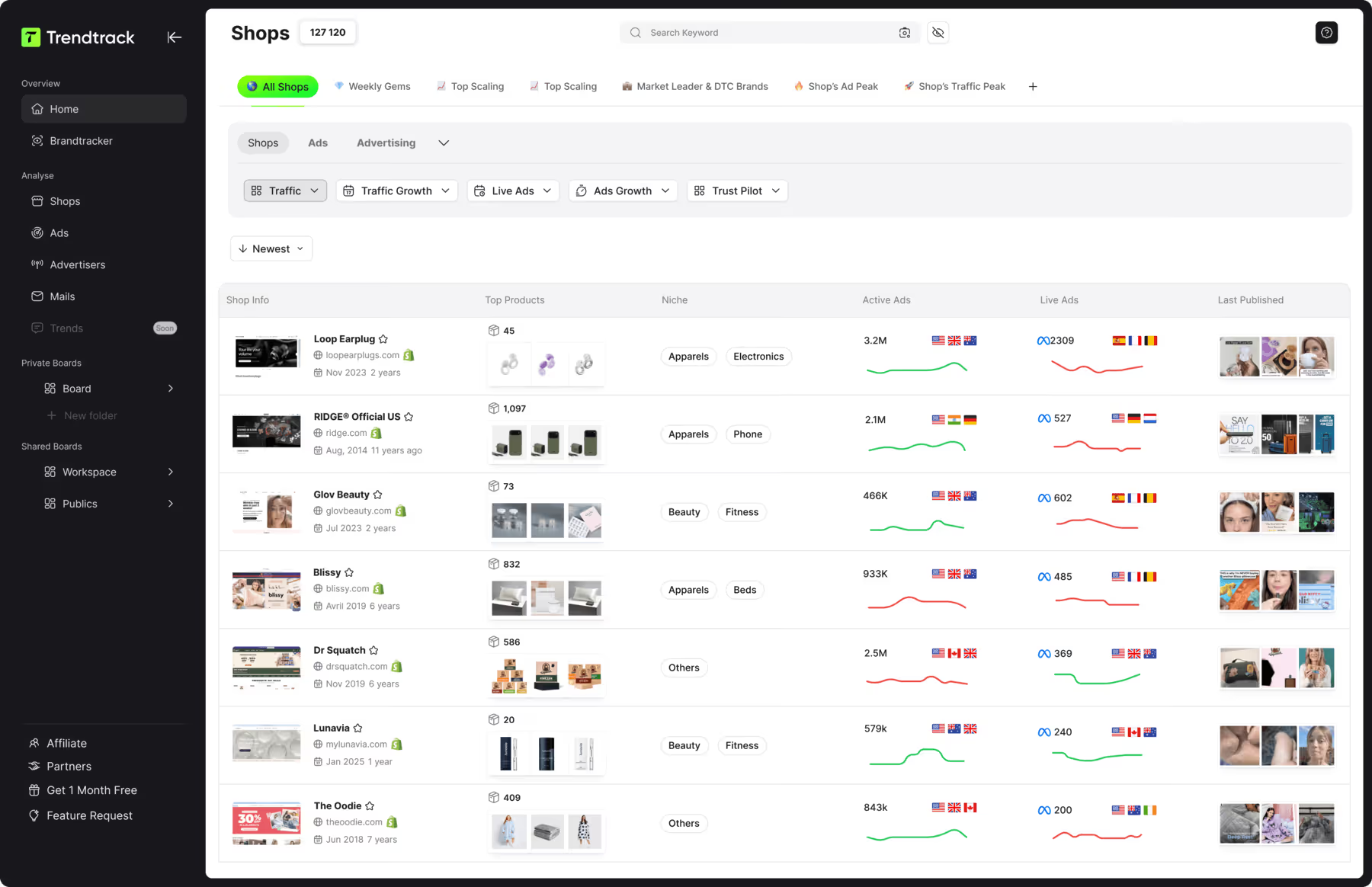
Trendtrack offers two complementary approaches to accelerate product research. Our browser extension analyzes in real time the products and ads you view during your daily browsing and instantly displays the associated performance data without changing your work habits. Our MCP connection with Claude and ChatGPT allows you to query our database in natural language for in-depth on-demand analyses. Ask Claude to identify the products whose advertising demand is growing fastest in your niche, to analyze the common characteristics of the best-selling products, or to flag unsaturated emerging niche opportunities. Documentation for connecting Trendtrack to Claude is available at docs.trendtrack.io/connect/claude.
What are the most common mistakes in winning product research?
The most common mistakes fall into five categories. Choosing a product solely because it sells well without verifying the real margin after all costs. Entering a market already saturated by well-established players without a clear differentiation angle. Basing decisions solely on subjective visual signals rather than objective performance data. Failing to test before heavily investing in inventory or ad campaigns. And neglecting the real demand validation phase through search data and advertising signals. All of these mistakes are avoidable with a structured methodology and the right market data analysis tools.

.avif)
Ready to build a million-dollar brand?
.avif)