AI and E-commerce: How Can You Automate Your Benchmarking with AI in E-commerce?



Every ecommerce entrepreneur knows the feeling. You open a new tab to check a competitor's store. Then another tab for their traffic estimates. Then a spreadsheet to log the numbers. Then a trend tool to cross-reference demand signals. Then another competitor. Then another niche. Two hours later, you have a document full of data that is already partially outdated and a strategy meeting starting in ten minutes.
Manual benchmarking is not just slow. In 2026, it is a structural disadvantage.
The brands that are scaling the fastest this year are not spending their mornings buried in spreadsheets and browser tabs. They have done something fundamentally different they have connected their competitive intelligence infrastructure directly to AI. And the result is not just faster benchmarking. It is smarter benchmarking, deeper benchmarking, and benchmarking that happens in the time it takes to type a single sentence.
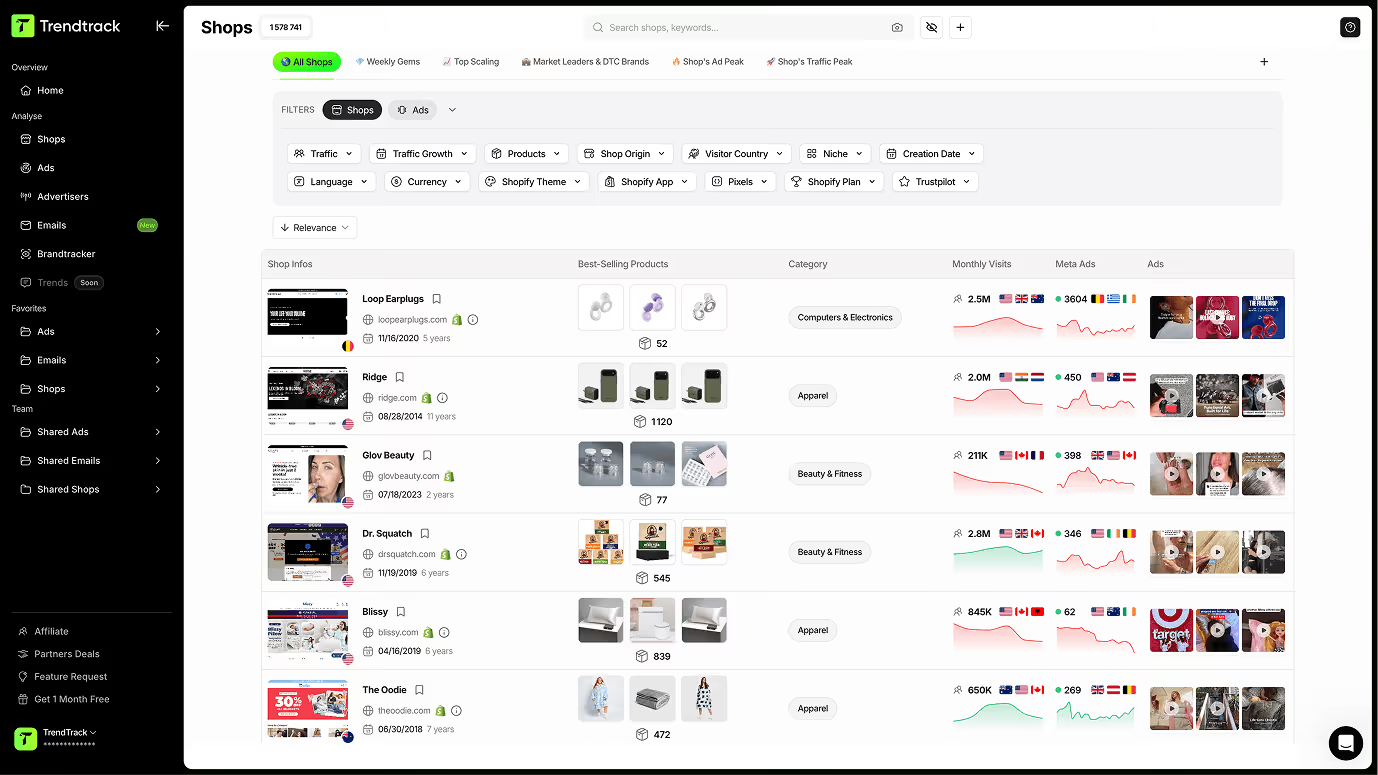
This is exactly what we built our TrendTrack MCP integration for.
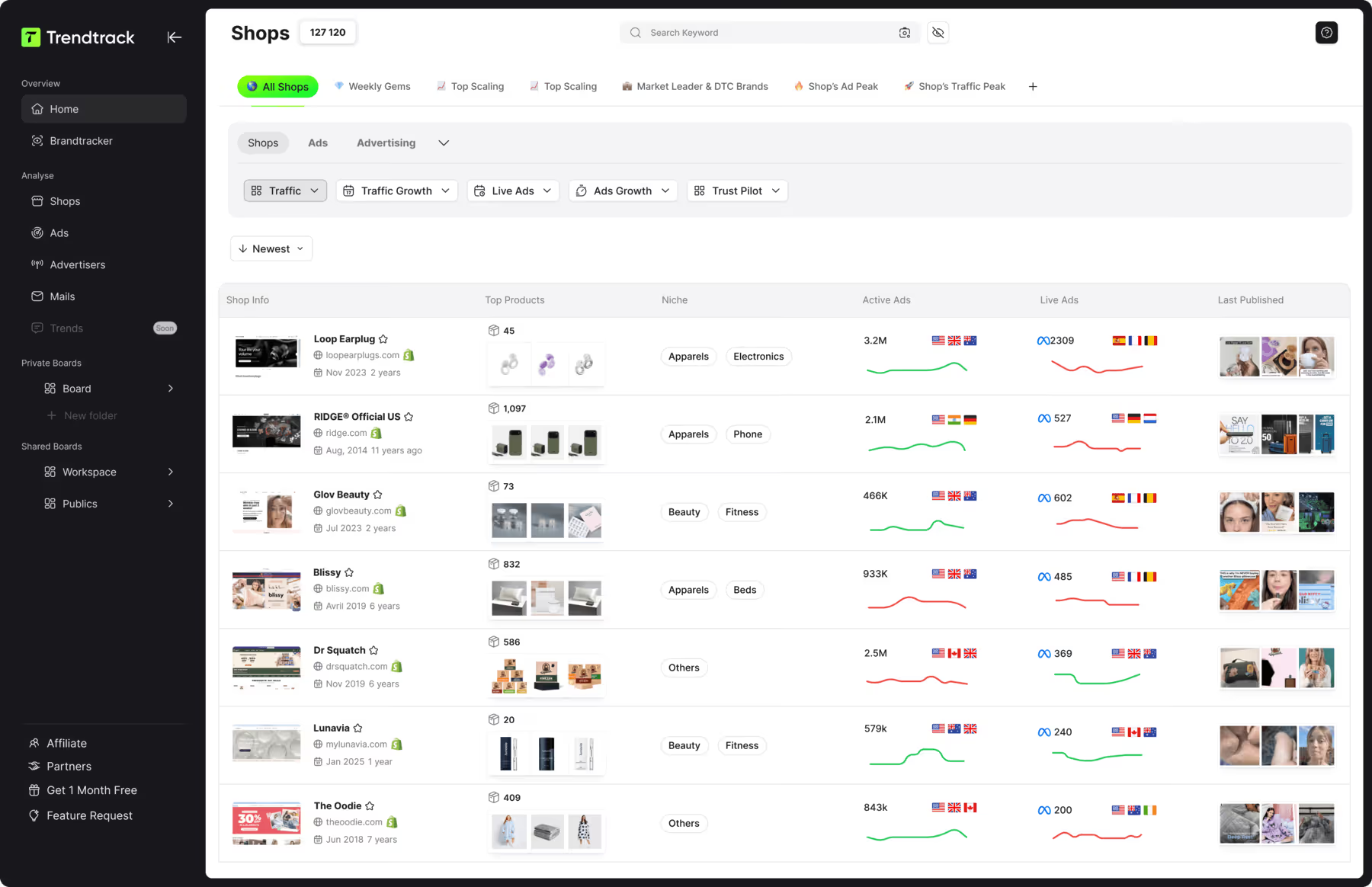
MCP Model Context Protocol is the technology that allows AI tools like Claude and ChatGPT to connect directly to our live TrendTrack database. Not to static exports. Not to uploaded spreadsheets. To our actual, continuously updated ecommerce intelligence infrastructure in real time. The moment you connect our MCP to your preferred AI tool, your benchmarking workflow transforms completely. Instead of manually gathering data from multiple sources and asking an AI to interpret it after the fact, you simply ask: "Benchmark the top competitors in the beauty niche right now" and receive a fully structured competitive analysis built from live data in seconds.
Our full integration documentation is available at docs.trendtrack.io/connect/claude for Claude users and docs.trendtrack.io/connect/chatgpt for ChatGPT users and the setup takes less than five minutes regardless of your technical background.
In this article, we break down exactly how AI-powered benchmarking works with TrendTrack's MCP, what you can automate immediately, and why the entrepreneurs who adopt this workflow in 2026 will have a competitive intelligence advantage that manual researchers simply cannot match.
What is Benchmarking in E-commerce And Why Manual Methods Are Failing You in 2026?
Benchmarking in e-commerce is the process of systematically comparing your store's performance against your competitors measuring traffic, product positioning, acquisition channels, pricing strategy, and growth trajectory to understand where you stand in your market and where the real opportunities lie.
Done correctly, benchmarking is not a one-time exercise. It is an ongoing intelligence discipline that informs every major decision in your business from product selection and pricing to content strategy and paid advertising allocation. The brands that benchmark consistently and act on what they find are the ones that scale with intention rather than stumbling into growth by accident.
But here is the problem that almost every ecommerce entrepreneur faces in 2026: the way most people benchmark is fundamentally broken.
Manual benchmarking the process of visiting competitor stores one by one, estimating traffic through separate tools, logging data into spreadsheets, and then trying to synthesize everything into a coherent strategic picture was already time-consuming two years ago. Today, it is no longer just inefficient. It is strategically dangerous.
The first reason manual methods are failing ecommerce brands is speed. The competitive landscape of online retail moves faster in 2026 than at any previous point in the industry's history. Product trends peak and saturate within weeks. New competitors emerge overnight. Pricing dynamics shift with algorithm updates and seasonal demand swings. A competitive benchmark that took you three hours to compile on a Monday morning is already partially obsolete by Thursday afternoon. When your intelligence infrastructure cannot keep pace with the speed of the market, every decision you make is based on a reality that no longer fully exists.
The second reason is completeness. A manual benchmarking process is only as good as the researcher conducting it — and human researchers, no matter how diligent, have finite cognitive bandwidth. When you are manually analyzing three to five competitors across multiple data dimensions simultaneously, important signals get missed. A traffic spike on a competitor's category page. A new keyword they started ranking for last week. A paid advertising surge that suggests a new product launch is imminent. These are exactly the kinds of signals that change strategic decisions and they are exactly the kinds of signals that manual processes consistently fail to surface because there is simply too much data for a human to monitor comprehensively at all times.
The third reason is consistency. Manual benchmarking happens when you have time for it which in practice means it happens irregularly, incompletely, and with varying levels of analytical rigor depending on how much bandwidth you have on any given day. Inconsistent benchmarking produces inconsistent intelligence, which produces inconsistent decisions. For a scaling ecommerce business, that inconsistency is a compounding liability that quietly erodes your competitive position over time even when individual business metrics look healthy.
The fourth and perhaps most consequential reason manual methods are failing in 2026 is the opportunity cost they generate. Every hour spent manually gathering, formatting, and interpreting competitive data is an hour not spent on product strategy, creative development, customer experience, or the hundred other high-leverage activities that actually move the revenue needle in an ecommerce business. When manual benchmarking consumes five to ten hours per week a conservative estimate for any brand operating in a competitive niche the cumulative opportunity cost across a year of operation is significant enough to represent a genuine constraint on growth.
This is the precise problem our TrendTrack MCP integration was designed to eliminate. Not to improve manual benchmarking at the margins, but to replace the manual process entirely with an AI-powered intelligence workflow that delivers faster, deeper, and more consistent competitive analysis than any human researcher could produce in response to a single conversational prompt, connected directly to our live ecommerce database in real time.
The era of manual benchmarking is not ending. For most ecommerce brands operating without the right tools, it has already ended.
How TrendTrack's MCP Transforms Benchmarking Into a One-Prompt Workflow?
The concept of a one-prompt benchmarking workflow sounds almost too good to be true for ecommerce entrepreneurs who have spent years grinding through manual research processes. But understanding exactly how our MCP integration works makes it immediately clear why this is not marketing language. It is a genuine description of what happens when you connect TrendTrack's live database to Claude or ChatGPT and ask it a competitive intelligence question.
The Architecture Behind the Magic
When you connect our MCP to your preferred AI tool using the documentation available at docs.trendtrack.io/connect/claude or docs.trendtrack.io/connect/chatgpt, you are establishing a direct, authenticated bridge between the AI model and our continuously updated ecommerce intelligence database.
This means that when you type a benchmarking question into Claude or ChatGPT, the AI does not generate an answer from its general training data. It reaches directly into our live TrendTrack database, pulls the most current available data relevant to your question, and synthesizes that data into a structured, actionable response in real time. The AI becomes the interface. Our database becomes the intelligence engine behind it.
The result is a benchmarking workflow that is fundamentally different in both speed and quality from anything a manual process can deliver.
From a Five-Hour Process to a Single Sentence
Consider what a traditional competitive benchmark in the beauty niche used to require. Identifying the top competing stores. Visiting each one manually. Running traffic estimates through separate tools. Logging data into a spreadsheet. Analyzing acquisition channels. Identifying top performing product categories. Cross-referencing keyword rankings. Writing up a summary. That process, done properly, consumed the better part of a working day.
With our MCP connected to Claude or ChatGPT, the same benchmark is initiated with a single prompt: "Give me a full competitive benchmark of the top five stores in the beauty niche right now, including their estimated monthly traffic, primary acquisition channels, and best performing product categories."
The AI pulls live data from our TrendTrack database and returns a structured analysis in seconds. Not an approximation. Not a generic overview based on outdated training data. A real benchmark built from current market intelligence, delivered in the time it takes to read the response.
Benchmarking That Builds on Itself
One of the most powerful aspects of our MCP integration is that the benchmarking workflow is conversational rather than transactional. You do not just get one answer and start over. You build on each response with follow-up prompts that deepen the analysis progressively.
After receiving your initial benchmark, you can immediately ask: "Which of these competitors is growing the fastest month over month?" Then: "What product categories are driving that growth?" Then: "Are there any underserved segments in this niche that none of these competitors are targeting effectively?"
Each prompt draws fresh data from our live database and builds on the context of the previous response. This conversational depth transforms benchmarking from a static snapshot into a dynamic, evolving intelligence session that surfaces insights a one-time manual analysis would never reach.
Benchmarking at a Scale That Was Previously Impossible
Perhaps the most underappreciated capability our MCP integration unlocks is the ability to benchmark at a scale that manual processes simply cannot match. Analyzing one competitor takes time. Analyzing five takes significantly more. Analyzing an entire competitive landscape across multiple niches simultaneously was practically impossible for a solo operator or small team working manually.
With our MCP, scale is no longer a constraint. You can ask Claude or ChatGPT to benchmark ten competitors across three niches simultaneously and receive a comprehensive, structured analysis in the same time it previously took to analyze one store in one category. This ability to compress what used to be days of research into minutes of conversation is what makes our MCP integration not just a productivity improvement but a genuine transformation of what competitive intelligence means for ecommerce entrepreneurs in 2026.
Real Benchmarking Prompts You Can Use With TrendTrack's MCP Today
Understanding how our MCP integration works is one thing. Knowing exactly what to ask it to get maximum value from day one is another. The quality of your competitive intelligence output is directly proportional to the quality of the prompts you use and the good news is that you do not need to be a prompt engineering expert to get exceptional results. You just need to know the right questions to ask.
Here is a complete, ready-to-use library of benchmarking prompts organized by use case, each designed to extract specific categories of competitive intelligence from our live TrendTrack database through Claude or ChatGPT.
| Use Case | Prompt Example |
|---|---|
| Full competitive benchmark | "Give me a complete benchmark of the top 5 stores in the [niche] space right now, including estimated monthly traffic, primary acquisition channels, and top performing product categories." |
| Traffic comparison | "Compare the monthly traffic of the leading stores in the [niche] niche and tell me which ones are growing the fastest month over month." |
| Niche demand validation | "Is the [niche] niche still showing strong demand signals in 2026? Give me a data-driven assessment of its current momentum and competitive density." |
| Product opportunity discovery | "Which products in the [niche] category are gaining the most traction right now based on current trend velocity data?" |
| Acquisition channel analysis | "Break down the primary traffic sources for the top competitors in the [niche] niche. Which channels are dominant and which appear underutilized?" |
| Market saturation assessment | "How saturated is the [niche] market right now? Is there still room for a new store to enter profitably in 2026?" |
| Trend trajectory analysis | "Show me the trend trajectory for [product or niche] over the last 90 days. Is momentum accelerating, plateauing, or declining?" |
| Cross-niche comparison | "Compare the current growth signals and competitive density of [niche A] versus [niche B]. Which represents the stronger opportunity for a new dropshipping store?" |
| Competitor gap analysis | "Analyze the top competitors in the [niche] space and identify any underserved customer segments or product categories they are currently ignoring." |
| Seasonal pattern detection | "Are there identifiable seasonal traffic patterns among the top stores in the [niche] niche? When do they typically peak and what drives those spikes?" |
| Pricing intelligence | "What does the competitive pricing landscape look like for [product type] right now? Where is the market's price tolerance concentrated?" |
| SEO opportunity mapping | "Which organic keyword categories are driving the most traffic to top performing stores in the [niche] niche? Are there high-intent queries that appear underexploited?" |
| New entrant detection | "Are there any fast-growing new stores in the [niche] space that have emerged in the last 60 to 90 days? What appears to be driving their early growth?" |
| Ad spend signal analysis | "Which competitors in the [niche] niche show the highest concentration of paid traffic right now? Does this suggest aggressive scaling or overdependence on advertising?" |
| Full market landscape overview | "Give me a complete strategic overview of the [niche] market in 2026 top players, traffic dynamics, product momentum, acquisition channel distribution, and the single biggest opportunity for a new entrant." |
The real power of these prompts emerges when you use them conversationally rather than in isolation. Start with a broad market overview prompt, then drill down progressively into the specific signals that matter most to your immediate decision. Found a competitor with unexpectedly high traffic growth? Follow up immediately with a prompt asking what is driving that growth and whether the trend is product-specific or category-wide. Identified a promising niche with low competitive density? Ask immediately for the top performing product subcategories within it and whether seasonal patterns affect entry timing.
Each follow-up prompt continues to draw live data from our TrendTrack database through the MCP connection, building a progressively deeper and more actionable competitive picture with every exchange. This is the difference between getting a data point and building a genuine market intelligence session and it is available to every TrendTrack user who connects our MCP to Claude or ChatGPT using the setup guides at docs.trendtrack.io/connect/claude and docs.trendtrack.io/connect/chatgpt.
Useful Resources

.avif)
Ready to build a million-dollar brand?
.avif)