The 5 Best SEO Tools for E-commerce in 2026



Search engine optimization remains one of the highest-ROI acquisition channels available to e-commerce businesses in 2026. While paid advertising costs continue to rise and social media algorithms become increasingly unpredictable organic search delivers compounding returns that improve with time rather than degrading the moment you stop spending. But capturing those returns requires the right SEO tools that can handle the specific technical complexity, content volume and competitive intelligence demands of e-commerce sites.
The challenge is that the SEO tool landscape in 2026 has never been more fragmented. Dozens of platforms compete for the same budget with overlapping feature sets and marketing claims that make objective comparison difficult. The tools that actually move the needle for e-commerce operators are those that combine technical audit depth, keyword research accuracy, backlink intelligence, competitive analysis and content optimization in workflows that your team can execute consistently at scale.
What makes e-commerce SEO specifically demanding is the volume. A boutique with a few hundred products needs to manage thousands of pages including collection pages, product pages, filtered URLs and blog content all of which need to be technically healthy, semantically optimized and competitively positioned simultaneously. Generic SEO tools designed for smaller sites frequently fail at this scale producing audits that identify hundreds of issues without the prioritization intelligence needed to focus limited resources on the fixes that actually improve rankings.
The five tools on this list have been evaluated specifically against e-commerce use cases. They cover every dimension of the e-commerce SEO workflow from technical crawling and site health monitoring to keyword gap analysis, backlink acquisition and content optimization. Each has genuine strengths for specific use cases and honest limitations that determine which profile of e-commerce operator it serves best.
In this article we give you the complete breakdown of the 5 best SEO tools for e-commerce in 2026 to help you build the stack that fits your site's scale, your team's capabilities and your growth objectives.
1. HaloScan

HaloScan is a French SEO platform that claims a database of over 330 million keywords with metrics and detects on average twice as many ranked keywords as competing tools. For e-commerce operators who have been frustrated by the blind spots of Semrush and Ahrefs on lower-traffic product pages and long-tail commercial queries this detection advantage is commercially significant.
HaloScan positions itself as the ultimate SEO tool to outperform competitors with a large database covering over 190 million keywords, questions and synonyms. For e-commerce sites whose product catalog generates thousands of long-tail keyword opportunities this database depth produces keyword gap analyses that surface commercially valuable queries that narrower databases miss entirely.
The first strength of HaloScan for e-commerce is its keyword research accuracy and detection depth. Users report that HaloScan identifies keyword positions for sites relaunched just days ago that every other tracking tool missed completely. For e-commerce operators managing large catalogs where new collection pages and product pages need to be tracked from their first days of indexation this early detection capability is a genuine operational advantage over platforms with longer data refresh cycles.
The second strength is its pricing accessibility. One user reports switching from the Semrush API at $6,000 annually to the HaloScan API at €588 annually. An independent SEO consultant paying €49.20 per month where a Semrush subscription costs three to four times more makes a real difference on their margin. For e-commerce teams managing SEO tools across multiple sites or client accounts this cost efficiency compounds significantly.
The third strength is its competitive intelligence capabilities. HaloScan's bulk competitive spying allows you to outrank competitors including major players like Amazon.fr on local queries. For e-commerce operators competing against marketplace dominance in French-speaking markets this niche competitive intelligence depth is particularly valuable.
The fourth strength is its support quality. Multiple users highlight response times under 30 minutes and genuine responsiveness to user feedback for product evolution. For e-commerce teams who need fast resolution when tracking issues affect campaign decisions this support quality is a genuine competitive differentiator.
Where HaloScan's limitations become relevant is in its primary focus on French-language markets. For international SEO you will need to look elsewhere. E-commerce operators whose primary markets are English-speaking should evaluate whether HaloScan's international keyword database depth matches their specific geographic requirements before committing.
HaloScan is available at approximately €49 per month making it the most cost-efficient e-commerce SEO tool on this list by a significant margin.
HaloScan Key Features and Pricing Table:

Feature | Details |
|---|---|
Keyword Database | 190M+ keywords, questions and synonyms |
Keyword Detection | 2x more ranked keywords detected vs competitors |
Rank Tracking | Daily position monitoring with AI enhancements |
Competitive Analysis | Bulk competitor spying available |
Backlink Analysis | Coming April 2026 |
API Access | Included in Pro plan |
Support | Under 30 minutes response time |
Primary Market | French-language markets |
Entry Price | Free plan available |
Pro Plan | ~€49/month |
Annual API | ~€588/year |
Best For | French-market e-commerce, agencies, SEO consultants |
2. Semrush
Semrush is the most widely used SEO platform by professional e-commerce teams and digital marketing agencies globally and its combination of keyword research depth, technical audit capabilities, competitive intelligence and content optimization tools makes it the most comprehensive all-in-one SEO solution available for serious e-commerce operators in 2026.
The first strength of Semrush for e-commerce is its competitive intelligence depth. Semrush's organic research tool surfaces every keyword a competitor is ranking for, their estimated traffic, their ranking position history and the pages generating the most organic value. For e-commerce operators who need to understand the complete SEO strategy of their category competitors before investing in content production this intelligence produces actionable insights that narrower tools simply cannot match.
The second strength is its technical audit capabilities. Semrush's site audit tool crawls e-commerce sites of any size and identifies the technical issues that most directly impact organic rankings. Crawl errors, duplicate content across product variants, missing canonical tags, thin category page content, page speed issues and internal linking gaps are all surfaced with prioritization scores that help e-commerce teams focus their development resources on the fixes that produce the most significant ranking improvements.
The third strength is its keyword research database. Semrush's keyword database covers billions of keywords across more than 140 countries and its keyword difficulty scores, search volume estimates and keyword intent classifications are consistently cited as among the most accurate available. For e-commerce teams building category page hierarchies, informational blog content and product page optimization strategies this database depth produces keyword maps that capture the full commercial opportunity of a niche.
The fourth strength is its backlink intelligence. Semrush's backlink database surfaces the complete link profile of any domain and its gap analysis tools identify the backlink opportunities that competitors have captured but your site has not yet secured.
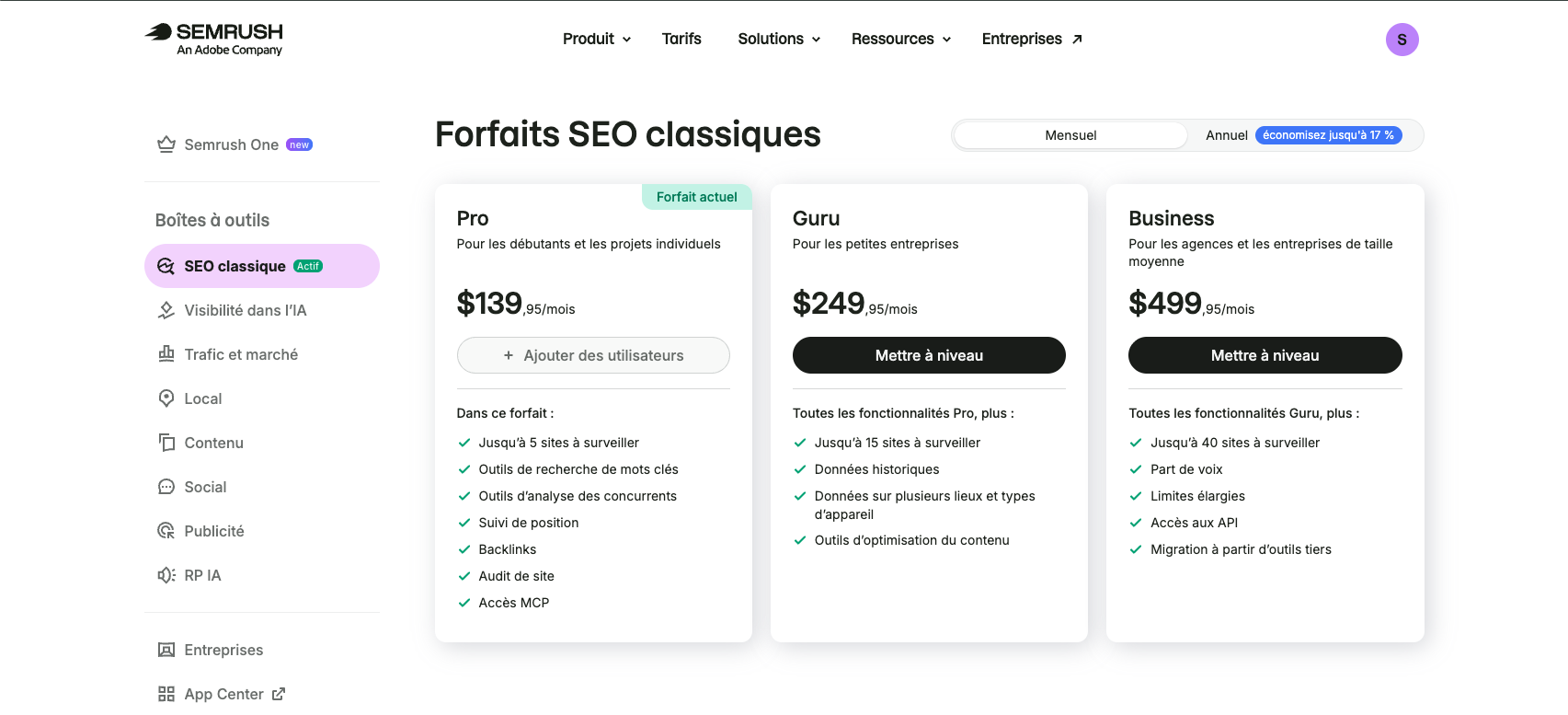
Semrush Pricing in 2026:
Plan | Monthly Price | Best For | Key Features |
|---|---|---|---|
Pro | $139.95/month | Beginners and individual projects | Up to 5 sites, keyword research, competitor analysis, position tracking, backlinks, site audit, MCP access |
Guru | $249.95/month | Small businesses | All Pro features + up to 15 sites, historical data, multi-location and device data, content optimization tools |
Business | $499.95/month | Agencies and mid-sized companies | All Guru features + up to 40 sites, share of voice, expanded limits, API access, migration from third-party tools |
Annual billing saves up to 17% on every plan making the Pro plan available at approximately $117.33 per month and the Business plan at approximately $416.66 per month for teams that can commit to a yearly subscription.
The pricing gap between Semrush and more accessible alternatives like HaloScan which starts at €49 per month is significant for independent e-commerce operators and small teams who need strong keyword research capabilities without the enterprise price tag. HaloScan's API is available at €588 annually compared to Semrush's $6,000 annual API pricing making it the more commercially rational choice for budget-conscious e-commerce SEO teams.
For enterprise e-commerce teams with complex multi-site SEO requirements and sufficient budget Semrush remains the strongest all-in-one platform available. For budget-conscious operators HaloScan delivers comparable keyword research depth at significantly lower cost.
3. Ahrefs
Ahrefs is the SEO platform most consistently cited by professional SEOs as the reference for backlink intelligence and keyword research accuracy and its combination of the largest backlink database available with keyword research tools that surface commercial intent queries with exceptional precision makes it a genuinely powerful option for e-commerce operators who prioritize link building and organic keyword strategy above all other SEO dimensions.
The first and most commercially significant strength of Ahrefs for e-commerce is its backlink database. Ahrefs crawls the web more frequently than any competing platform and its database of over 35 trillion backlinks is consistently regarded as the most comprehensive and most accurately updated available. For e-commerce operators whose category pages, product pages and blog content need authoritative backlinks to compete in crowded keyword landscapes this backlink intelligence is the most actionable available. The link gap analysis tool surfaces every domain linking to competitors but not to your site giving your link building team a validated prospecting list that would take months to compile manually.
The second strength is its keyword research accuracy. Ahrefs' keyword explorer covers more than 170 countries and its click-through rate data which estimates not just search volume but the actual clicks available after featured snippets, ads and SERP features absorb query traffic is one of the most commercially useful metrics available for e-commerce keyword prioritization. Knowing that a 10,000 monthly search volume keyword generates only 2,000 actual clicks because Google answers it directly in a featured snippet fundamentally changes how you prioritize content investment.
The third strength is its site audit tool which Ahrefs has significantly improved in recent releases. Its technical audit covers the most commercially significant e-commerce technical issues including crawl budget waste on faceted navigation, indexation problems on product variant URLs, duplicate content generated by filtered category pages and internal linking gaps that prevent PageRank from flowing efficiently to high-value commercial pages.
The fourth strength is its content gap analysis which identifies the keywords your competitors rank for that your site does not, organized by keyword difficulty and traffic potential to help e-commerce content teams prioritize their production roadmap around the opportunities most likely to generate meaningful organic revenue.
Ahrefs Pricing in 2026:
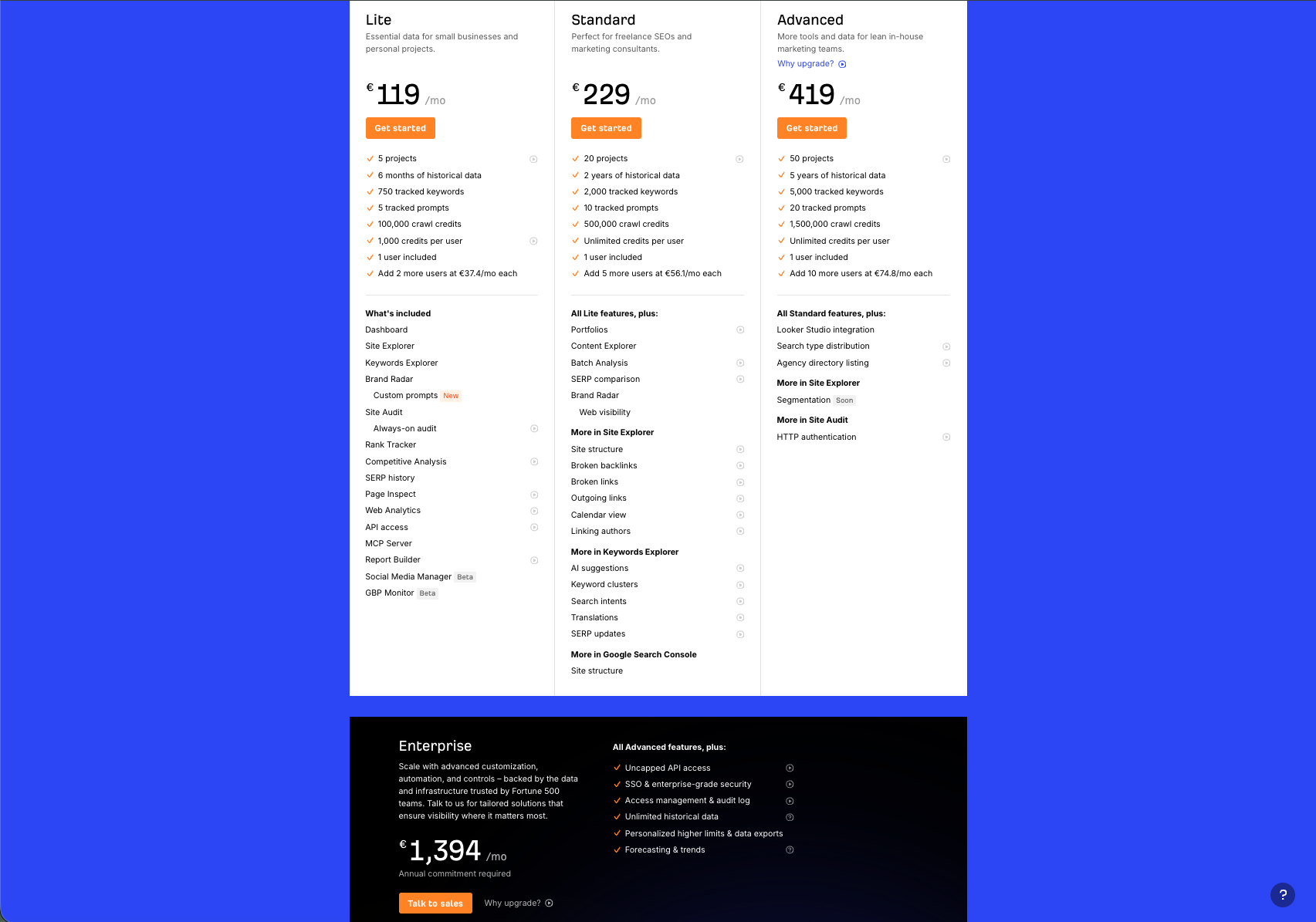
Plan | Monthly Price | Best For | Key Limits |
|---|---|---|---|
Lite | €119/month | Small businesses and personal projects | 5 projects, 750 tracked keywords, 6 months historical data, 100K crawl credits, 1 user |
Standard | €229/month | Freelance SEOs and marketing consultants | 20 projects, 2,000 tracked keywords, 2 years historical data, 500K crawl credits, 1 user |
Advanced | €419/month | Lean in-house marketing teams | 50 projects, 5,000 tracked keywords, 5 years historical data, 1.5M crawl credits, 1 user |
Enterprise | €1,394/month | Fortune 500 and large agencies | All Advanced features + uncapped API access, SSO, unlimited historical data, personalized limits |
Annual billing saves up to 17% on every plan. Additional users can be added at €37.4/month on Lite, €56.1/month on Standard and €74.8/month on Advanced making team access progressively more expensive as your SEO operation scales.
The Standard plan at €229 per month is the most commercially relevant entry point for serious e-commerce SEO teams who need Content Explorer, Batch Analysis and the expanded keyword clustering and search intent features that the Lite plan excludes. However this price point is significantly higher than more accessible alternatives like HaloScan which delivers strong keyword research and competitive analysis capabilities at €49 per month making it the more commercially rational choice for budget-conscious e-commerce operators who prioritize keyword research over backlink intelligence depth.
4. Screaming Frog

Screaming Frog SEO Spider is the most widely used dedicated technical SEO crawler available and its combination of crawling depth, customization flexibility and data export capabilities makes it an indispensable technical audit tool for e-commerce sites whose scale and architectural complexity generate technical SEO issues that cloud-based auditing tools frequently miss or underreport.
The first and most commercially significant strength of Screaming Frog for e-commerce is its crawling accuracy and depth. Unlike cloud-based audit tools that crawl your site remotely and may be blocked or rate-limited by server configurations Screaming Frog crawls from your local machine simulating exactly how Googlebot navigates your site. This local crawling approach produces a more complete and more accurate picture of the technical issues affecting your site's indexation and ranking potential than any cloud-based alternative.
For e-commerce sites specifically this matters enormously. A mid-sized Shopify or WooCommerce store with 5,000 products generates thousands of URLs through product pages, collection pages, filtered navigation, pagination, canonical variants and parameter-based URLs that need to be systematically audited for duplicate content, crawl waste and indexation issues. Screaming Frog handles this scale without the crawl credit limitations that constrain cloud-based tools on large sites.
The second strength is its customization depth. Screaming Frog allows you to configure custom extraction rules that pull specific data points from your pages during the crawl. For e-commerce teams this means you can extract product prices, review counts, schema markup validation data and custom meta information across your entire catalog in a single crawl producing a structured dataset that feeds directly into content optimization and technical remediation workflows.
The third strength is its integration capabilities. Screaming Frog integrates natively with Google Analytics, Google Search Console and PageSpeed Insights allowing you to enrich crawl data with performance metrics, traffic data and Core Web Vitals scores in a single unified export. This integration produces the most complete technical audit dataset available combining crawl data with real user performance signals.
Screaming Frog Pricing in 2026:
Feature | Free Version | Paid Version |
|---|---|---|
Price | Free | £199/year |
Crawl limit | 500 URLs | Unlimited |
Broken links and redirects | ✅ | ✅ |
Page titles and meta data analysis | ✅ | ✅ |
Duplicate page detection | ✅ | ✅ |
XML sitemap generation | ✅ | ✅ |
JavaScript rendering | ❌ | ✅ |
Scheduling | ❌ | ✅ |
Crawl comparison | ❌ | ✅ |
Near duplicate content | ❌ | ✅ |
Custom extraction | ❌ | ✅ |
Crawl with OpenAI and Gemini | ❌ | ✅ |
Google Analytics integration | ❌ | ✅ |
Search Console integration | ❌ | ✅ |
PageSpeed Insights integration | ❌ | ✅ |
Structured data and validation | ❌ | ✅ |
Accessibility auditing | ❌ | ✅ |
Looker Studio crawl report | ❌ | ✅ |
Mobile usability | ❌ | ✅ |
AMP crawling and validation | ❌ | ✅ |
Spelling and grammar checks | ❌ | ✅ |
Link metrics integration | ❌ | ✅ |
Free technical support | ❌ | ✅ |
At £199 per year approximately €235 the paid license is the most cost-efficient technical SEO investment on this list. The free version covering up to 500 URLs is sufficient for initial technical audits on small e-commerce stores and makes Screaming Frog the only tool on this list that allows meaningful evaluation before any financial commitment. The paid version's unlimited crawl depth combined with OpenAI and Gemini integration for AI-powered crawl analysis makes it particularly powerful for large e-commerce catalogs with thousands of product and collection pages.
5. Google Search Console

Google Search Console is the single most important SEO tool available to any e-commerce operator in 2026 and it is completely free. While every other tool on this list provides intelligence derived from third-party data estimations and database approximations Google Search Console delivers direct first-party data from Google itself about exactly how your site is performing in Google Search. No estimation. No approximation. Real data from the source that determines your organic rankings.
The first and most commercially significant feature of Google Search Console for e-commerce is its performance data. The performance report shows you every query that generated impressions or clicks for your site in Google Search over the last 16 months including the exact number of clicks, impressions, average click-through rate and average ranking position for each query. For e-commerce operators this data is commercially invaluable. You can identify product pages that rank on page two for high-commercial-intent queries and prioritize them for content optimization. You can surface collection pages with high impression volume but low click-through rates indicating title tag and meta description optimization opportunities. And you can identify seasonal query patterns that inform your content calendar and promotional planning.
The second critical feature is index coverage reporting. Google Search Console shows you exactly which pages Google has indexed and why it has excluded others. For e-commerce sites that generate thousands of URLs through product variants, filtered navigation and pagination this indexation intelligence is essential for diagnosing crawl waste and ensuring that your highest-value commercial pages are consistently indexed. Understanding why Google is not indexing a collection page or is showing a duplicate content warning on a product variant URL requires the direct source data that only Google Search Console provides.
The third critical feature is Core Web Vitals monitoring. Google Search Console surfaces your site's real-world page experience scores including Largest Contentful Paint, Interaction to Next Paint and Cumulative Layout Shift across your URL categories. For e-commerce sites where slow loading product pages and layout shifts during checkout directly reduce conversion rates this performance monitoring data is simultaneously an SEO signal and a commercial optimization input.
The fourth critical feature is manual action and security issue alerts. If Google has applied a manual penalty to your site or detected security issues like hacked content or malware Google Search Console notifies you directly and provides the documentation needed to resolve the issue and request reconsideration.
No third-party SEO tool can replicate the accuracy of Google Search Console's first-party data. Every e-commerce operator regardless of budget should have Google Search Console configured and monitored before investing in any paid SEO platform on this list.
Useful Resources:

.avif)
¿Listo para construir una marca de millones de dólares?
.avif)