SpyFu Review 2026: Pricing, Features, Drawbacks...



Knowing what your competitors are bidding on before you spend a single euro on Google Ads is what separates profitable campaigns from wasted budget. This is exactly the promise of competitive intelligence tools and SpyFu has been one of the most established names in this space for years. But is it still the right choice in 2026? In this complete SpyFu review we examine its pricing, its features and its real drawbacks to help you decide.
SpyFu is a search marketing intelligence platform built around competitor keyword and PPC research. Its main strength lies in the depth of its historical archive with up to 18 years of ranking and ad history which no general-purpose SEO suite matches. Pricing starts at around 39 dollars per month for the Basic plan and climbs to roughly 119 dollars for Pro and 249 dollars for Team, with all tiers including unlimited searches and exports. For agencies and PPC managers focused on Google Search it delivers genuine value at an accessible price.
However SpyFu also comes with real limitations. It offers no technical site audit, its backlink data is thin, its interface feels dated and users regularly report accuracy issues on smaller or newer domains. Its Basic plan caps exports at 10,000 rows which is exhausted quickly on a large competitor project. More fundamentally SpyFu remains a search-only tool with no visibility into social advertising where a growing share of e-commerce budget now goes.
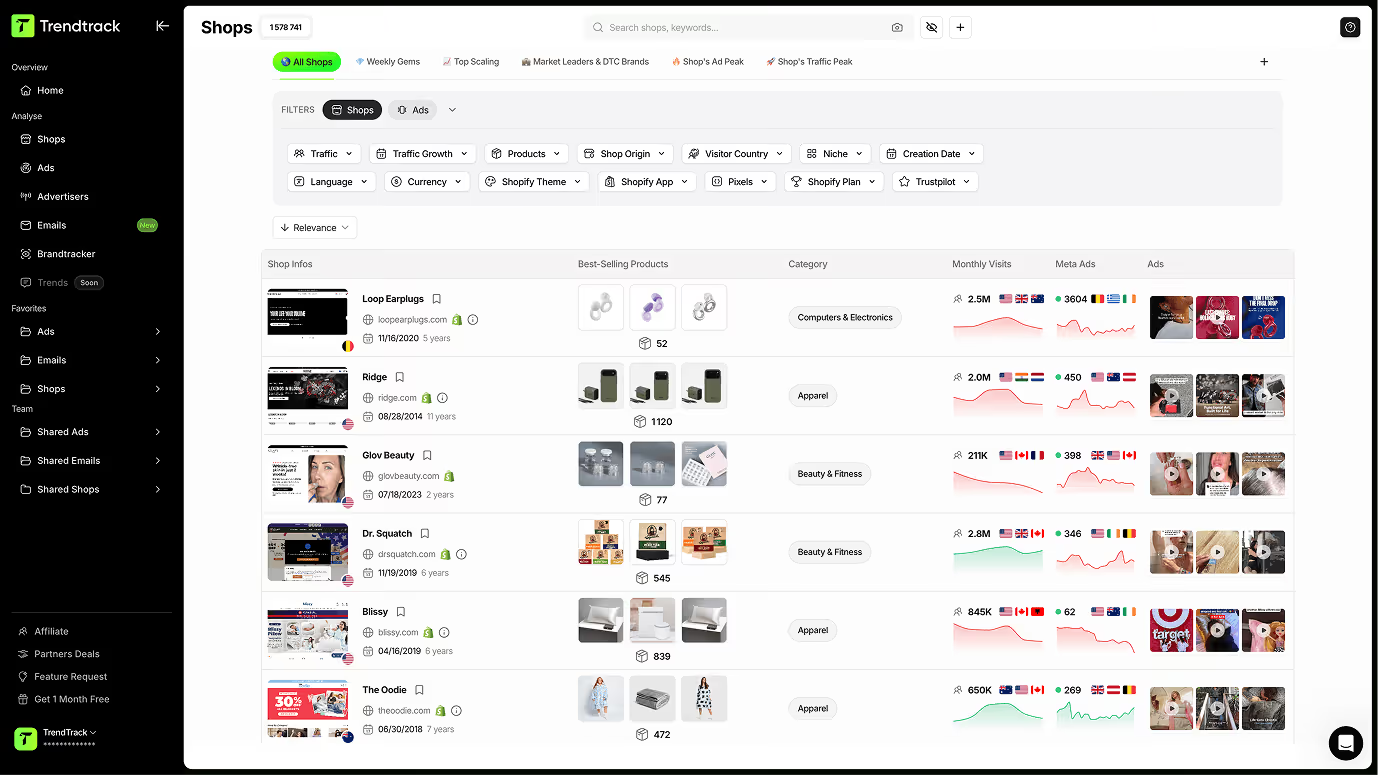
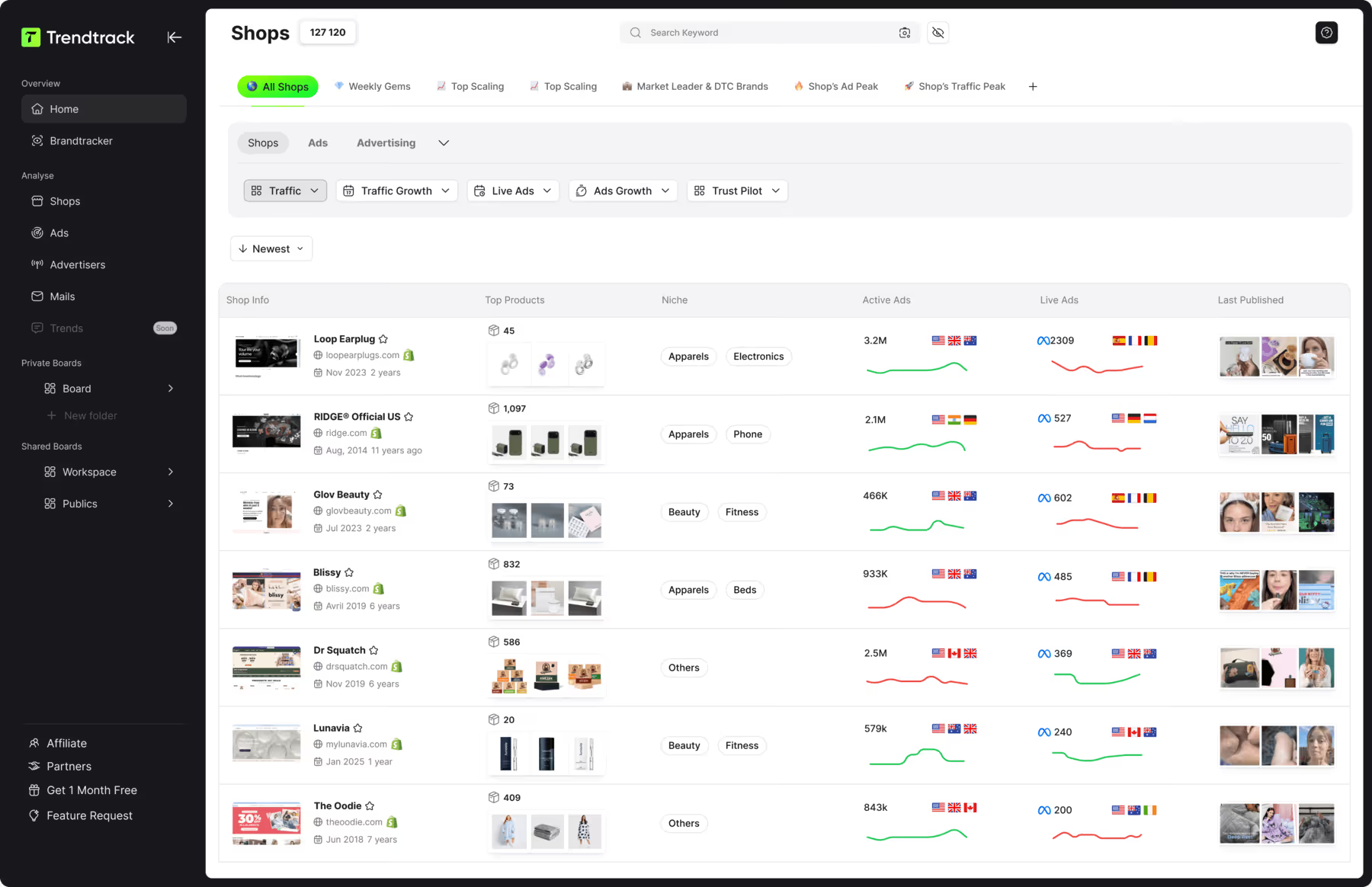
This is where Trendtrack available at app.trendtrack.io/en/sign-up stands apart as the most complete ad intelligence platform. It combines a Google Ads library, Meta and TikTok coverage with 95 million indexed TikToks and 700,000+ brand profiles updated every 24 hours which gives you the full picture rather than a single channel.
In this article we reveal our complete SpyFu review for 2026.
What Is SpyFu?

SpyFu available at spyfu.com is a search marketing intelligence platform designed to reveal what your competitors are doing on Google. Rather than guessing which keywords to target or how much to bid you can see the terms your rivals rank for organically, the ads they run, the budgets they allocate and the copy that performs for them. In short SpyFu turns competitor strategy into visible data.
The core purpose of SpyFu is competitive intelligence rather than general SEO. This distinction matters because it explains both its strengths and its gaps. Where suites like SEMrush or Ahrefs try to cover every aspect of search marketing SpyFu concentrates on one thing which is understanding what competitors do and how you can exploit it. This focus allows it to charge significantly less than comprehensive platforms.
Its most distinctive asset is its historical archive. SpyFu holds up to 18 years of ranking and advertising history which means you can trace how a competitor's strategy evolved over more than a decade. You see which keywords they abandoned, which ads they ran repeatedly and how their budget shifted over time. An ad that has run for years is almost certainly profitable which is an insight no snapshot tool can give you.
SpyFu also offers a set of dedicated features built around this data. Kombat compares up to three domains to reveal shared keywords and gaps. Its PPC research surfaces ad copy variations, estimated spend and keyword overlap. More recent additions include RivalFlow for content improvement suggestions and a ChatGPT integration for querying competitive data conversationally.
The platform primarily serves agencies, PPC managers, SEO consultants and small to medium businesses who need actionable competitor insight without paying enterprise prices. Its learning curve is gentle which makes it accessible even without advanced SEO expertise.
However SpyFu covers Google Search exclusively. It has no visibility into Meta, TikTok or the social platforms where a large share of e-commerce advertising budget now flows. For businesses running multi-channel acquisition this is a significant blind spot.
This is exactly where Trendtrack available at app.trendtrack.io/en/sign-up goes further by combining a Google Ads library with Meta and TikTok coverage in a single platform.
What Are the Main Features of SpyFu?
SpyFu offers a focused set of features built around competitor intelligence on Google. Understanding what the platform actually delivers helps you assess whether it fits your workflow. Here are the main features of SpyFu.
Competitor PPC research
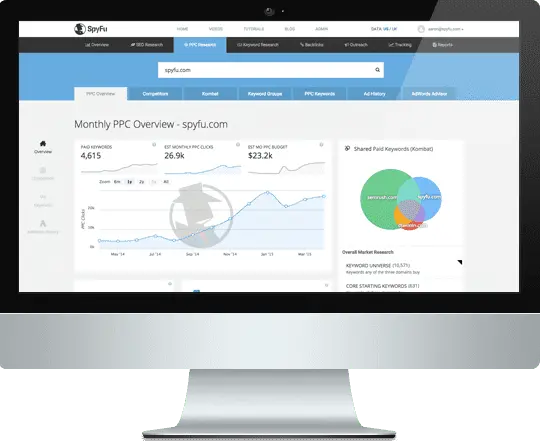
The first and most valuable feature is its PPC research. SpyFu reveals the Google Ads your competitors run, their estimated monthly spend, the keywords they bid on and the ad copy variations they test. You see which ads have run longest which is the strongest signal of profitability since no advertiser sustains an unprofitable campaign for years. For anyone managing Google Ads this alone justifies the subscription.
Historical data archive
.png)
The second feature is its historical archive which is SpyFu's true differentiator. With up to 18 years of ranking and advertising history you can trace how a competitor's strategy evolved over more than a decade. You identify the keywords they abandoned, the ads they returned to repeatedly and how their budget shifted across periods. No general-purpose SEO suite offers comparable depth on this dimension.
Organic keyword research
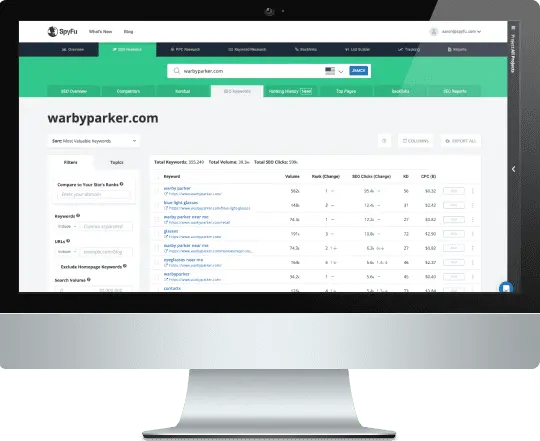
The third feature is organic keyword research. SpyFu shows the terms a domain ranks for, their positions, their search volumes and their difficulty. You can uncover long-tail opportunities your competitors already exploit and identify gaps in their coverage where you could rank more easily. This works both for your own domain and for any competitor you enter.
Kombat and domain comparison
The fourth feature is Kombat which compares up to three domains simultaneously. It displays shared keywords, terms unique to each competitor and gaps you could exploit. This visual comparison is particularly useful for positioning yourself in a competitive niche or for preparing a client audit quickly.
Rank tracking and reporting
The fifth feature is rank tracking and reporting. SpyFu monitors your positions over time and generates white-labeled reports which agencies particularly appreciate for client deliverables. All plans include unlimited searches and exports which is rare among competing tools.
AI tools
The sixth feature covers its AI additions with RivalFlow suggesting content improvements based on competitor gaps and a ChatGPT integration for querying competitive data conversationally.
How Much Does SpyFu Cost?
SpyFu offers three plans with monthly pricing and a 25% discount on annual billing. Understanding what each tier unlocks matters because the gap between Basic and Pro is significant. Here is what SpyFu costs.
Table: SpyFu pricing plans
Feature | Basic | Pro + AI | Team / Agency |
|---|---|---|---|
Monthly price | $39 | $119 (first month $59) | $249 |
Search results | 10k rows | Unlimited | Unlimited |
Data exports | 10k rows | Unlimited | Unlimited |
Live site tracking | 1 project | 10 projects | Unlimited |
Historical data | Not included | 10+ years | 10+ years |
RivalFlow AI | Not included | 1 site | 5 sites |
ChatGPT integration | Not included | Included | Included |
Tracked keywords | 5k weekly | 15k weekly | 50k weekly |
Automated reports | 10 | 100 | Unlimited |
Google Ads campaigns | Not included | Included | Included |
API access | Not included | Included | Included |
User seats | 1 user | 1 user ($30 extra each) | 5 users ($30 extra each) |
As the table shows the Basic plan at 39 dollars per month looks affordable but comes with real restrictions. It caps search results and exports at 10,000 rows which a single large competitor analysis exhausts quickly. More importantly it excludes historical data which is SpyFu's main differentiator. It also omits the AI tools, API access and white-labeled reporting.
The Pro + AI plan at 119 dollars per month is where the platform delivers its full value. You get unlimited searches and exports, over 10 years of historical data, RivalFlow, the ChatGPT integration, GSC integration, white-labeled reporting and API access. The 59 dollar first month makes it easier to test. For most serious users this is the realistic entry point rather than Basic.
The Team plan at 249 dollars per month targets agencies with unlimited tracking projects, 50,000 tracked keywords, unlimited reports and five included seats.
Note that additional users cost 30 dollars each on both paid tiers which adds up for growing teams. Annual billing saves 25% and effectively gives three months free.
What Are the Drawbacks of SpyFu?
SpyFu delivers genuine value in its niche but it comes with limitations that matter depending on your needs. Here are the main drawbacks of SpyFu.
Google Search only since the platform has no visibility into Meta, TikTok or the social channels where a growing share of e-commerce advertising budget now flows
A restrictive Basic plan which excludes historical data, AI tools, API access and white-labeled reporting while capping exports at 10,000 rows
No technical site audit as SpyFu is not a full SEO suite and cannot analyze your site's crawlability, speed or structural issues
Limited backlink data which is thin compared to specialized tools and often requires supplementing with Ahrefs or an equivalent
Accuracy issues on small domains since estimates are less reliable for new or low-traffic sites where the sample data is limited
A dated interface that users regularly describe as less polished than more recent competing platforms
Estimated rather than exact figures as spend and traffic numbers are directional indicators and not verified data from the advertiser
Additional seats at 30 dollars each which adds up quickly for growing teams since even the Pro plan includes only one user
Data widely accessible because thousands of users query the same database meaning the insights you find are rarely exclusive
Among these limitations the Google Search exclusivity is by far the most significant in 2026. Search intelligence alone no longer reflects how acquisition actually works for e-commerce brands. A competitor may run a modest Google Ads budget while scaling aggressively on TikTok and SpyFu would show you nothing of it. You get a partial picture and act on incomplete information.
The restrictive Basic plan is the second issue worth flagging. Advertising an entry price of 39 dollars while excluding the historical archive that constitutes the platform's core differentiator creates a gap between the marketed price and the realistic one. Most users end up on the Pro tier at 119 dollars.
Finally the estimated nature of the data requires interpretation. Spend and traffic figures indicate scale and direction but should never be treated as precise numbers on which to base exact budget decisions.
SpyFu vs Trendtrack: Which Tool Should You Choose?
Both tools promise competitive intelligence but they operate on entirely different scales. Here is the comparison between SpyFu and Trendtrack.
Criterion | SpyFu | Trendtrack |
|---|---|---|
Google Ads intelligence | Yes, search focused | Yes, dedicated Google Ads library |
Meta coverage | Not available | Full Meta ad intelligence |
TikTok coverage | Not available | 95 million indexed TikToks |
Brand intelligence | Domain level only | 700,000+ brand profiles |
Update frequency | Periodic | Every 24 hours |
Competitor tracking | Rank tracking only | BrandTracker across channels |
E-commerce focus | Generalist search tool | Built for e-commerce and DTC |
Product discovery | Not available | Winning product research |
AI integration | ChatGPT only | MCP with Claude and ChatGPT |
Browser extension | Not available | Chrome extension |
Entry limitations | Basic plan excludes historical data | Full access from the start |
As the table makes clear the gap is not marginal. The first decisive difference is channel coverage. SpyFu sees Google Search and nothing else. Trendtrack covers Google Ads, Meta and TikTok simultaneously which reflects how acquisition actually works in 2026. A competitor scaling hard on TikTok while running a modest search budget appears invisible in SpyFu and fully mapped in Trendtrack.
The second difference is database scale. SpyFu indexes search data at domain level. Trendtrack holds 95 million indexed TikToks and 700,000+ brand profiles updated every 24 hours which means you analyze entire businesses across every channel rather than isolated keyword lists.
The third difference is freshness. Trendtrack refreshes its brand profiles every 24 hours. In a market where creative fatigue is measured in days and where a winning product saturates in weeks working with periodic data means arriving after the opportunity has closed.
The fourth difference is BrandTracker. Trendtrack lets you monitor specific competitors continuously across all their channels and see their launches, their scaling patterns and their strategic shifts as they happen. SpyFu offers rank tracking which is a far narrower capability.
The fifth difference is AI integration through MCP with Claude and ChatGPT plus a Chrome extension that analyzes stores while you browse.
Conclusion: Is SpyFu Worth It in 2026?
To conclude this SpyFu review SpyFu remains a solid and legitimate tool but only for a specific use case. If your acquisition runs primarily through Google Search and your priority is understanding competitor keywords, ad copy and bidding strategy it delivers genuine value. Its historical archive spanning over a decade is a real differentiator that no general-purpose SEO suite matches, and its Pro plan offers unlimited searches and exports at a price well below premium marketing suites.
Its limitations are just as clear. The Basic plan at 39 dollars excludes the historical data that constitutes the platform's core value which pushes most serious users toward the 119 dollar Pro tier. There is no technical site audit, backlink data is thin, accuracy suffers on small domains and the interface feels dated. Additional seats at 30 dollars each add up quickly for growing teams.
But the fundamental issue is structural. SpyFu sees Google Search and nothing else. In 2026 e-commerce acquisition happens across Google Ads, Meta and TikTok simultaneously. A competitor running a modest search budget while scaling aggressively on TikTok appears invisible in SpyFu. You get a partial picture and make decisions on incomplete information which is precisely how budget gets wasted.
This is why Trendtrack available at app.trendtrack.io/en/sign-up operates on a different level. It combines a dedicated Google Ads library with full Meta and TikTok coverage backed by 95 million indexed TikToks and 700,000+ brand profiles updated every 24 hours. Its BrandTracker monitors competitors continuously across every channel, its Chrome extension analyzes stores while you browse and its MCP integration with Claude and ChatGPT lets you query market data conversationally.
So is SpyFu worth it in 2026? For pure Google Search intelligence it can be. But for e-commerce brands who need to see the full competitive picture rather than one channel Trendtrack is the more complete and forward-looking choice.
Useful Resources

.avif)
¿Listo para construir una marca de millones de dólares?
.avif)