Alibaba vs AliExpress for Dropshipping: A Comparison



Both belong to the same group, both source from the same Chinese manufacturers, and most new dropshippers choose the wrong one for their stage. So which platform should you actually use?
The distinction is simpler than the comparison articles make it.
AliExpress is retail. Single units, no negotiation, no minimum order, and a price that already includes the seller’s margin. You buy one item and it ships to your customer.
Alibaba is wholesale. Minimum order quantities, direct manufacturer contact, negotiated pricing and custom branding. You buy a hundred units and they ship to you or to a fulfillment partner.
That difference produces one practical rule.
AliExpress for testing. Alibaba for scaling.
The reasoning is cash rather than quality. Validating a product on AliExpress costs nothing in inventory and lets you kill a bad idea after twenty orders. Doing the same on Alibaba means committing several thousand dollars to stock you may never sell.
Once a product proves itself, the economics reverse. AliExpress unit costs and shipping times become the constraint on your margin and your customer experience, and moving to Alibaba fixes both.
Three factors decide your timing: your order volume, your available capital and whether you intend to build a brand rather than resell a generic product.
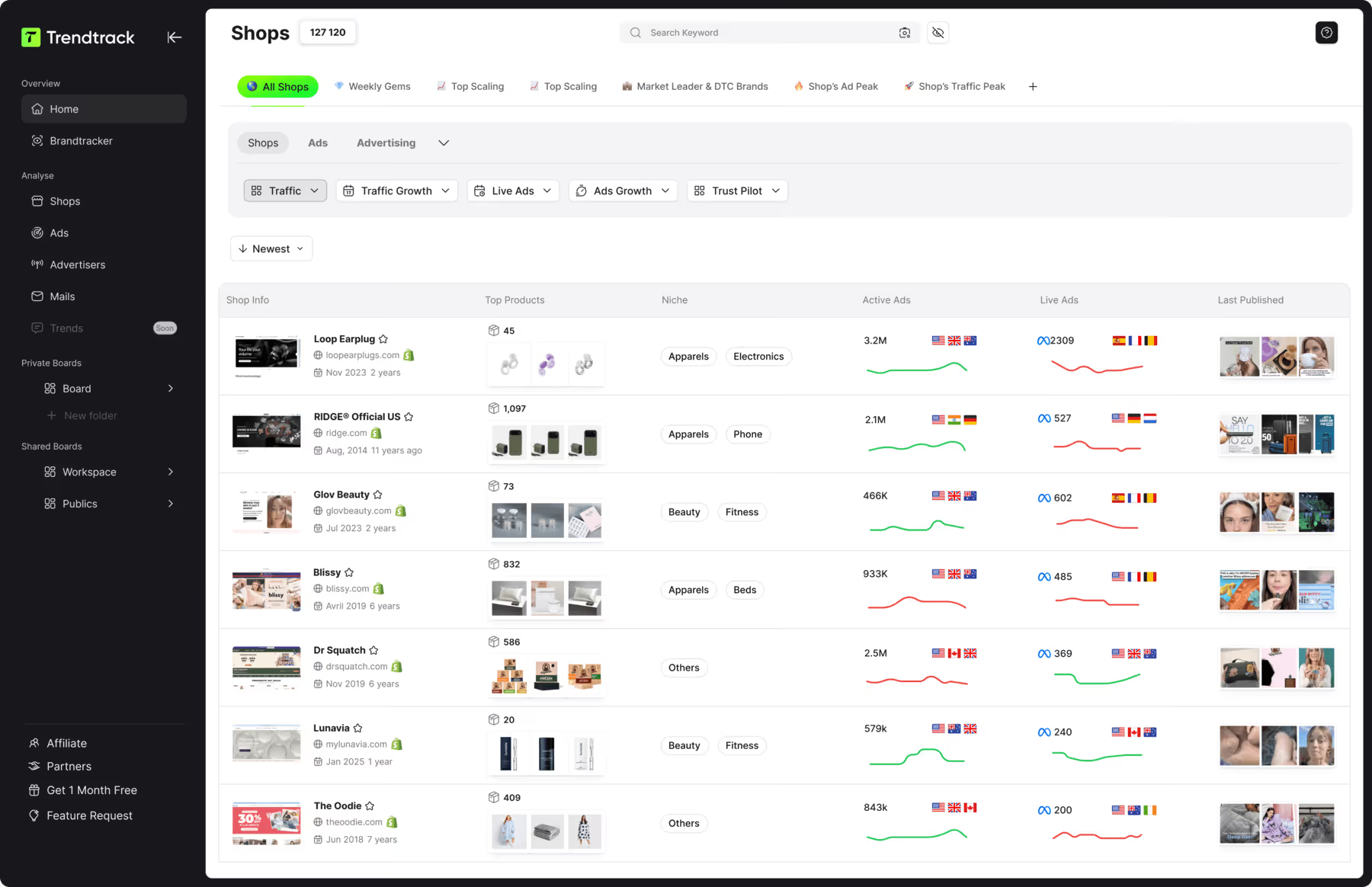
One thing neither platform tells you: which products are already selling. At Trendtrack available at app.trendtrack.io/en/sign-up, we index 95 million TikToks and refresh 700,000+ brand profiles every 24 hours.
In this article we compare both platforms in detail.
What Is AliExpress?
AliExpress is a retail marketplace operated by Alibaba Group, built for consumers buying single items directly from Chinese sellers.
That consumer orientation explains everything that follows, including why it works for dropshipping and why it stops working at scale.
Three characteristics define it.
No minimum order. You buy one unit, which is the entire reason dropshippers use it. Testing twenty products costs twenty single purchases rather than twenty inventory commitments.
Fixed pricing. Listed prices are final, with no negotiation. That removes a skill barrier and removes your ability to improve margins through relationship.
Direct shipping to your customer. The seller ships to whatever address you provide, which means no warehouse, no fulfillment and no capital tied up in stock.
Who you buy from matters more than most dropshippers realise.
AliExpress sellers are frequently trading companies rather than manufacturers. They buy from factories and resell, which adds a margin layer you pay and a communication layer that slows problem resolution.
Some sellers are manufacturers operating a retail storefront. Distinguishing between the two is difficult from the listing alone, and it determines how much room exists below the listed price.
Two structural limitations shape the dropshipping experience.
Shipping times typically run one to four weeks depending on the method and destination. Faster options exist at higher cost, and the standard experience falls short of what customers now expect.
No branding control. Products arrive in generic packaging with the supplier’s materials inside, occasionally including invoices showing what you paid. That last detail has ended more customer relationships than slow shipping.
On quality, the variance is wide and the ratings help less than they appear. Review volume accumulates across product variations, which means a highly rated listing can include a poorly performing variant.
Order samples before selling anything, regardless of the rating.
AliExpress suits product validation, early-stage stores and anyone testing without capital.
What Is Alibaba?
Alibaba is a business-to-business wholesale marketplace connecting buyers directly with manufacturers and suppliers, primarily in China.
The orientation is the opposite of AliExpress. This platform assumes you are buying to resell, which changes the terms, the pricing and the relationship.
Three characteristics define it.
Minimum order quantities. Suppliers list an MOQ, frequently between 100 and 1,000 units depending on the product. That threshold is the barrier and the advantage simultaneously: it excludes casual buyers and it unlocks pricing they never see.
Negotiated pricing. Listed prices are starting points rather than final. Volume, payment terms and relationship all move the number, and suppliers expect the conversation.
Direct manufacturer contact. You speak with the factory producing the item rather than a reseller, which removes a margin layer and shortens the distance when something goes wrong.
That third point produces the capability dropshippers eventually need: customisation.
Custom packaging, your logo on the product, modified specifications, exclusive colourways. None of this exists on AliExpress, and all of it is standard practice on Alibaba.
This is what separates a store reselling a generic product from a brand.
Two protections deserve knowing before your first order.
Trade Assurance holds your payment until you confirm the order meets agreed terms, which covers quality and delivery disputes. Use it rather than paying suppliers directly, whatever discount they offer for doing so.
Verified Supplier and Gold Supplier statuses indicate paid verification levels. They reduce risk without eliminating it, and they say nothing about quality.
Two practical realities shape the experience.
Shipping is yours to arrange. Sea freight, air freight, customs clearance and duties all become your responsibility, which adds complexity and cost most first-time buyers underestimate.
Lead times run weeks. Production plus shipping typically spans four to ten weeks, which means forecasting rather than reacting.
Alibaba suits proven products, brand builders and anyone with capital to commit.
Alibaba vs AliExpress: The Key Differences
Both platforms source from the same manufacturers. Everything about how you access them differs.
Table: Alibaba vs AliExpress
| Criterion | AliExpress | Alibaba |
|---|---|---|
| Model | Retail, B2C | Wholesale, B2B |
| Minimum order | 1 unit | 100 to 1,000+ units |
| Pricing | Fixed, final | Negotiable |
| Unit cost | Highest | 30 to 70% lower at volume |
| Who you buy from | Often trading companies | Usually manufacturers |
| Ships to | Your customer directly | You or your 3PL |
| Upfront capital | None | Several thousand dollars |
| Custom branding | None | Standard practice |
| Custom packaging | None | Available |
| Product modification | Impossible | Negotiable |
| Shipping arrangement | Handled by seller | Your responsibility |
| Customs and duties | Usually included | Yours to manage |
| Lead time | 1 to 4 weeks | 4 to 10 weeks |
| Payment protection | Buyer Protection | Trade Assurance |
| Samples | Buy one unit | Request from supplier |
| Best for | Testing products | Scaling proven products |
As the table shows, the decisive difference is what each platform costs you upfront.
AliExpress costs nothing in inventory. You test a product, and if it fails you lose the advertising spend rather than a warehouse full of stock.
Alibaba costs thousands before your first sale. That commitment is justified only once demand is proven, which is why sequencing matters more than choosing.
The second difference that changes your business is branding.
AliExpress ships generic products in generic packaging, occasionally with supplier invoices inside showing your cost. You are reselling, and your customer can find the same item elsewhere.
Alibaba lets you put your logo on the product and your packaging around it. That is the difference between a store and a brand, and it determines whether you build defensible margins or compete on price indefinitely.
The third is unit cost, and the gap is substantial. The same product frequently costs 30 to 70% less at Alibaba volumes, because you remove the trading company margin and the single-unit handling premium.
That gap becomes decisive once your advertising costs rise, since margin is what absorbs a worsening cost per acquisition.
One point the table understates: shipping complexity. AliExpress handles everything invisibly. Alibaba makes freight, customs and duties your problem, and first-time importers consistently underestimate the cost and the paperwork.
When Should You Switch From AliExpress to Alibaba?
The question is not whether, but when. Switching too early wastes capital on unproven products. Switching too late caps your margin while competitors undercut you.
Four signals indicate the moment has arrived.
Consistent volume on one product. The commonly cited threshold sits around 20 to 30 orders per day on a single SKU, sustained for several weeks rather than during one good campaign.
That consistency matters more than the number. A product selling 25 units daily for a month is proven. A product that hit 25 once during a viral moment is not.
Margin pressure from rising ad costs. When your cost per acquisition climbs and your unit economics tighten, the 30 to 70% cost reduction available at wholesale is the lever that restores viability.
Most dropshippers reach this point and respond by testing new creatives. Reducing product cost achieves the same result more reliably.
Shipping times costing you customers. When refund requests and support tickets cluster around delivery delays, holding stock closer to your market solves what no supplier negotiation can.
Competitors selling the same generic product. The moment your item appears in three other stores, price becomes the only differentiator. Custom packaging and modified specifications restore a reason to buy from you.
Before committing, three preparations are worth the time.
Order samples from several suppliers. Expect to pay for them. A supplier refusing samples or charging unreasonably for them has answered a question about the relationship.
Calculate landed cost, not unit cost. Add freight, customs duties, port handling and inland delivery. A product costing 40% less per unit can cost more delivered if the shipping method is wrong.
Start with a smaller first order where the supplier allows it. Paying slightly more per unit on an initial run is cheaper than discovering a quality problem across a thousand units.
One warning on timing: never switch during a peak season. Four to ten week lead times plus a new supplier relationship is the wrong combination for Q4.
Conclusion: Test on AliExpress, Scale on Alibaba
The comparison resolves into one rule. AliExpress for testing. Alibaba for scaling.
Neither platform is better than the other. They serve different stages, and choosing wrongly costs you either capital or margin depending on which direction you get it wrong.
AliExpress lets you validate without committing. No minimum order, no inventory, no freight to arrange. You test twenty products, kill nineteen, and lose advertising spend rather than a warehouse. That optionality is worth paying a premium for, and the premium is real: higher unit costs, slower shipping and no branding control.
Alibaba reverses every one of those terms. Unit costs drop 30 to 70% at volume, you speak directly with manufacturers, and custom packaging and product modification become available. The price is several thousand dollars committed upfront, four to ten week lead times, and freight and customs becoming your responsibility.
Four signals indicate the switch. Consistent volume around 20 to 30 daily orders on one SKU sustained over weeks. Margin pressure from rising acquisition costs. Shipping times generating refund requests. And competitors selling the same generic product, which makes branding the only remaining differentiator.
Three preparations before committing. Order samples from several suppliers and expect to pay for them. Calculate landed cost including freight, duties and handling rather than unit cost alone. And start with a smaller first order where the supplier permits it.
One scheduling warning worth repeating: never switch during a peak season. New supplier plus four to ten week lead times is the wrong combination for Q4.
The decision underneath all of this is which product deserves the commitment. Neither platform tells you what is already selling, which is the information that determines whether your inventory investment pays back.
At Trendtrack available at app.trendtrack.io/en/sign-up, we index 95 million TikToks, preserve full ad history across Meta, TikTok and Google, and refresh 700,000+ brand profiles every 24 hours.


¿Listo para construir una marca de millones de dólares?