Why analyze your competitors' best sellers in e-commerce?



In e-commerce, guessing is expensive.
Every product you launch requires inventory, ad budget, time, and positioning. And yet, many online sellers still choose products based on intuition instead of data. That’s where a powerful growth lever comes into play: analyzing your competitors’ best sellers.
If certain products consistently drive traffic and visibility for competing stores, that’s not random. It’s a signal.
Studying your competitors’ top-performing products allows you to understand what the market is already validating. It helps you identify demand trends, pricing positioning, category momentum, and even marketing angles that resonate with buyers.
This isn’t about copying. It’s about intelligence.
When you analyze competitors’ best sellers, you reduce risk, accelerate product validation, and make smarter strategic decisions. Instead of testing blindly, you build around proven performance patterns.
In this article, we’ll explore why analyzing competitor best sellers is essential for e-commerce growth, what insights you can extract from this data, and how to turn that intelligence into a scalable advantage.
How Can Competitor Best-Seller Analysis Improve Your Product Strategy?
Launching products in e-commerce without data is one of the fastest ways to waste time and budget. Inventory costs, advertising spend, and creative production add up quickly. That’s why analyzing your competitors’ best-selling products can dramatically strengthen your product strategy.
When you study what consistently performs for other stores in your niche, you’re not copying you’re identifying validated demand. This intelligence reduces risk and increases precision in your decision-making.
It Helps You Validate Market Demand
One of the biggest challenges in e-commerce is product validation. How do you know if a product category has real demand or just temporary hype?
By analyzing competitor best sellers, you gain clarity.
If multiple competitors consistently promote similar products and generate strong traffic around them, it signals stable demand. Repeated visibility across stores often means the market is responding positively.
Instead of guessing which items might perform, you build your catalog around proven interest. This reduces failed product launches and improves your overall success rate.
Validation removes emotional bias from product decisions.
It Reveals Category Momentum
Best-seller analysis doesn’t just highlight individual products it reveals category trends.
You may notice that certain product types dominate competitor stores. For example, a specific material, design style, bundle format, or price range may appear frequently among top-performing items.
These patterns signal momentum within your niche.
Understanding category momentum allows you to position your store more strategically. Rather than offering a scattered product selection, you align your catalog with what customers are actively purchasing.
Momentum-based strategy increases conversion potential.
It Sharpens Pricing Strategy
Pricing plays a central role in product success.
When analyzing competitor best sellers, you should observe:
- Price positioning (premium vs. budget)
- Discount frequency
- Bundle offers
- Subscription models
If best-selling products cluster within a specific price range, that range likely aligns with customer expectations.
This doesn’t mean matching prices blindly. Instead, it provides context. You can choose to compete directly, differentiate through value, or position above the market with stronger branding.
Pricing intelligence reduces underpricing and overpricing mistakes.
It Improves Your Marketing Angles
Competitor best sellers often reveal which marketing messages resonate.
Pay attention to:
- Product descriptions
- Visual presentation
- Highlighted benefits
- Social proof emphasis
If top products consistently focus on convenience, durability, luxury, or problem-solving, those themes likely connect with buyers.
By understanding how competitors frame their winning products, you refine your own positioning and creative strategy.
Messaging alignment increases engagement.
It Supports Inventory Planning
Product strategy is not just about selection it’s also about forecasting.
If certain products dominate traffic and visibility across multiple competitors, that suggests stable or growing demand. This insight helps you allocate inventory more confidently.
Instead of spreading inventory budget thinly across untested items, you prioritize high-potential categories.
Strategic inventory allocation improves cash flow efficiency.
It Identifies Gaps and Differentiation Opportunities
Competitive analysis is not only about replication it’s also about identifying gaps.
While reviewing competitor best sellers, you may notice:
- Overcrowded subcategories
- Repetitive product variations
- Weak branding or limited customization
These gaps create differentiation opportunities.
For example, if many competitors sell similar products but neglect premium packaging or storytelling, you can position your store differently.
Differentiation builds long-term brand equity.
It Aligns Product Strategy With Data
Ultimately, competitor best-seller analysis transforms your product strategy from reactive to proactive.
Instead of launching products randomly and hoping they convert, you align decisions with market evidence.
This structured approach:
- Reduces testing costs
- Increases launch success rates
- Improves pricing accuracy
- Strengthens marketing positioning
In a competitive e-commerce landscape, guesswork is expensive. Data-driven product strategy is efficient.
Analyzing competitor best sellers doesn’t eliminate creativity it guides it. It provides boundaries within which innovation becomes strategic rather than speculative.
The brands that scale consistently are not those launching the most products. They are the ones launching the right products, positioned correctly, at the right time.
And competitor best-seller intelligence is one of the most powerful tools to achieve that.
What Tool Can Help You Identify Competitors’ Best-Selling Products?
In e-commerce, product selection is everything. A strong marketing strategy cannot save a weak product, and a great product without visibility rarely scales. That’s why identifying competitors’ best-selling products is such a powerful growth lever. But manually guessing which items perform well is inefficient and unreliable.

This is where a specialized competitive intelligence tool like TrendTrack becomes essential.
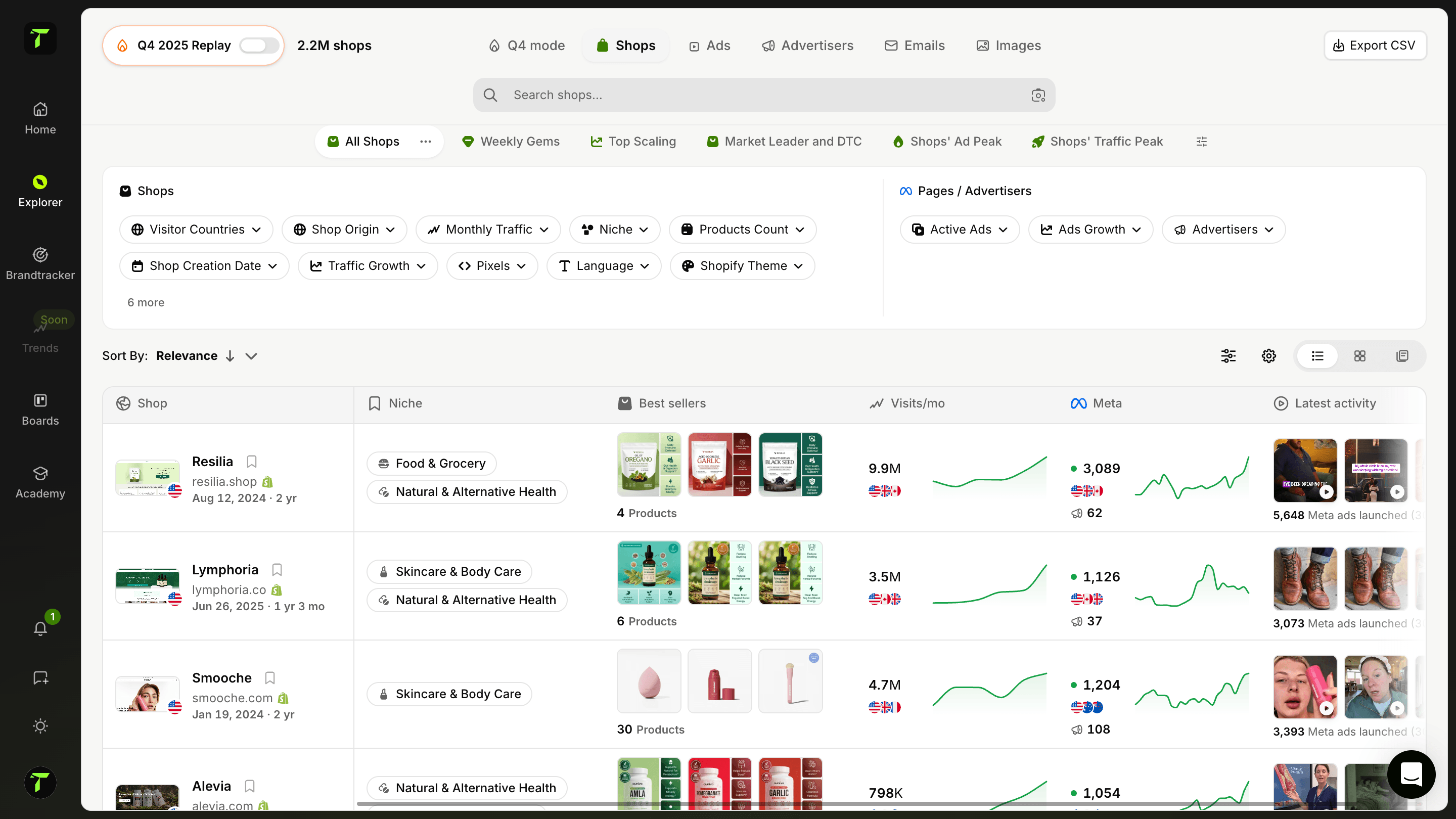
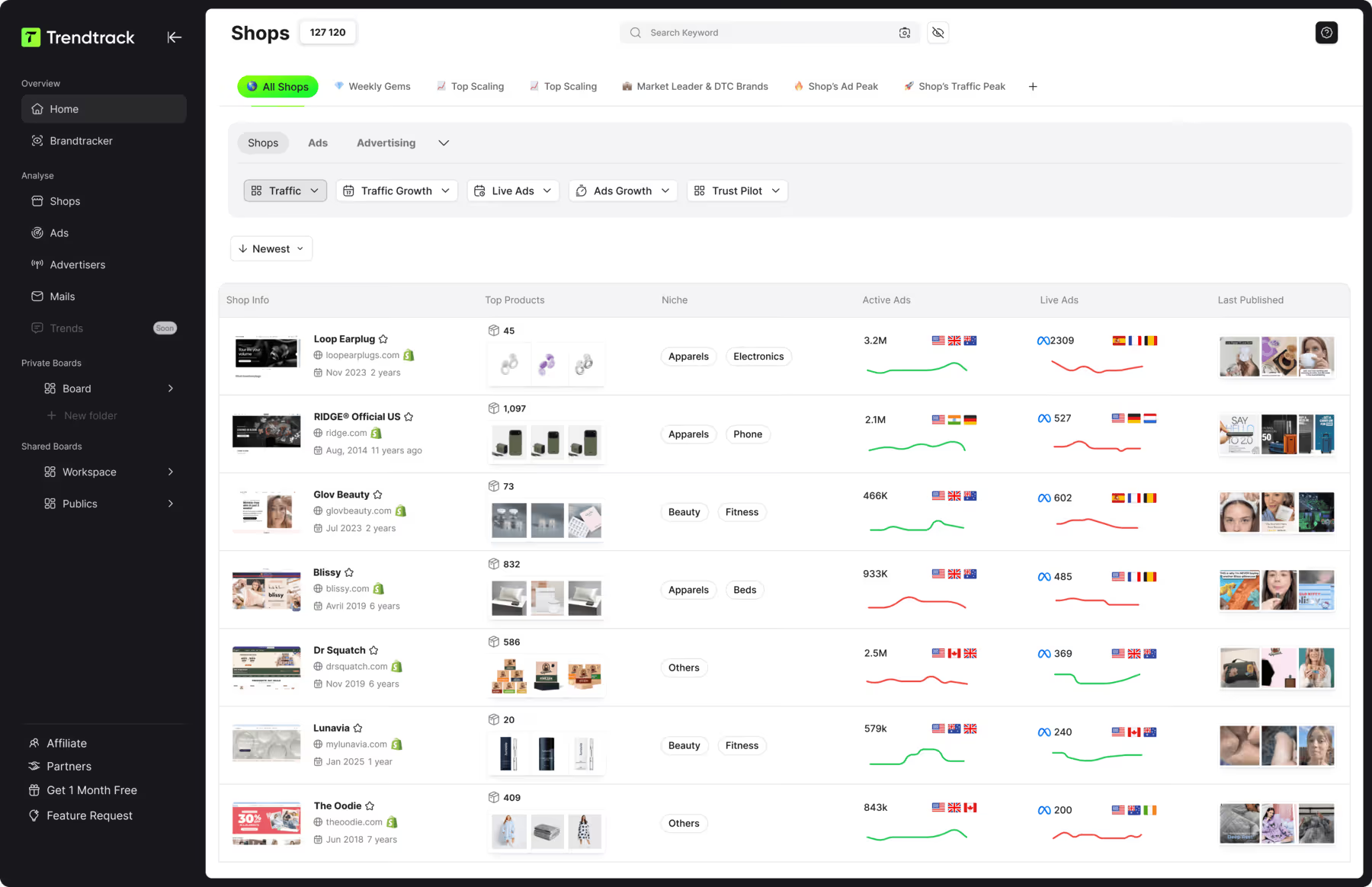
TrendTrack is built specifically for e-commerce entrepreneurs who want real visibility into their competitive landscape. Instead of browsing competitor stores randomly and trying to infer performance from social proof or reviews, TrendTrack gives you structured, data-driven insight.
One of its strongest capabilities is helping you identify which products drive traffic and traction for competing Shopify stores.
When analyzing competitors manually, you might assume that the first products displayed on their homepage are their best sellers. But that’s not always accurate. Many stores highlight new arrivals or promotional items that may not actually generate the most revenue.
TrendTrack eliminates that uncertainty by allowing you to evaluate performance signals directly. By analyzing estimated traffic, growth patterns, and product visibility, you gain insight into which items likely attract the most attention and engagement.
This matters because traffic concentration often reveals revenue concentration.
If a specific category or product consistently appears across competitor marketing campaigns and correlates with traffic growth, it likely plays a significant role in their performance. Instead of guessing, you operate with evidence.
Another key advantage of using TrendTrack is speed. E-commerce moves quickly. Trends rise and fade within weeks. A tool that centralizes competitive insights allows you to react faster than manual research ever could.
With TrendTrack, you can analyze multiple competitors within minutes. You can compare their traffic trends, detect scaling signals, and observe which products receive consistent visibility. This helps you identify not only current best sellers but also emerging momentum.
Product validation becomes structured rather than emotional.
Beyond identifying top-performing products, TrendTrack also helps you understand the broader context. You can observe how competitors position their products, what pricing tiers dominate, and whether certain categories consistently outperform others.
This contextual intelligence sharpens your product strategy.
For example, if multiple competitors experience traffic growth around bundled offers or subscription-based products, that signals a pattern. If a certain price range repeatedly dominates top-performing categories, that gives you reference points for positioning.
TrendTrack also supports benchmarking. Instead of analyzing products in isolation, you evaluate them relative to competitor performance. If a competitor with rapid traffic growth consistently promotes specific items, those products likely contribute to scaling momentum.
This insight reduces product launch risk.
Launching new inventory involves financial commitment. Advertising campaigns require budget. Without validation, every product launch becomes a gamble. TrendTrack minimizes that uncertainty by giving you structured data about what works in your niche.
Importantly, using TrendTrack is not about copying competitors. It’s about identifying validated demand signals and understanding market dynamics.
You can choose to compete directly within successful categories, differentiate through branding or premium positioning, or target adjacent subcategories with less competition.
The advantage lies in clarity.
Instead of building your product catalog blindly, you build it strategically.
In a crowded e-commerce ecosystem, the brands that scale fastest are not necessarily the most creative they are the most informed.
TrendTrack provides the intelligence layer needed to transform product decisions into strategic moves.
If your goal is to reduce risk, accelerate validation, and identify competitors’ best-selling products with precision, TrendTrack is one of the most powerful tools available.
In digital commerce, data is leverage. And when it comes to product strategy, leverage makes all the difference.
How Can You Turn Competitor Best-Seller Insights into Scalable Revenue?
Identifying your competitors’ best-selling products is powerful but insight alone does not generate revenue. The real leverage comes from execution. Competitive intelligence only becomes valuable when you translate it into structured action.
Turning competitor best-seller insights into scalable revenue requires strategy, differentiation, and alignment with your brand positioning. It’s not about copying products blindly. It’s about understanding why those products perform and building your own optimized version of success.
The first step is validation. If multiple competitors consistently generate traffic and visibility around a specific product category, that signals proven demand. Demand validation reduces uncertainty. Instead of experimenting randomly, you focus on categories with clear market traction.
However, validation should lead to refinement, not imitation.
Analyze what makes the product successful. Is it solving a specific pain point? Is it visually appealing? Is it priced within a psychological sweet spot? Does it target impulse buyers or research-driven consumers?
Understanding the underlying reason for performance allows you to adapt strategically.
The second step is differentiation. If a product category is already validated, your competitive advantage must come from positioning.
You can differentiate through:
- Stronger branding
- Better product descriptions
- Enhanced packaging
- Bundled offers
- Subscription options
- Premium materials
- Clearer value proposition
Revenue scalability depends on margin and positioning. Competing only on price erodes profitability. Competing on perceived value builds long-term brand equity.
The third step is traffic alignment.
Once you identify a high-potential product category, align your acquisition strategy accordingly. If competitors generate traffic through organic search for that product, optimize your collection and product pages around relevant transactional keywords.
If competitors scale using paid ads, test advertising campaigns with structured budgets and controlled experiments. Monitor conversion rates, customer acquisition cost, and average order value carefully.
Data-driven acquisition transforms insights into measurable growth.
The fourth step is conversion optimization.
Traffic alone does not create revenue. Your store must convert efficiently.
When launching products inspired by competitor best-seller analysis, ensure:
- Product pages are optimized for clarity and persuasion
- Benefits are highlighted prominently
- Social proof builds trust
- Upsells increase average order value
- Checkout experience remains frictionless
Even a small improvement in conversion rate can significantly increase revenue when traffic scales.
The fifth step is scaling strategically.
Once a product demonstrates strong performance through consistent sales, stable margins, and healthy return on ad spend you can scale more aggressively.
Scaling may involve:
- Expanding ad budgets gradually
- Creating additional creatives
- Entering adjacent subcategories
- Exploring international markets
- Increasing inventory depth
The key is controlled expansion. Revenue scalability requires disciplined reinvestment rather than impulsive spending.
Another important element is retention.
If competitor analysis reveals repeat-purchase potential within a product category, build retention mechanisms into your strategy. Email flows, loyalty programs, subscription offers, and post-purchase engagement increase customer lifetime value.
Higher lifetime value supports higher acquisition budgets which fuels scalability.
Finally, continuously monitor competitor evolution.
Best sellers today may shift tomorrow. Trends evolve. Demand fluctuates. Ongoing competitive intelligence ensures you stay proactive rather than reactive.
Revenue scalability is not achieved through a single winning product. It is achieved through a system — a repeatable process of validation, differentiation, optimization, and scaling.
Competitor best-seller insights provide the starting point. Strategic execution builds the revenue engine.
In e-commerce, those who move blindly burn capital. Those who move with intelligence build sustainable growth.
When you transform competitor insights into structured action refining positioning, aligning traffic, optimizing conversion, and scaling responsibly you don’t just replicate success.
You build your own.
What Mistakes Should You Avoid When Analyzing Competitor Best Sellers?
Analyzing your competitors’ best-selling products can dramatically improve your product strategy but only if you approach it correctly. Many e-commerce entrepreneurs misuse competitive intelligence and end up making costly strategic errors.
Competitor analysis is a tool for clarity, not imitation. If applied poorly, it can lead to margin erosion, poor positioning, and wasted inventory.
Here are the most common mistakes you must avoid.
Copying Products Without Differentiation
One of the biggest mistakes is directly copying a competitor’s best seller without adding differentiation.
Just because a product performs well for another store does not guarantee it will perform the same for you. That competitor may have:
- Stronger brand authority
- Higher trust signals
- Better email flows
- Established customer loyalty
- Superior ad creatives
Blind replication often leads to price wars and reduced margins.
Instead of copying, analyze why the product works. Is it solving a specific pain point? Is it positioned as premium? Is it bundled creatively? Then refine your own version with added value.
Competitive intelligence should guide strategy not eliminate creativity.
Ignoring Your Own Brand Positioning
Another major mistake is abandoning your brand identity to chase competitor trends.
If your store is positioned as premium and you suddenly introduce low-cost trend-driven products just because competitors are selling them, you risk confusing your audience.
Brand consistency builds trust. Short-term opportunism weakens it.
Before adding a product inspired by competitor best-seller analysis, ask:
Does this align with my brand values?
Does it fit my target audience?
Does it reinforce my positioning?
Revenue without positioning rarely builds long-term sustainability.
Focusing Only on Visible Products
Many entrepreneurs assume that the most visible products on a competitor’s homepage are their best sellers.
That assumption is risky.
Some stores promote new arrivals, seasonal items, or discounted inventory that may not represent their top revenue drivers.
True best-seller analysis requires traffic patterns, product category dominance, and consistent promotional signals not just surface-level observation.
Avoid basing product decisions on homepage placement alone.
Ignoring Market Saturation
Seeing multiple competitors selling the same product may indicate demand but it may also indicate saturation.
If a niche is overcrowded with identical offers, customer acquisition costs can rise quickly. Competing purely on price becomes inevitable.
Before entering a validated category, evaluate competition intensity.
Ask yourself:
Can I differentiate meaningfully?
Can I compete profitably after advertising costs?
Is there room for positioning variation?
Validation without margin analysis can destroy profitability.
Misinterpreting Traffic Signals
Not all traffic growth equals profitability.
A competitor’s best-selling product may generate high traffic but low margins. They may rely heavily on paid ads, sacrificing profitability for volume.
If you only analyze visibility without considering sustainability, you risk copying a fragile model.
Always evaluate performance patterns holistically.
Look for consistency in growth trends rather than short-term spikes. Long-term stability is more valuable than viral bursts.
Neglecting Conversion Optimization
Another mistake is focusing exclusively on the product itself rather than how it is presented.
A product may succeed not only because of what it is but because of how it’s marketed.
Strong:
- Product descriptions
- High-quality visuals
- Social proof
- Upsell systems
- Checkout optimization
can dramatically influence performance.
If you replicate a product but ignore the conversion system around it, results will differ significantly.
Competitor best-seller analysis should include the entire customer journey not just the product.
Failing to Monitor Continuously
E-commerce trends evolve rapidly. What is a best seller today may lose momentum in a few months.
Many entrepreneurs conduct competitor analysis once and assume the insight remains relevant indefinitely.
That’s a mistake.
Competitive intelligence must be continuous. Traffic trends, pricing strategies, and product positioning shift constantly.
Ongoing monitoring allows you to anticipate changes rather than react too late.

.avif)
Ready to build a million-dollar brand?
.avif)