Tyver Review: Is It a Good Spy Tool?



Finding winning products and profitable ad creatives is the foundation of every successful dropshipping business. This is why spy tools have become essential for e-commerce sellers who want to know what actually works before spending money on ads. Among the newer names on the market Tyver has gained attention as a Facebook ads spy tool. But is it really a good spy tool for your business in 2026? In this complete Tyver review we examine its features, strengths and limitations to help you decide.
Tyver is an ad spy tool that helps users find, analyze and track high-performing advertising creatives across Meta platforms including Facebook and Instagram. It combines a large creative database, an advanced filtering system and built-in analytics, collecting millions of ads daily from different countries and updating in near real time. Its main strength lies in the depth of its Meta coverage. Where the Facebook Ads Library simply shows that an ad exists Tyver adds performance data like reach, active days and audience demographics so you can tell whether an ad is a test or something a competitor is actively spending behind.
However Tyver also comes with a significant limitation. It is an intelligence platform engineered specifically for Meta traffic sources meaning Facebook, Instagram, Threads and Messenger. In 2026 a huge share of winning products explode on TikTok first which means a Meta-only tool leaves you blind to where trends actually start.
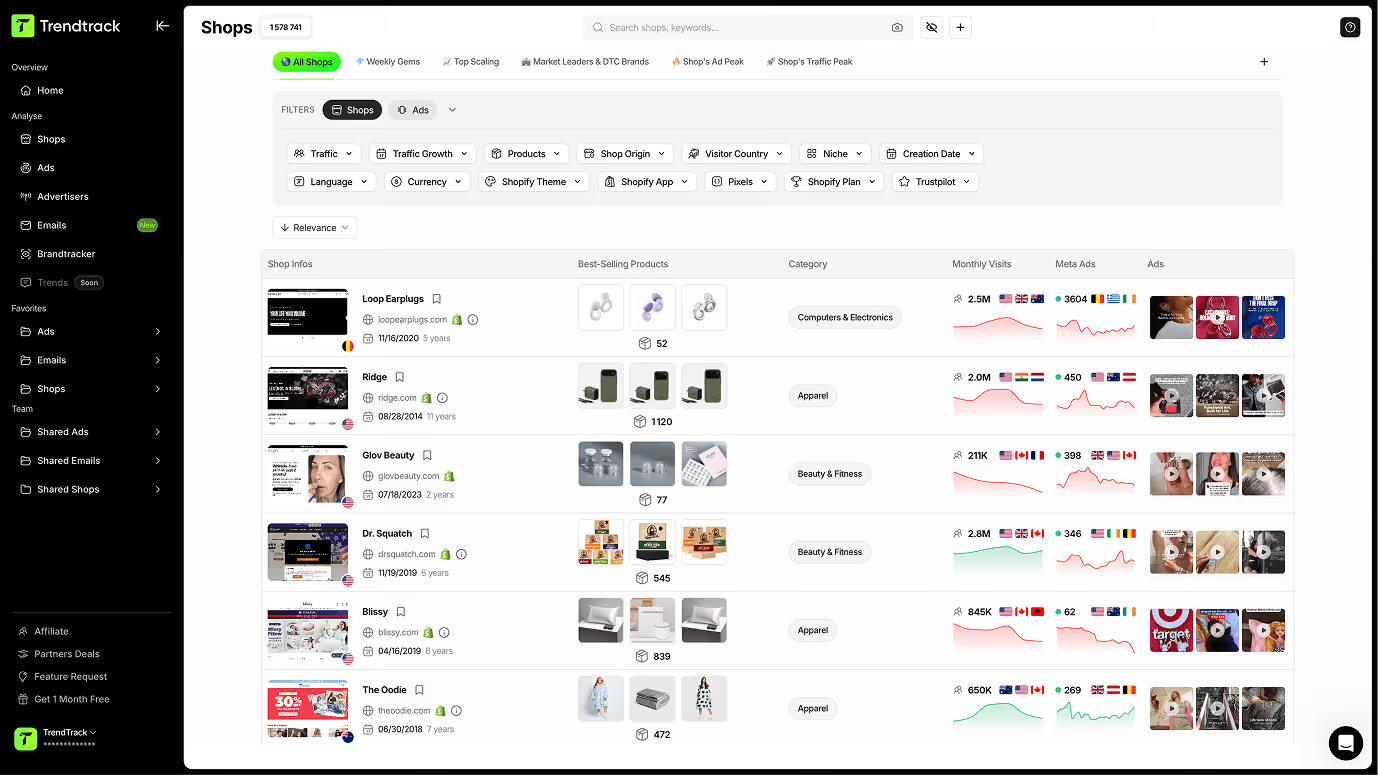
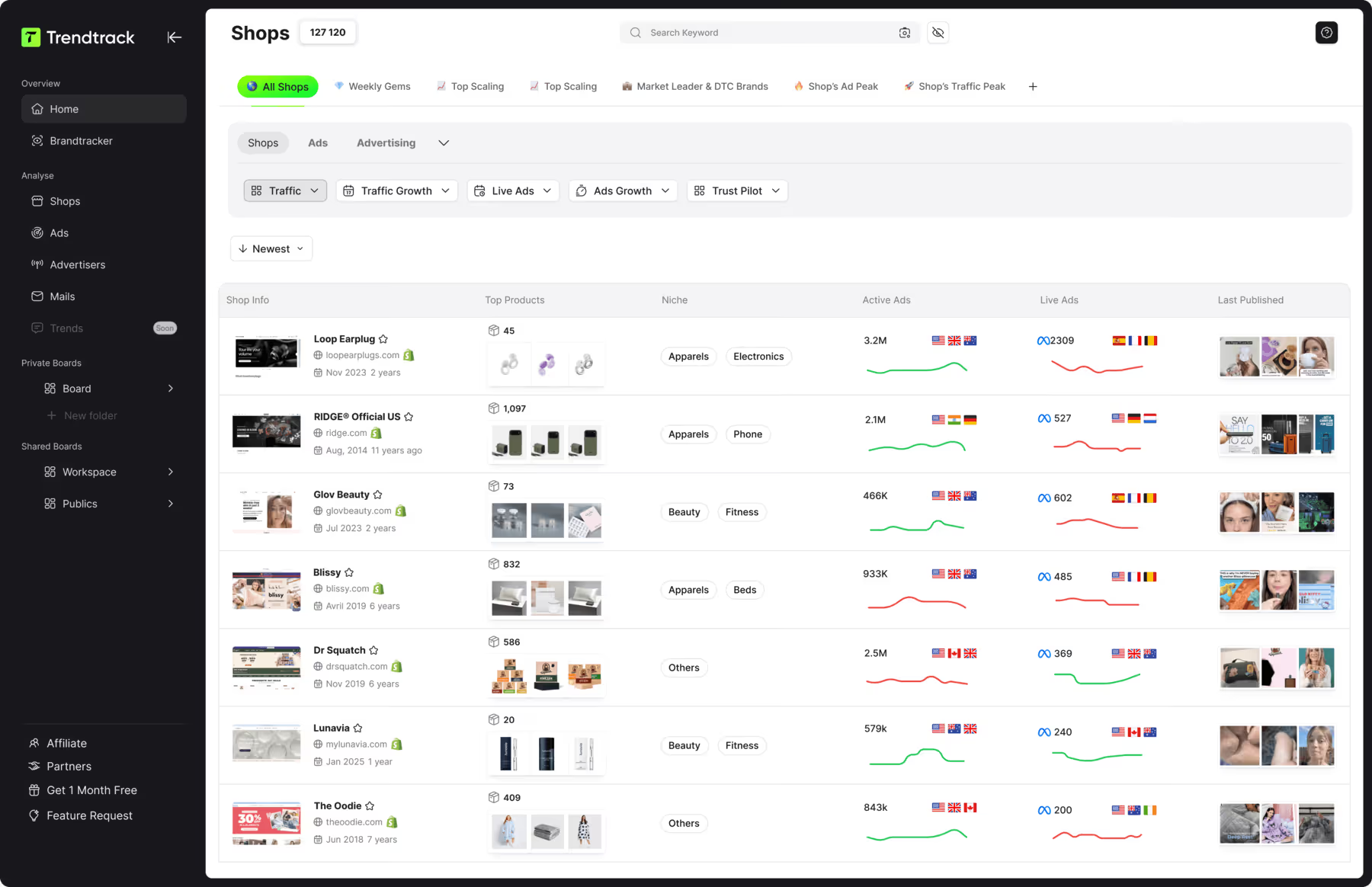
This is exactly where Trendtrack stands out. Available at app.trendtrack.io/en/sign-up it delivers cross-platform product research covering both TikTok and Meta with 95 million indexed TikToks and 700,000+ brand profiles updated every 24 hours so you catch winning products before they saturate.
In this article we reveal our complete Tyver review and why Trendtrack is the more complete solution.
What Is Tyver?
Tyver is an ad spy tool designed to help users find, analyze and track high-performing advertising creatives across the Meta ecosystem. It covers Facebook, Instagram, Threads and Messenger giving media buyers and dropshippers visibility into the ads their competitors are actually running. In short Tyver lets you see what is working on Meta before you spend your own money testing. It is built specifically for the Meta ecosystem.
The core purpose of Tyver is to go beyond what free tools show you. The Facebook Ads Library simply reveals that an ad exists. Tyver adds a layer of performance data such as reach, active days and audience demographics which lets you distinguish between an ad a competitor is merely testing and one they are actively scaling. This distinction is critical because a long-running ad is usually a sign of profitability.
One of the defining features of Tyver is its large and frequently updated database. The platform collects millions of ads daily across many countries and updates in near real time. This freshness matters in a market where creative fatigue is fast and campaign lifespans are short. Working with outdated data means chasing products that have already saturated.
Tyver also stands out for its advanced filtering system. Users can filter by keywords, geographic markets, ad formats, placements, calls to action and even technical link parameters like pixel identifiers or tracking macros. There is also a filter to isolate ads from Shopify stores which is useful for dropshippers researching competitor stores rather than large retail brands.
What Are the Main Features of Tyver?
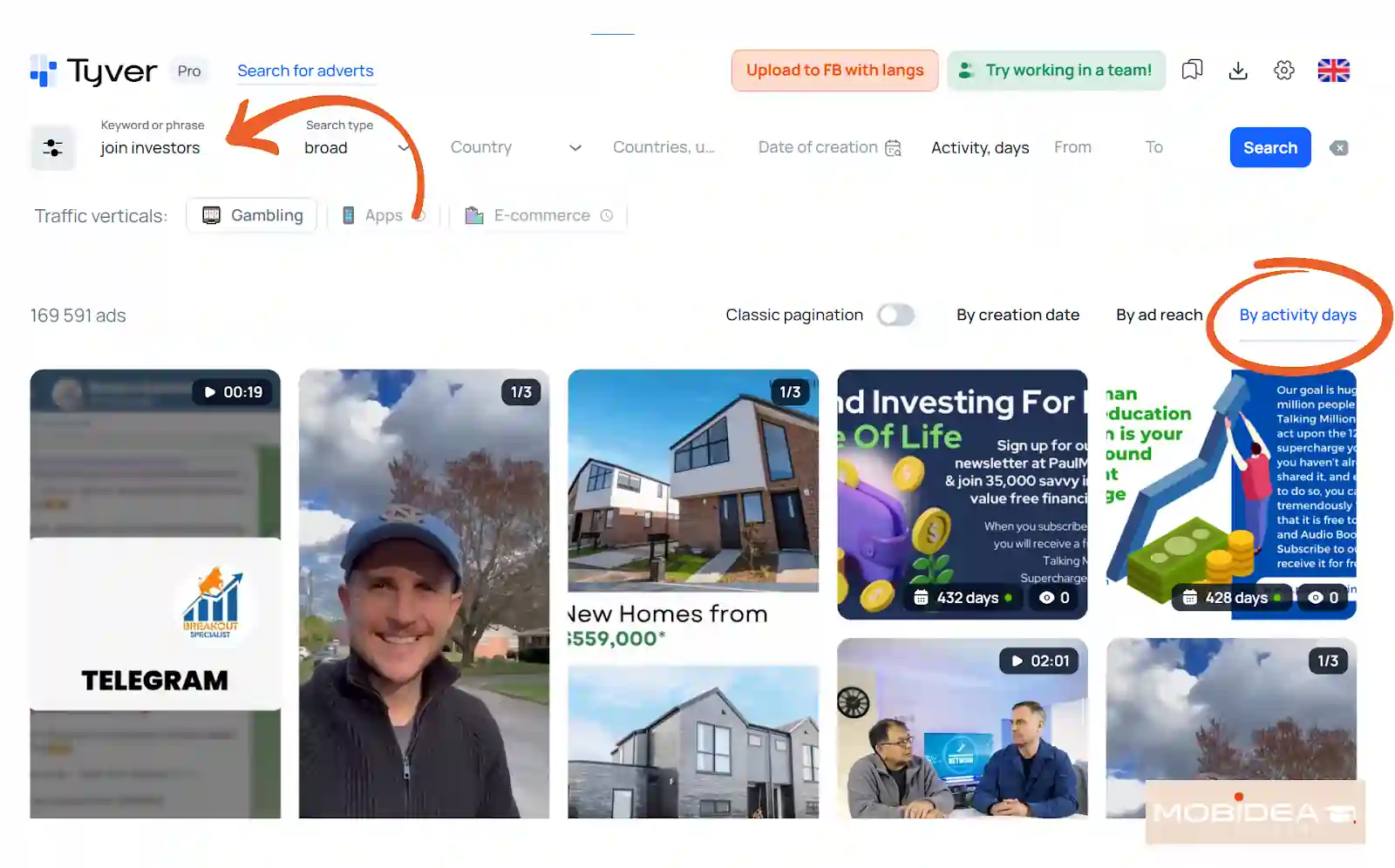
Tyver offers a range of features built around Meta ad intelligence. Understanding what the platform actually delivers helps you assess whether it fits your workflow and where it stops compared to a cross-platform tool like Trendtrack. Here are the main features of Tyver.
Table of Tyver's main features
Feature | What it does |
|---|---|
Large ad database | Millions of Meta ads collected and updated daily |
Performance data | Reach, active days and audience demographics per ad |
Advanced filters | Keywords, GEOs, formats, placements, CTAs |
Technical link filters | Search by pixel ID, UTM, sub IDs and tracking macros |
Shopify store filter | Isolates ads from dropshipping stores specifically |
Fan page discovery | Reveals the pages running each ad |
Swipe files and folders | Saves and organizes creatives for later use |
As the table shows Tyver's first key feature is its large and frequently updated ad database. The platform collects millions of Meta ads daily across many countries with near real-time updates. This freshness is essential in a market where creative fatigue is fast and where working with stale data means chasing already saturated products.
The second feature is its performance data. Unlike the free Facebook Ads Library which only confirms an ad exists Tyver shows reach, active days and audience demographics. This lets you distinguish a competitor's quick test from a campaign they are genuinely scaling which is the signal that actually matters.
The third feature is its advanced filtering system. Users can filter by keywords, geographic markets, ad formats, placements and calls to action. More impressively Tyver also allows filtering by technical link parameters such as pixel identifiers, UTM tags and tracking macros which is rare among spy tools.
The fourth feature is its Shopify store filter. This narrows results to live dropshipping campaigns rather than large retail brand campaigns which is particularly relevant for e-commerce sellers.
What Are the Limitations of Tyver?
While Tyver is a capable Meta ad spy tool it comes with several limitations that matter for dropshippers who want a complete product research workflow. Understanding these weaknesses explains why Tyver works best alongside a cross-platform tool. Here are the main limitations of Tyver.
Limitation | Why it matters |
|---|---|
Meta only | No TikTok coverage where many winning products first explode |
Ad-focused, not product-focused | Shows creatives rather than validated winning products |
No brand tracking over time | Harder to follow a competitor's full trajectory |
Learning curve on filters | Advanced parameters require technical familiarity |
Crowded Meta data | Popular ads are seen by every user, raising saturation risk |
No store-level intelligence | Limited visibility into the stores behind the ads |
As the table shows the most significant limitation of Tyver is that it is Meta only. The platform is engineered specifically for Facebook, Instagram, Threads and Messenger. In 2026 a huge share of winning products emerge on TikTok first and spread to Meta later. Relying on a Meta-only tool means you discover trends after they have already started scaling which puts you behind faster competitors.
The second limitation is that Tyver is ad-focused rather than product-focused. It shows you creatives and their performance but it does not surface validated winning products in a structured way. You still need to interpret the ads yourself and deduce which products are genuinely worth testing.
The third limitation is the absence of brand tracking over time. Following a competitor's full evolution, their product launches and their scaling patterns is harder without a dedicated brand monitoring layer.
The fourth limitation is the crowded nature of Meta data. Because thousands of users search the same database the most visible ads are seen by everyone which increases saturation risk on the products you find.
Tyver Review: Tyver vs Trendtrack
Now that we have covered Tyver's features and limitations the real question is how it compares to a cross-platform solution. Both tools serve dropshippers but they operate on a fundamentally different scale. Here is the comparison between Tyver and Trendtrack.
Table: Tyver vs Trendtrack
Criterion | Tyver | Trendtrack |
|---|---|---|
Platform coverage | Meta only | TikTok and Meta |
TikTok data | Not available | 95 million indexed TikToks |
Brand intelligence | Limited | 700,000+ brand profiles |
Update frequency | Daily | Every 24 hours |
Brand tracking | Not available | BrandTracker included |
Focus | Ad creatives | Winning products and brands |
AI integration | Not available | MCP with Claude and ChatGPT |
Browser extension | Not available | Chrome extension |
As the table shows the gap between the two tools is substantial. The first and most decisive difference is platform coverage. Tyver is engineered exclusively for the Meta ecosystem. Trendtrack covers both TikTok and Meta which changes everything for product research. In 2026 winning products explode on TikTok first and reach Meta later. A Meta-only tool shows you products that are already scaling while Trendtrack lets you catch them at the emergence stage before saturation.
The second difference is brand intelligence. Where Tyver focuses on individual ad creatives Trendtrack provides over 700,000 brand profiles updated every 24 hours. This means you analyze entire businesses and not just isolated ads which gives you a far deeper understanding of what is actually working and why.
The third difference is BrandTracker. Trendtrack lets you follow specific competitors over time and monitor their product launches, their scaling patterns and their strategic moves. Tyver has no equivalent monitoring layer which limits long-term competitive intelligence.
The fourth difference is Trendtrack's AI integration through MCP with Claude and ChatGPT along with its Chrome extension. These allow you to query market data conversationally and analyze stores directly while browsing which dramatically accelerates research.
For dropshippers who want complete cross-platform intelligence Trendtrack available at app.trendtrack.io/en/sign-up operates on another level entirely.
Conclusion: Is Tyver Worth It in 2026?
To conclude this Tyver review Tyver is a capable and legitimate Meta ad spy tool but it is only worth it for a specific use case. If your entire operation runs on Facebook and Instagram traffic and your priority is analyzing ad creatives Tyver delivers real value. Its large database updated daily, its performance data on reach and active days and its advanced filtering system including technical link parameters are genuine strengths that free tools like the Facebook Ads Library cannot match.
As we have seen Tyver also comes with real limitations. It is engineered exclusively for the Meta ecosystem which means no TikTok coverage. It is ad-focused rather than product-focused so you still have to interpret creatives yourself to deduce which products are worth testing. It offers no brand tracking over time and limited store-level intelligence. Its advanced filters also require a certain technical familiarity to exploit fully.
The most significant issue is the Meta-only coverage. In 2026 the vast majority of winning products explode on TikTok first and reach Meta later. Relying on a Meta-only tool means you consistently discover products after competitors have already started scaling them. In dropshipping timing is everything and arriving late on a product often means arriving after saturation. This is a structural limitation that no amount of filtering can compensate for.
Useful Resources

.avif)
Klaar om een brand van miljoenen te bouwen?
.avif)